Sunday, April 29, 2007

Haverfordwest

It seems like ages since I last flew, but it was in fact only three weeks. Since then, I have been in Vienna to my sister’s wedding and the plane has been through an annual. Nothing adverse discovered on the annual and I have to work out with my group how we pay for that (hands in the pocket time as we haven’t accrued much from two months worth of monthlies).

I decided I was safe enough to risk taking up a passenger. So it was my long-suffering next door neighbour, Martin from Canada / Scotland.

We rocked up at the airfield mid-morning and set about finding the plane (it has been moved to yet another new hangar). The hangar this time is to one in front of Aeros maintenance. This seems much better as it is large and usually involves moving only one aircraft to get your out.

I checked it over carefully and noted the lovely clean oil on the dipstick. We moved a flexwing microlight and pulled G-ATSR out blinking into the sunshine. It was one of those classic high pressure but murky days with a light but highly variable wind, swinging around all over the place.

I booked out, this time to Haverfordwest. This would give me a sensible run and take in the final airfield in Wales I have not yet landed at.

I briefed Martin on the differences and where to step (and where not to) and we climbed in. As usual for a cold start, I primed the engine with the fuel pump and tried to start the engine. No joy. So I tried again. It briefly came to life then stopped. Odd! It is normally an excellent starter (unlike the Arrow). I checked everything through then I remembered, the fuel cock was set to ‘Off’ – DOH! That explains why it seemed for all the world like there was no fuel getting through! While this may seem obvious, all previous groups I have flown with adopted the practice of always leaving the fuel cock on one of the tanks (to prevent vapour lock).

Once started, she ran smoothly as we called for taxy to the pumps. The mystery of the fuel keys seems to remain as despite assurances from the airfield that Chris had picked them up. I could not find them, so called the fire crew to refuel on account.

Gloucester was surprisingly quiet as I called ready for departure and was given clearance for take-off on 04 with left hand departure. I lined up and applied power. The powerful engine accelerated the aircraft quickly as I applied a lot of right rudder to keep it straight (much more than the Arrow). The surge of acceleration for such a heavy aircraft is quite something. Soon we were airborne climbing away at 90 kts IAS.

I decided to climb above the murk, but got to 5000’ and was still in it. There was an airway en-route near BCN at 5500’ so rather than risk hitting that, I elected to stay at 5000’ in the murk. I think it would have taken at least 6500’ to get above it.

I set course for BCN and sorted the aircraft for the cruise. FREDA check, lean the mixture and trim. A pleasing 145 kts was showing for airspeed with 165 kts groundspeed on the GPS.

I played with the avionics while my passenger tried his best to get photos of the Brecon Beacons through the murk – none too successful I might add.

I called Cardiff Radar for FIS. Although I was clear of their zone, I would be going over BCN and I wanted to know about traffic, especially in this visibility. Downward was OK, but there was no horizon and I was flying partly on instruments to trim for straight and level – no drama, just interesting as I pointed this out to my somewhat aviation-savvy passenger.

Established at 5000' over BCN

At 35 miles to run, I contacted Haverfordwest Radio with no expectation of raising anyone. I was surprised when I got a clear reply. They were on 09 with left hand circuits with a slight crosswind and the wind varying in strength and direction. They seemed very informal and relaxed and I mirrored this in my radio replies – quite unlike the ‘by-the-book’ RT common in most of the UK.

The circuit was clear as I approached, so I opted for a direct downwind join for 09. Downwind checks and gear down. Good approach, although I can feel the crosswind as I crab in slightly. Start the roundout, power off, flare and kick straight at the same time, a little into wind aileron and hold off, and off, stall warner chirps and we touch. Pleased with that. Taxy in and park by two fine looking, leggy Russian birds (Yaks!) on the apron.

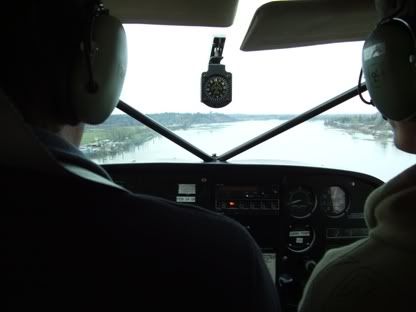
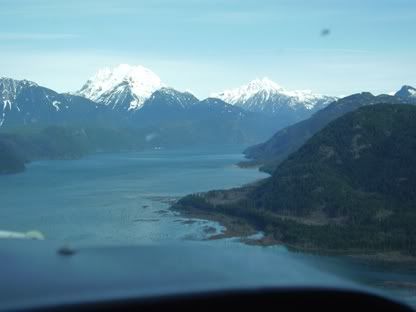
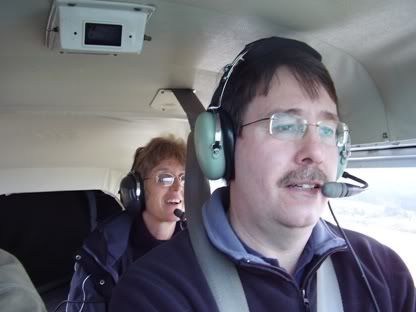
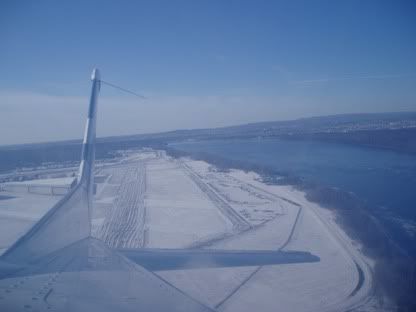
Haverfordwest in the murk at about 4000'

A very friendly reception from the guy in the tower, only he wasn’t in the tower, he was sensibly sat outside on one of the picnic tables enjoying the weather! The place was actually very busy, partly with pilots but also with locals enjoying the basic but tasty food and weather.

Apparently, the Yaks are a flight of three, two based at Swansea and one at Haverfordwest. They get together at weekends to practice formation aerobatics. Sure enough as we were eating, they started up and carried out a formation take-off with all three of them on runway 09.

It really is a very nice, friendly and well maintained airfield.

We saddled up and took off and headed for a low level trip to St David’s along the coast. Past the ‘disused’ RAF Brawdy – for a disused airfield, the runways are certainly in superb condition! We saw the cathedral and rounded Ramsey Island, then climbed to 5000’ for the return journey. The visibility was a little better, but still no horizon.

St Davids Cathedral

Uneventful trip back. Cardiff handed me off 10 miles east of BCN as I got the Gloucester ATIS. I started a leisurely cruise descent at 35 miles and called them at 25. Given a standard overhead join for 04 left hand circuits. They didn’t seem too busy, but I was advise to turn SE a bit to avoid the instrument approach for 09.

Standard overhead join was fine and I spotted a PA28 in the circuit. He was in front so I slotted in behind him and had to run a wider than normal circuit not to cut inside him and catch him up. Got the gear down early to slow me down and extended downwind. Kept him in sight as I turned final. He was about 0.5 mile in front and making a touch and go, so I figured (and was advised) that I would get a late clearance. So set up for 80 kts and got a good approach picture. The wind was straight down the runway. Rounded out but overdid it a bit, so small balloon, corrected and held off until the stall warner for a gentle touch. Either my landing are improving or the undercarriage of the Bonanza is flattering – hmmmm…. probably the latter! Shut her down, put her away and updated the logs.

A good flight in poor visibility. Gave me a chance to settle in during the cruise and play with various bits of avionics, autopilot etc. The plane really does cover distance well and I look forward to touring. I owe the wife a couple of French weekends and have trips to Annecy with Flyer Forum and a mini-tour to Switzerland and France planned with my buddy from Canada in August. Looking forward to it.

Sunday, April 08, 2007

Solo in the Bonanza

The weekend of 31st March, after I got back from Canada, I took the Bonanza up for my first solo circuits. The weather looked good, if 'high pressure claggy' and a bit breezy. When I got to the airfield, the windsock was hanging on for dear life, with the tower giving 25G33, albeit pretty much straight down runway 04.

In one of my poorer decisions, I decided on a few circuits and booked out. Probably not my finest decision as once I was up, the visibility was pretty poor and the wind was pretty bouncy.

First circuit was great, I thought I had shot past the runway, so cranked the plane around and lined up and called final, only to be told by ATC that I was final on 09 and should go around - DRAT! - I haven't done that since I was a stude! How embarassing!

Well, the next three touch and gos were OK, probably good given the conritions, but a bit of a challenge controlling the aircraft on approach in the gusty wind conditions.

On the third circuit, I decided I wasn't learning anything so opted to cut it short and land. What I really need is a fine day so I can cement my landing techniques, not a gusty day where I am not certain what is me and what is the wind. So I booked the plane for a half days general handling and circuits for the easter weekend.

The day was Sunday the 8th. I decided to go to the airfield early for a very leisurely walk-around and a sit in the plane just cementing in the controls so everything fell to hand. Well, it sort of worked out that way, but it took me and one other volunteer about 40 minutes playing the hangar shuffle to get my plane (at the back again of course) out and the others back. It is a tight hangar and I am very keen not to inflict 'hangar rash' on any aircraft. I am keen on treating other peoples aircraft as I would handle my own.

I bought Pilot Magazine and saw that there were free landing vouchers for both Enstone and Kemble. So why not fly to Enstone for a free landing them back for another at Gloucester. I booked out for general handling around Malvern then en-route to Enstone.

I was a lot happier with the start up and taxy and taxied to the pumps. But the fuel keys were missing, so out with the fire crew to fuel the plane. Power checks were fine and I lined up after a landing aircraft on 22 cleared for take-off. Take-off was good, I am getting used to the heavier nose left action and the quicker acceleration. In no time I was rotating at 65 and climbing at a sprightly 1300 fpm!

Routed to Malvern and at 3700' played leaned her out and played with the straight and level picture, different power settings and turns of varying degrees of steepness. I called Gloucester for a QSY to Enstone and set course. I tuned to Enstone and heard him tell another inbound aircraft that there was a Luscombe fly-in at Enstone today. I didn't think they would welcome a Bonanza skittling around their circuit full of sedate taildraggers, so where else could I go? I know, freebie to Kemble! So set course.

Called them up and while a bit busy, they weren't manic. The lateral visibility was pretty poor and although I knew where to look, no joy at 8 miles. Then counted the miles off - 7, 6, 5, 4 - where the hell is it? At about 3.5nm, I spotted the 747's and hangars - geeze, this vis is pretty cr*ppy!

I decided on a standard overhead join for 26 with left hand circuits. Slotted in nicely and got the speed under control and dropped the wheels downwind. Avoided the noise sensitive areas and cranked flaps and MP to low turning base. Lined up on 26 and it was looking good at the prescribed 80kts. Held that nicely, finals check, Red / Green / Blue (looks at uniformly ivory coloured controls and chuckles to himself!). Remember what Chris showed you, power to idle at the start of the roundout and hold off, off, off and get the stall warner blaring - it won't drop out of the sky like the slab-wing Arrow 200. Just start the round-out, power off. Fly her down, now hold off - try hard not to land. Back, back, back - stall warner chirps, back, back stall warner blaring and we touch - wow, nice one - pleased with that!

Not a greaser, not a true greaser, but good and the way it should be. Greasers are as rare as hens teeth. I had a chat recently with another pilot who said 'I THINK I have had some greasers' and I hope I didn't offend him when I said 'If you only THINK you have, then you haven't'. I have only ever had two, both flukes of course. They were so smooth I was confused why we were flying so slow in the hold-off until I realised that we had touched down without feeling it! Fortunately, one was with an instructor, so it was independently verified!

Anyway, Kemble was lovely in the sunshine. The AV8 was doing a brisk trade and I am plased to report and excellent experience there. Service was fast and they do both quick 'pilot' food and freshly prepared 'full service' food.

Kemble and a busy AV8 restaurant

They were happy with the free landing voucher and told me that the airfield was currently served with an enforecement notice to close in November - all because of on NIMBY who himself if an ex-airline pilot! I was happy to sign the petition and advised them to start an electronic on on the 'Number 10' PM website.

While sitting out on the sun deck in the lovely weather, we were treated to a Yak ‘beating the place up’ with low runs over the runway with zoom climbs and aerobatics at the top. I tried to get a photograph, but the auto-focus wouldn’t play until it was too late. One miserable git was mumbling ‘You should send that photo to the CAA what he is doing is dangerous and illegal……should be prosecuted…..mumble’. I commented that it wasn’t illegal and he was having fun and asked what his problem was. As he was drinking beer, it would safe to assume he wasn’t a visiting pilot – maybe Mr NIMBY himself???

Reluctantly decided to saddle up and go. Started up, did power checks then quickly given take off clearance. Take off was fine with the usual spirited rate of climb. I set track for the Malverns and decided to climb to above the inversion layer. I was above it by about 4500’, but continued to 5500’ to admire the light cumulus. A bit more general handling with cruise climbs, reset and trim for straight and level then level turns.

Nice inversion layer

Eventually called for a rejoin at Gloucester who were surprisingly quiet as they offered a direct to right base for 27.

Gotta go down sometime!

I took them up on this and reported at three miles. Manifold pressure back to approach settings, gear down starting base which helped reduce the speed and pulled flaps on. Prop fully fine, then ‘Red / Green / Blue’ check. Turned final over the doughnut and a bit high, but nothing to worry about. Power back, airspeed pegged to 80 kts, now full flap. Approach looking good, power back some more, over the fence, over the displaced threshold, power to idle. Round out and start the flare. Flare going well, bit of a chirp from the stall warner and we touch, a bit early as I misjudged the height by a foot or two, so not fully stalled, but getting there and with a decent attitude and smooth touch down. A bit of light braking and I make the first intersection for turn-off, so must have been a reasonable landing.

I think I am getting the hang of the Bonanza now. What I need now is a decent landaway, maybe a trip to one of the French channel towns with the wife.

Friday, March 30, 2007

Floatplanes in Vancouver

As is usual when I go on holiday, I try to wangle some sort of flying. The wife is OK about this as long as it is ‘just the once’ and the holiday is not dominated by it. Of course with a driving holiday in the Canadian Rockies, there was only one sort of flying that would do – FLOAT PLANES!!!!

We would be landing at Calgary and driving through to and leaving from Vancouver with a number of stops on the way and a flexible itinerary. I had no idea where to go for float training, so I put a posting on the ever reliable Flyer Forum fishing for personal recommendations. It wasn’t long before an experienced instructor who used to do training on floats in Vancouver came back and recommended two places. One in Kelowna (a bit south of my planned track) and one in Fort Langley near Vancouver.

So I made email contact with Fort Langley Air Limited and received a friendly and prompt reply. I made a booking for Monday 26th March and was asked to contact them when I made it to Vancouver to firm up on this. We got to the area early on Sunday, so I thought why not drop in and introduce myself. We found the place easily (courtesy of Goggle Maps) and it had a lot of aircraft, both floats and conventional. It was very quiet, but I spotted a car at the far end so wandered down to search for life. The aircraft line up was great, there were all sorts! Meaty Beavers with huge radial engines on floats, one with tundra tyres that were so huge they looked like a cartoon!

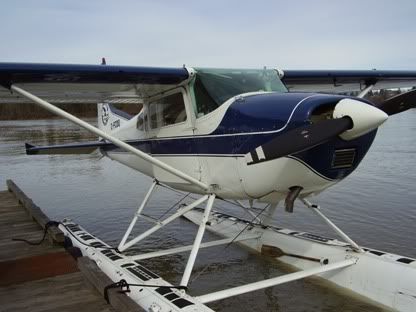
I was greeted by the owner, ‘Pappy’ who lived up to his name. He was friendly and clearly vastly experienced. I introduced myself and we got acquainted. He gave me a quick tour and pointed out both the 4000’ grass strip as well as the piers for float planes. The place is right on the Langley River very near the historic Fort Langley, the first permanent settlement in British Columbia. The school itself is small and there are only two planes for float training. One is a Super Cub and the other is a Cessna 180. I opted for the Cessna 180 so I could get the wife in the back, that and I had not flown a C180 before, so double bonus.

The Cessna 180 Floatplane

He gave me a quick chat about the differences of float plane handling and I gave him a run down on my experience to date. He confirmed that I would be flying with one of his instructors and the weather looked good for tomorrow. So we made a time for 10:00.

I got there on time to be greeted by an extremely tall guy who was to be my instructor. He had to be 6’ 6” – I am 6’ 2” and he made me feel small! We got on well and brought him up to speed on my flying experience to date and said I wanted primarily a float plane training lesson, with sightseeing as a vague secondary objective. He was happy with this as he said ‘Great – so you’re doing all the work!’.

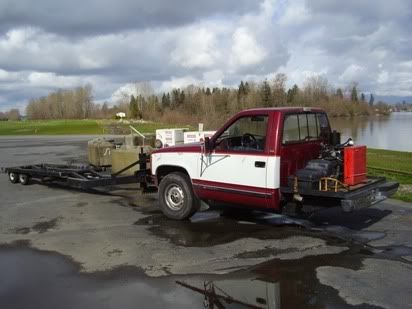
He again explained the techniques involved and that we would be doing mainly take-offs and landings, and lots of them! We did the walk around and climbed in while the plane was still on land. Pappy then appeared in a old 4x4 which had been cut in half (yes really!) and had a dolly wheel assembly welded on the front. This hooked up to the plane as he pushed the plane around and down the ramp into the water.

Whats missing in this picture?

John helped me with the start procedures as I did not have a checklist for the plane. The controls were standard Cessna (vernier) but the flaps were the mechanical ‘Piper’ type (which I prefer anyway). We had to get the plane started and the rudders down fairly sharpish as we were now drifting downstream in the current – no time to hang around on floats!

Once the engine is running, you simply use the rudders as normal to steer, except of course they are turning water rudders not the nosewheel. We played with this for a bit while John talked me through the take-off sequence. We pointed out towards the middle of the river and did the power checks quickly on the move (there is of course no other way of doing them on floats – you can hardly use the park brake!). Power checks complete and we started the take off run. John had me do the first one while he followed through on the controls, which surprised me a bit as I thought it would be the other way around. However, he talked me through calmly, clearly and very professionally all the way.

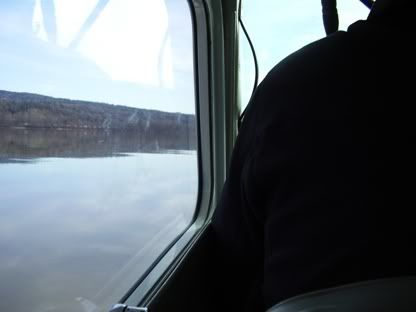
First it’s 20 degrees of flaps then full power with right rudder to hold straight. The yoke is held back as the aircraft picks up speed and accelerates with a nose high attitude. Glance out of the side window to watch for where the wake is on the floats. Once the wake ‘comes back’ and reaches the ‘step’ in the float, relax back pressure on the yoke (i.e. don’t actually check forward, almost let it go to neutral) and allow the aircraft to nose down a bit into the ‘step attitude’. Then hold back pressure to keep the prop out of the spray and watch the airspeed as the speed builds up slowly. The water was pretty smooth, almost ‘glassy’ for the first run, so there was little bouncing or thumping. At about 60 mph (yes it was calibrated on the outside of the ASI in the dreaded MPH), the plane gently unstuck and started flying in ground effect – we were off!

Wake from the floats 'on the step'

As instructed, I held it level off the water while the speed built up and pulled the power back to 24” and wound the RPM on the VOP prop back to 2400. Water rudders up and once established in the climb at 90 mph, flaps off one stage at a time.

Well, that was the take-off. Different and vital to get it right as any nose level or down or mis-judgement while transitioning to the ‘step’ could result in the front of floats catching a wave and digging in and whole plane then tumbling ass-over-teakettle in the water! So no pressure then!

We climbed to a lofty 800’ following the course of the river so we would clear the power lines. John showed me how to turn the plane and graphically demonstrated that the plane would not turn with ailerons alone, all it did was continue to fly the same track but tilted over! With the ponderous and heavy pontoons and draggy rigging, the plane needs co-ordinated use of rudder and aileron. So I used my experience of flying the poorly harmonised Super Cub and found that worked a treat. John got me to do a few tight turns in the confines of the river valley, which was a lot of fun with an obvious incentive to get it right.

Then of course the landing. As we were flying upstream, John simply picked a patch of river and said ‘OK, we’ll land ahead towards the south bank of the river’.

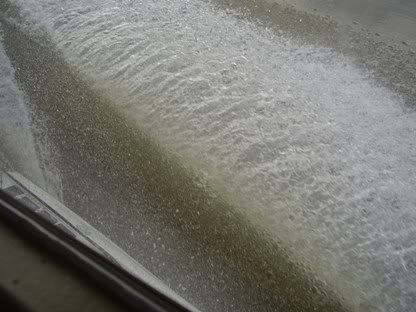
The key to this as he explained was to always try to land near to the shore, not for safety as I naively thought, but to provide a peripheral visual reference, otherwise, it was very hard to judge height, especially with the dreaded ‘glassy water’. It is one of those things that until you have done it, you think ‘yeah yeah, sure!’ and assume they are exaggerating – a bit like how tough it is to fly in solid IMC and that your body cannot tell banked from straight and level – until you have done it you can’t understand how it can be that tough.

Glassy water or what?

So we go into the landing sequence. Power back to almost idle. Prop to fully fine. Line up and click on two stages of flaps. Get and maintain 80 mph. Keep the descent going. Judge the height, start the round out and assume the ‘step’ position. The step position is the attitude of the plane when it was flying ‘on the step’ during the take-off run. For this aircraft that means a bit nose high, but nowhere near as nose high as a fully stalled landing or a taildragger landing – you just have to ‘lock’ the picture in your head. By now you are not far off the water and must carefully regulate the rate of descent using power so it eases down slowly (there are no shock absorbers on floats and water is hard!). Hold the position and play with the power and yes, it touches on the step. Power to idle and hold the back pressure. Under no circumstances ease off the back pressure. As the plane slows it comes off the step and you must have the yoke fully back as it does so or the plane can lurch forward and dig in. Hold back pressure until stopped. Once it has stopped, drop the water rudders and steer as normal – well as you would normally for a boat fighting a current that is. John made it clear that unlike a runway landing, you could not relax for a moment until the plane was shut down and securely tied up.

Final to land - I am number 1!

Well the first landing went fine, albeit with help and talk through from John. We then did several more take-off and landings with touch and go’s on the river. He asked if I fancied a lake landing – of course! So we climbed to a dizzying 1500’ and headed a short distance inland to hydro lake. The lower end was bristling with the remains of tree stumps – not a good place to land. As we headed for the middle of the lake, the valley was forcing a wind which was creating some whitecap waves. John thought it better not to land there, so we headed back to the Langley River.

The hydro lake - complete with exposed tree stumps!

We did a low approach to a more narrow part of the channel between an island and the south bank which had me setting it up for landing on base at 400’ and during the short final turn – fun!

Well basically we did about 10 take-off and landings with some tight turns other bits of handling. I think it was on only one of the landing that I ‘bounced’ it and that wasn’t too high and was fairly easily controlled. The others it seemed to me were pretty good and John agreed (after he peeked through the fingers he had firmly clamped over his eyes for most of the time that is!).

....and the wife was enjoying it too!

We taxied in and tied up at the moorings. John had to give me instructions as he leapt out to secure the line. There was no bump so I guess we got that right too.

I got a good de-brief and John seemed very happy with lesson – I know I was! Apparently, a conversion course is normally a minimum of 7 hours, six dual and one solo. I was up for 1.3 hours and I was certainly tired at the end of it. A lot of concentration and work, but wow – what fun! I was relieved of $CAN 360 odd but hell, it was great.

Would I do it again – yes! Would I try for a float plane rating – Yes! This was a really great session and I enjoyed it hugely. I strongly recommend that any pilot tries this at least once (along with aerobatics and taildragging and yes, possibly gliding, but I haven’t done that yet). If all you do is fly nosewheel tourers, you really don’t know what you are missing!

Who knows, one day?

Saturday, March 10, 2007

Bimble to Norwich

With this the last weekend before a two week holiday, I did want to do some circuits, but decided to do these when I get back, so a call to Chris as we agreed to split the flying. I thought I would go for a decent run, an hour or so airtime. I hedged my weather bets and selected airfields I haven't yet been to West, South and East.

The weather looked best in the east and as Chris hadn't been there either, we opted for Norwich.

I was a bit early, so with the help of the lad working at Cotswolds, pulled three aircraft about until we could get at G-ATSR at the back of the hangar (of course!). I gave her a leisurely check over in my own time and had just finished adding a litre of oil when Chris appeared.

I opted to fly there and Chris to fly back. So in we hopped and trundled over to the pumps for fuel. After a bit of fun and games, we finally got one of the pumps to work and filled up the main tanks. We trundled off to the hold for 22 for the power checks. I got it right this time and my new checklist seems to say the right things. Called ready and got a 'depart immediate'.

I am now ready for the considerable right rudder required to hold the eager Bonanza on the centreline and was even ready for the rotate in an agreeably short length of runway, no doubt also flattered by the 1034 Mb pressure.

It really climbs well compared to anything I have flown before as I set course direct to DTY VOR. I climbed to 4000' and levelled off and configured for the cruise. By the time I had sorted this out, my mental picture for the Arrow meant that the Bonanza had climbed a further 500'! B*gg*r! Well 4500' it is then! I am starting to get used to the much lower nose picture of the Bonanza, but like all things, it will come with time. Meanwhile, keep a careful eye on the altimeter.

It trims out nicely at 23" MP for 2400 rpm and 13.2 USG fuel flow. This give a pleasing 150 kts IAS. This really is a 'go places' tourer (yes, yes a Cirrus would be nice but I haven't got £250,000 to spare!).

We were nicely on top of the thin cumulus with lots of ground visible below. After DTY, it started to thicken as the undercast came up to mee us at 4500'. Rather than shoot the ILS at Norwich (which would have been good practice) in an aircraft I am still becoming familiar with, I chickened out and found a 'hole' near Peterborough and descended through that to VMC below the clouds at about 2000'. Norwich were giving CAVOK over the radio (seemend unlikely with solid overcast at 2500' with 25 miles to run). We were given a direct to left downwind approach for 27.

Spotted the field at 10 miles and changed to TWR. They asked how long we would be staying 'Just long enough for the mandatory £100 hamburger' was my non-standard reply. That seemed to amused him and they gave us stand 7. Now I don't know about other pilots, but I have a serious attack of 'the stupids' once I have landed (that and I always forget to brush up on the airfield chart for taxyways etc.) and can screw up by taxying the wrong way, or missing the turnoff etc. So I bravely handed the chart to Chris and said 'you're telling me where to go on the ground'.

The approach was good, a bit of chop coming from somewhere. Nailed 80 kts. Chopped the power later than Chris would have done and flared. I held off, but still had a fair bit of speed, so floated and held off and landed reasonably. However, not on the stall warner and not with the nose nice and high (but still not a 'three-pointer'). I am still landing this like the slab-wing Arrow, where the speed bled off very quickly and the wing stopped flying fairly abruptly, probably a bad habit I have gotten into. Chris offer to show me how on the landing back at Gloucester later.

G-ATSR with the distinctive V-tail at Norwich

We parked up and were bussed to the check-in point with both of us thinking 'this is going to be expensive'. And so it was - £34-odd - ouch! We wandered to the terminal. This is an aspiring regional airport - small but a decent range of shops and quite a few people about and checking in. We treated ourselves to a Latte each and people watched.

Norwich Airport shortly after take-off

Chris was keen to take his lady to Alderney that afternoon, so we didn't hang around and wandered back. But not before we had to go through the formal departures, complete with metal scanning and taking shoes off. I suppose I can understand it, it isn't a question of 'hijacking yourself' but more of letting people (pilots or otherwise) airside - so I don't object at regional airports.

We booked out and Chris was going to be P1 on the return leg so we boarded accordingly. Did the long taxy and held behind a very nice looking Cirrus SR22. We were lined up and away quickly enough. Chris then started a climbing left turn, which puzzled me a bit, but I assumed he was doing a climbing circle over the airfield to gain height before starting en-route. He then fiddled with the VOR and realised I had changed the GPS map orientation to 'north up' rather than Chris's preferred 'track-up'. We had a chuckle about that (sorry Chris!).

We went VMC on top to 4500' and the cloud began to break under us by Northampton. It is far easier to spot traffic against the backdrop of white clouds than against landscape.

We got the Gloucester ATIS about 22 nm east and were granted a direct approach to 27. We called at 5 miles and were given landing clearance. Chris carried out the downwind checks and prepared for final, putting the gear down, but leaving the flaps until the last mile.

Airspeed nicely nailed on the approach at 80 kts. Over the displaced threshold and Chris chopped the power pretty much just before the start of the round-out. Nice round-out with the speed bleeding off, but not that quickly, so that in the flare therre was still a good hold-off and a nice nose up attitude with the plane still wanting to fly. The stall warner sounded and the wheels touched - nice one. OK, I get it. Power off a lot earlier than the Arrow, the speed doesn't fall off that quickly and the wing is quite happy to keep on flying. Lesson learned.

We parked up and got out. I spotted a nice Stearman across the apron so said my goodbyes and took a few photos. Apparently, the chap cleaning it was going to fly it to Italy at the end of the month to its new owner.

So another flight in the Bonanza and I am starting to settle in. The controls fell to hand a lot better today and I am starting to get used to the picture. What I need now is a serious solo circuit session to nail the technique. I plan to do this on my return from holiday at the end of March, probably at Oxford or Kemble, who charge a lot less for touch and go's than Gloucester. I really look forward to touring in the Bonanza, it is a lovely machine, a real head-turner, comfortable and fast. Chris has it booked in for its annual while I am away, then I have to do the first of the monthly group accounts, which will be fun.

However, not before I sneak a quick floatplane lesson in in Vancouver on holiday. Can't go on holiday and not try to sneak a crafty one in can I?

Saturday, March 03, 2007

Check ride in the Beech Bonanza

Well, my 'official' membership of the Beech Bonanza group started on 1st March, so of course I booked it for the next available weekend! Chris was free and we agreed to go to Tatenhill so I could have a check ride with his favourite instructor.

The weather was excellent, with the odd shower, but mainly cumulus with good visibility and lots of blue bits (sorry, getting a bit 'technical' there). Off we went. Chris flew up there while I watched carefully. I am not used to vernier controls and those in the Bonanza are placed a bit at random and not colour coded, so it will take some getting used to.

Chris asked for and got a zone transit of Birmingham (I was amazed, but then I confess I have never tried it as I assumed there was little point).

Zone transit of Birmingham on the way to Tatenhill

Tatenhill was very busy as Pilot magazine had offered free landing vouchers which most of the UK flying community seemed keen to use on the same day!

We met up with Dave, a vastly experienced instructor very familiar with the V-tail Bonanza. We swapped over and I took over the left-hand seat. The Bonanza has a 'throw-over' yoke, so I guess not ideal for instruction, but there you go.

Off we went as I puzzled my way around the controls like a learner driver looking at the gearshift every time they change gears. I was ready for the acceleration and pull to the left and made a reasonable take-off. We were three up with full fuel and it was still climbing at 1000 fpm.

We climbed to over 3000' as I tried to get used to the nose high / coaming low picture. Whenever I relaxed, my 'Arrow' picture took over and we started to climb. But then I did the same going from the TB10 to the Arrow, so it is just practice.

We did a clean stall. I was warned about wing drop as the right wing dropped. I held it with rudder and recovered, although a bit hesitant. So we did it again and I was smoother this time.

Then the stall in landing configuration. I was warned this would be 'interesting' - don't you hate it when instructors say that? As we slowed to a crazy slow speed, with Dave constantly telling me 'UP, UP, UP etc. - nose up), it finally stalled - BIG TIME! Wow - the b*gger heeled over to the right in a heartbeat and started a spiral dive. I tried to correct with rudder, which seemed to stop it getting worse and recovered. I don't recall how much height we lost, but it would have been a lot. Dave was laconic about it and merely commented that 'there were no screms from the back so it can't have been that bad' - personally I think its because Chris was too busy praying! Lesson learned - don't ever do that on approach!

We went back to the airfield to do a couple of circuits. First one was a high workload for me. Looking for controls, strange picture outside, running to catch up to the plane. Amused all present as I called 'downhill' instead of 'downwind'. I don't know where I got that from, I have never said that before! Got settled into an OK 80 kts approach. Chop the power over the threshold just before the flare. Over-controlled it and balooned a bit, the brought it in. Power on then off again.

Next one was better, didn't over control it, but I did 'hunt' for it in the flare a bit.

Last one was to land and this was OK, except that while I was back-tracking, I pulled a little too much throttle off and the engine died. Dave got it going again sharpish as we didn't want to hang around in the middle of the only runway at Tatenhill.

As the aircraft is that much quicker, climbs faster etc. and I was having to look at pretty much everything I was touching to make sure I was pulling back on the right thing, I found the workload pretty high. Familiarity is the key here.

Tatenhill was pretty manic with planes jostling for limited parking as the grass wasn't in use. After some quick refreshment at local tavern (orange juice for me), we mounted up and took off back for Gloucester. I was flying with Chris in the RHS. Again we asked for and received transit of Birmingham at 3000'. I couldn't resist a peek at Liz Hurley's bash at Winchcombe, but as we did an orbit, it looked pretty deserted, only the marquees to show for the wedding.

Back to Gloucester and a standard overhead join for 27. The ciruit went well as did the approach. Went to chop the power in the roundout but instead of pulling out the throttle, I pushed it in. I realised the mistake (as of course did Chris and pulled it out rather quickly, but apparently not all the way back, so I held it off while Chris pulled it back to idle. Of course I landed longer than normal and had to roll to the end to vacate. The landing on the Beech seems to be very smooth, I don't know whether it is me (probably not) or the excellent gear (probably!).

Good lesson learned as I felt somewhat sheepish trundling back to stand.

Overall, a very worthwhile day and a lovely aircraft. Certainly a major step up from the Arrow (although I am certainly still very fond of Arrows). So I will go away and 'internalise' the position and feel of the controls so I am not looking all over the place on the next flight.

Maybe another dual with Chris next weekend, then a few landaways by myself to get really comfortable.

Saturday, February 03, 2007

Buying a new share

At the beginning of January, I sold my 1/6 share in the Arrow group. Reluctantly I might add, as the group wanted to admit three new members and with only two shares for sale, was about to vote to expand to seven members. Well, 1/6 is my minimum share, I would have preferred 1/5 or even ¼, so this was going in the wrong direction for me, so I put my share on the table subject to a good offer.

Unfortunately, I got a good offer, so accordingly, sold my share. This left me going back to club rental. My first full rental was towards the end of January, when I rented the club Arrow 2. I flew to Kemble to check on possible shares over there (didn’t see any), then bimbled around to the north of Gloucester at 8000’ VMC on top just for the hell of it. Bottom line is about 1.5 hours airtime for a charge of £GBP265 – OUCH!

I am certainly not panicking and I am very keen to ‘get it right’ and not simply opt for the first vaguely suitable share that presents itself. I had set myself a target of ‘end of April’ to either find something or consider doing it the hard way – forming a group of like minded individuals then buying a plane.

What I was looking for was:


- Good touring aircraft capable of taking two large guys, sensible baggage and sensible fuel (could be two or four seat).
- Not too fussed if CAA or PFA type.
- Some short-ish field capability
- ¼ to 1/6 maximum share
- Share cost up to £15,000 max, monthlies of £150 max and hourlies £70-ish or less
- Established, experienced and stable group
- Good paint, airframe and engine
- Fuel burn say 30-40 lph
- Good availability for one or two ‘big trips’ a year, three weekends and some weekend all day UK bimbles


Yes, of course it is an impossible list (or is it?) and I knew I would either have to compromise somewhere, or try to form a group of like minded people (i.e. do it the hard way).

Well after an intensive look at what is on the local market, I came up with a wide variety of possibilities:

- 1/6 share of an RV6 based Gloucester (established group)
- ¼ to 1/6 share in a Cessna 172 based Gloucester (owner starting a group)
- ¼ share in a Jodel C140D based on a farm strip (established group)
- ¼ share in Robin DR400 based on a grass strip (established group)
- ¼ share in Beech Bonanza based Gloucester (owner starting a group)
- Grumman Cheetah based Kemble
- Other misc shares greater than 1/6th based Gloucester and elsewhere

Quite a lot you might think, but of course the devil is in the detail.

I looked carefully at the RV6. Wonderful aircraft, cheap to run and would be excellent fun to fly, but I simply could not make it work for the two person touring weight I needed and go further than 20 minutes in the air. So a reluctant no.

The Robin was based at a grass strip which was out of use when I visited due to waterlogging (bad sign) and was an eye-watering £30,000 for the share, so err…no.

The Jodel was a ‘late entry’ and potentially very interesting. Excellent range and load lifting capacity. Interesting type, very cheap to run on a farm strip. Slow compared to what I was used to but do-able. Downside was that the engine was on-condition with no appreciable engine fund, the value they indicated for the aircraft seemed very high to me and although I didn’t see it, I knew it had been recently recovered, but may have ancient avionics. So an over-priced aircraft where the engine could go at any time in need of an avionics upgrade…. I would guess that I could discuss price as it seems unrealistically high at the moment, but there are rather a lot of other risk factors, so probably no.

Anything based at Kemble for me would have to be ideal in every other respect to justify the 40-45 minute journey time I would incur, so no.

Buying a smaller share in a PA28 Archer or similar based at Gloucester – no, I want more of a plane not less.

Try to form a group (N-reg?) of like minded individuals? Yes, if I had to, but would take quite a while.

I spoke to the chap who owned the Beech Bonanza and went for a flight. We got on very well and the plane is in great condition for a 1959 vintage. It is relatively low hours TTAF and TTE 200 hours, so new engine. The mechanics that service it confirmed it condition. Excellent paint, leather interior and modern avionics. Lovely plane and fun to fly, a real performer. The issue was that it was right at the top end of my financial pain threshold and threshold at which the wife would go nuts! Love the plane, but would have a serious impact on the wallet.

The Cessna 172 has an excellent paint job (recent respray) and looks good. The engine is low hours. The interior was OK although the avionics were VFR (bit of a pity as I want to keep my IMC rating up). Flew nicely enough, but of course basic Cessna performance. So a tourer and a reasonably priced on at that, but would need some money spending on the avionics. My wallet loves the plane, but it isn’t fair to compare the visceral reaction to flying the Bonanza to flying the C172.

So after some late discussions regarding group rules and how we get from A to B, I decided to go for the Beech Bonanza. I am in the process of working with the current owner (who would then become the 75% shareholder with two further shares to sell) to get the group set up and all the relevant changes made and paper signed. We have agreed all of the major ‘stumbling block’ issues and now merely need to work through the detail where neither of us is particularly precious about one way or the other. So barring disaster, I would expect to be ‘in the group’ by the start of March.

G-ATSR in the air


The owner and I see eye to eye on most things and want to keep the shares at a maximum of four experienced pilots to give maximum sense and feel of ownership (rather than a large number of shares, where you feel more like putting a deposit down in order to secure reduced hourly charges on a ‘club’ type aircraft).

This is a serious touring aircraft and not really suitable for recent PPL’s. So we are after experienced pilots who want to do some serious touring in a lovely aircraft you can be proud of.

After all, there can’t be much wrong with an aircraft that they used to call ‘the fork-tailed doctor killer’ and in which Buddy Holly crashed and died can there?

Sunday, January 21, 2007

Group Trek - The search for Spock

Well I am on the trail for a group share in a suitable touring Aircraft and this is my story so far.

I was really interested in the RV6 at Gloucester. Following a recent round-the-world flight in the aircraft, Manual Querioz was offering 1/6 shares. A two seat, permit taildragger and a ‘hot ship’ to boot (150 kts). Could be just the job. So I met up with Manuel and had a look around the aircraft. It would certainly be ‘snug’ but do-able. The range would be excellent, the running costs very little. But the big question was, could it take the weight of me (200 lbs) and my buddy (250 lbs)? A quick dabble with the spreadsheet said yes, but only if I took 20 minutes of fuel. The strange thing was that the aircraft was cleared to a higher MAUW with a single pilot than with dual occupancy. If I could have used the higher single MAUW, it would have worked. With great regret, I had to let my head rule my heart and turn this one down.

I trekked over to Bidford to see if any shares were available. Only 10 minutes further away for me than Gloucester and likely to be cheaper for hangarage etc. When I got there the place was deserted and the airfield closed due to water-logging – matbe not such a great base! In the clubhouse was a single notice for a very nice Robin DR400. ¼, built in 2002 and all the toys. Downside was a whopping £30,000 share cost. Perfect plane, airfield probably OK, but eeekkk! The cost!!!

I am resisting looking at Kemble as it is 40 minutes away and that starts to become a bind.

There is a Piper Seneca going at Gloucester. 1/6th for £10,000. Thought briefly about this, but no – two lots of fuel – think of the hourlies! All that for a mere 150 kts to boot. No, too much like hard work – a single it is for me.

There are of course other shares going at Gloucester. One for a PA28 (not sure whether it’s a Warrior or Archer). But it is for 1/10 and that isn’t group ownership for me, it’s a ‘buy in deposit’ on a ‘club aircraft’.

So the favourites are two quite different aircraft where groups are forming where the aircraft is currently 100% owned by the current pilot trying to form the group.

One is a 1964 Cessna 172 with a recent excellent paint job and a low hours engine. It has a VFR instrument fit though. Looking at ¼ to 1/6 for the group and fairly and reasonably priced. A bit of a come down from the Arrow and not my ideal tourer. I think I would also miss the IFR / IMC option that my IMC rating allows.

The other is a 1959 (yes!) Beech Bonanza (V-tail). It has a good paint job, looks very well maintained, has a low hour engine and an excellent avionics fit. Great performance and in many ways an ideal tourer (apart from a four seat permit type that is). Selling ¼. The snag is the initial cost over the top end of my budget and the monthlies won’t be great. That said, the monthlies aren’t a huge amount more than I was paying with the old group. The hourlies are more, but then it is 150 kts as against 130 kts for the Arrow, so I’ll get there that bit quicker.

I’m going to have to have a serious think about this one. It’s a three-way fight – head vs heart vs wallet.

Anyone giving odd as to who will win?

Tuesday, January 09, 2007

Group Ownership

Many people think that group ownership of an aircraft is a panacea. They look at straight rental rates (say £GBP165 per hour for an Arrow) and compare it to rates for group ownership of £GBP70 – 75 per hour and decide ‘that’s a no-brainer’. Of course that is not the whole story by any means, and I don’t suppose anyone considering buying into a group thinks that is all there is to it either.

On top of the hourly charge, there is typically the fixed monthly charge per member (say £GBP130 for a six man group) and of course the up front buy-in costs (usually a proportion of the value of the aircraft plus money in the bank for the group for accruals for engine funds etc.). OK – most people reckon that between 25 and 35 hours per year is the ‘break-even’ point between renting and group ownership. That said, some may still buy into a group below these hours purely to escape the tyranny of rental timeslots and minimum hours per day.

On top of that of course are the unexpected bills that cannot easily be budgeted for, although you will only pay 1/n th of course, such as vacuum pump failures, replacement cylinders (ouch!) etc. Don't underestimate these or assume that they happen to someone else's plane but not yours!

But over and above all of this is the nature of the group itself. How is it structured? What is the method and proof of ownership? Do you all gel as a group? Are you all happy with the charging structure? What happens when some of the members interest in flying wanes and the monthlies become the significant charge?

The reason I mention this is because regardless of the hard money facts, the ‘soft stuff’ is as, if not more important.

I have recently experienced an example of the above, where I felt compelled to sell my share as the majority of the group were about to vote for an expansion of the group numbers – where I was outvoted. Let’s be very clear, I am not bitter, just disappointed. I really liked the Arrow and the group was going OK. Two of the member had shares for sale (which is a bit worrying and ‘de-stabilising’ in itself). Both for perfectly valid personal reasons - you know, just one of those coincidences.

The group was approached by three individuals who were looking to buy a share of their own at the same airfield, also in an Arrow or similar. Not unreasonably, they approached our group and asked if there may be a third share for sale now or in the near future and if so, they would be interested to buy in ‘en-bloc’. The caveat was that all three wanted to buy in at the same time or not at all. If there wasn’t a third share, then fair enough, they would continue to look their own aircraft.

Well, no one else wanted to sell, so we had a group meeting with a motion to expand the group from six to seven. Personally, I find 1/6th to be an ‘absolute maximum’ for me. I would happily vote for a reduction as I have some ambitious touring plans and am happy to ‘pay’ for good availability – after all, the plane is for fun, it is not a business asset which must be ‘sweated’. However, I was in a minority of one, so rather than agree to a reduced share, I offered my own share for sale as it was clear to me that the group were going in one direction and I was going in the other.

All very amicable, but as I say, disappointing. Now there may or may not be a huge difference between 6 and 7 members. I was simply going on my own instincts and ‘gut feel’ – which I have learned to trust over the years. Availability for our group of six has been excellent, but I feel this is only because the two members selling their shares flew it very little in one case and not at all in the other. It was going to be a bit of a ‘feeding frenzy’ with six active members, let alone a seventh – hence my rationale and my decision.

Anyway, I got a reasonable price (not what I paid, but not too far short) and the new members got a good deal.

I write this as an experience that other may read and understand that there is more to a group than simple financials.

Now on the look out for a group at or near Gloucester (maybe also Kemble, Croft Farm, Bidford?) with a decent touring aircraft and a group size of between 1/4 to 1/6 maximum.

If anyone knows of a group of 4 with a four seat touring aircraft that does 150 kts on Jet A1 at 25 litres per hour with a per hour charge of £GBP50 and monthlies of £GBP100 and endurance of 5 hours then I am your man – no aircraft around like that? What a surprise!! Guess I’ll have to compromise somewhere!!

Sunday, January 07, 2007

Flying in Ottawa

I had a trip booked back to my homeland to see my friend in Ottawa over the Christmas and new year period. So of course I checked up on some of the local flying clubs to try to book a quick flight while I was there.

The weather in Ottawa was superb. It had only recently snowed, unusually the first of the year for this area (it is normally much colder – more evidence of global warming?).

I selected Rockcliffe flying club, based at Rockliffe which is about as close to central Ottawa as you can get. We went to the aviation museum which is on the other side of the airfield (which is excellent by the way) and I called in at the club to book a flight. We booked it for the next day, 29th December.

The day dawned clear and crisp, a balmy -5 C (it is usually much colder) with a moderately high pressure and a good covering of snow, so off we went.

I had booked a Cessna 172 as this is a Cessna school. This was only the second time I have flown a Cessna, but of course they are simple enough – I just don’t much like the throttle and mixture controls – I prefer the throttle ‘quadrant’ and low wing of the Piper series, but there you go!

Warming an aircraft engine - Canadian style!

They had just refuelled to the brim and we only just squeezed into the weight and balance limits with me (not small), my friend (a lot more not smaller) and an instructor (mercifully light). I had to go with an instructor as although I have both a JAA and an FAA license, I don’t have a Canadian one (and even if I did, they would sensibly have wanted a check flight).

I asked the instructor to do the radio work, while I flew the plane. I am fine on the radio and would probably have gotten by, but it is always the slight differences that throw you, and being so close to Ottawa controlled airspace (and of course the capital of Canada) I didn’t fancy creating air alerts through misunderstandings!

The runway was cleared of most of the slow by snowblowers, but there was enough about to make it all look white. The instructor advised me to use the soft-field technique because of this. So off we went on Rockcliffe runway 09. I was surprised at how quickly the aircraft accelerated and became light at MAUW and had to ‘hold it down’ in ground effect to gain speed as it really wanted to shoot skywards.

Climbing out on 09 from Rockcliffe

Up we went, a bit too slow, so I checked forward to gain speed. I am always surprised at how quickly C172’s climb and today was the same. Probably due to the flattering met conditions of low temperature and high’ish pressure.

We wanted to see my friend’s house from the air then back for a tour of central Ottawa. So we set course and followed the Outaouais river initially, then cut inland towards Casselman. It took about 20 minutes to find his house over flat, snow covered countryside. We were given a squawk by Ottawa control before take-off and used this, flying at the cleared altitude of 2000’ all the way. A quick orbit of the house, then back to Ottawa.

My friend's house

The countryside looked great in the snow, and with good visibility, this was easy flying indeed.

Highway 417 to the south of Ottawa

Unfortunately, due to some poor time calculations on my part, the instructor advised us that we had to go back to Rockcliffe and skip the tour of downtown as the plane was due out for another lesson at 13:30. A shame but not a problem as I am sure I will be back another time – maybe for a Canadian license?

Downtown Ottawa - as close as we got

Rockcliffe is an uncontrolled airfield and we joined downwind for 09. This involved flying over the north of the river and over Gatineau, which is in Quebec. Another aircraft was joining at mid-downwind as a 45 degree angle (common in North America). We thought he was well ahead of us, but he wasn’t. So we did a full orbit to allow for spacing until we saw that he was well onto base before continuing.

Rockcliffe airfield - from downwind for 09

Did the downwind checks as normal and turned base.

I came onto final and was too high. I did think about a small sideslip, but didn’t think it was that bad, so pulled on the carb heat and dropped the power. I had the approach speed nicely pegged and was still a bit too high but it was starting to come off.

Final for 09 at Rockcliffe

I missed the numbers, but it is a long runway and the exit was at the end. I noticed to airspeed dropping off so put a squirt of power on, then started to flare. I found this harder than normal as the usual visual clues were missing – the whole bloody thing looked white! I did flare and we touched. Not a great landing, but then not one measured on the richter scale either – my first landing in snow!

We taxied back and shut down at precisely 13:30, and yes, the next student was waiting – they run this place like clockwork!

The bill for dual rate wet hire (i.e. me flying with an instructor) was $CAN161 – about £GBP70! Bargain! I highly recommend Rockcliffe Flying Club and the airfield. They were a very friendly and helpful bunch and have reasonable rates (bargain by UK standards).

A really fun flight which could give me a real taste for flying in Canada!

Saturday, December 09, 2006

IMC Revalidation

With my IMC rating to be renewed by the end of January, I decided to get some refreshers in and sort my revalidation before Christmas. This is my second revalidation since I gained the rating at the end of 2002.

I do fly in solid IMC and shoot real approaches and I do carry out practice IMC and practice approaches under the hood with a safety pilot – not as often or as many as I would like, but enough that I am current and confident when I feel I might have to use the rating for real. I know of course that it is not valid for flying outside of the UK, but if it all went pear-shaped over France, I could deal with it and sort out the formalities later.

On a number of occasions now, it has ‘saved’ trips. It is funny how the problem is usually always at the UK end and once you get out, while it is not always clear skies and smooth cruising, it is at least VFR – don’t get me started on why we can’t have a JAA IR for private pilots like the FAA IR!!!!!

Anyway, I booked the midday slot with Phil Mathews at Cotswold and rocked up early. Phil was available and had already booked a beacon slot for 13:00, so I went out to the plane the settle down and check it out. Garry was just taxying back from refuel having shown a few potential new shareholders around the plane.

I checked her out and she was good to go. Phil sauntered out and we buttoned up. I got the ATIS and made a taxy call and was told to standby. There was racing on at the nearby Cheltenham National Hunt racecourse and the airfield was buzzing with expensive private jets, twins and helicopters. Glos Tower were manic, but I also noticed the fire truck was out and the firemen all togged up. There was an emergency in progress. We did the power checks there while we held for the best part of 20 minutes. It was no drama in the end as the aircraft with an emergency had an alternator failure and was low on battery.

We eventually got to taxy, then had to wait for a gap in traffic to call ready to copy clearance! Eventually I got this and was cleared to take-off immediate on 27. I goosed her up and took off from a roll. Phil had me under the hood at 600’ on one of the most beautiful flying days I have seen for months – it was perfect, unlimited visibility, mainly clear skies and only a light wind – and here I was under a hood!

As discussed, I climbed straight ahead to 1100’ and did a rate 1 climbing turn to port to a heading of 030. At about 5 miles north of the airfield and still climbing to FL50, I intercepted the required 360 NDB ‘radial’ from Gloucester and tracked north. A 10 degree offset to the left was needed to hold the track as we were getting pushed a bit by the westerly.

I settled into FL50 and carefully trimmed to straight and level, testing this with my hands off the yoke. A lesson I learned the hard way is that perfect trim is critical in instrument flying and lightens the workload hugely. I called at 15 miles north as we agreed and he asked me to track towards DTY VOR. I already had the frequency set and listed and got the ident on the VOR, then did the same on the VOR. I tuned the VOR heading to due east and was virtually bang on the CDI, so it was easy enough to hold it there. My height wobbled a bit, but I got it back to FL50 – yes my first mistake. As I was tracking 090 (i.e. not 089) I should have requested a climb to FL55 for the IFR quadrantal rule. He told me later. I did know this and I have not excuse.

We pottered about with some climbs and descends while still tracking the radial, then the dreadful card to blank to AI and DI came out – here we go! Yes, I was having vacuum failure again, drat, must get that fixed . Anyway, he asked for a climbing turn onto due south on partial panel. This I did and timed the turn, but must have over-cooked it as I rolled out on 200. I corrected this and got and held pretty mush a southerly heading. The climb was fun, as some was climb and some was level – guess who forgot to trim for the climb!

Same again, but this tome to 330 descending and the long way around. I calculated the time and started a timed turn. Quite a challenge doing a descent with a timed rate 1 turn on partial panel as I alternated between 500 fpm to 1000 fpm to nearly level! I rolled out and again overcooked it by about 15 degrees, which I corrected.

The he took control. Yep, I know what’s next! He tossed the plane around a bit and I could feel all sorts of conflicting sensations. The ‘you have control’ – Yep, get out of that one on a partial panel. I managed the first one pretty quickly as he dumped me in the start of a spiral dive to the left. Next once he threw me about a bit more, followed by an unusual and very quick reversal top the other side. All I heard was a laconic ‘we’ve got company up here’. That last manoeuvre was to avoid another aircraft ‘hiding behind the central strip on the screen’ he said. How close I’ll never know as I was sat there with the hood on. Probably a good thing really! A bit more throwing about and I had control in a steep climb and steep turn to the left – I got that one but it took a bit longer as I oscillated between too much nose down and nose up before I caught the height.

The bliss – the vacuum system worked again and I had a luxurious full panel! ‘OK – settle the plane down, decide where you are and ask Gloucester for an SRA for 27’.

I was just figuring out where I was when Gloucester called up and asked me. Rather than be rushed, I gave them a standby. Phil figured it was for good reason so got back to them and told them we were 20 miles to the east and FL50. Unsurprisingly, my own calculations based on the ADF and the DME agreed with this!! I did however explain to Phil how I decided on this by using the ADF as a relative bearing indicator, superimposing the needle onto the AI and reading from the tail of the needle. He knows I know how to do this anyway, I just needed a few seconds to get my ‘sandpapered brain’ to figure it out. Phil asked me to turn towards Gloucester and call for the SRA. I was heading north and was east of the airfield, so like a clot, I turned to the left. I was headed pretty much east when I realised I had turned the wrong way, so I told Phil I had been an idiot and was going the long way around and continued the turn – ‘I did wonder’ was his laconic reply.

We got an SRA for 27 and the controller gave me a turn for identification. He had me identified and gave me the usual schpiel to which I gave the requisite replies. He started vectoring me in. First base, then long final. I was cleared to descend to 2400’ on the QNH and to report passing 3000’. This I did and I was on 270 at 2400’ at about 9 miles. This was going pretty well. At 6 miles I was cleared to descend in the SRA pattern, next stop 2000’ at 5 DME. My calculated minima was 800’ which would be at about 2 miles. I dropped the gear and got three greens. I started a slow ‘one step at a time’ ‘downwind’ check as I continued the descent trying to hold the vectored heading. I pulled on one stage of flap and adjusted the power. The descent was good and I was getting small heading changes from control. At about 3 DME I was a little below the slope so started to arrest the descent and in the process, ‘wobbled’ a bit on the heading, but I did notice it before I was given a correction – damn! It was going really well up to then. Don’t worry, shrug it off and get on with it I told myself. At 2 DME I declared myself at MDA and levelled off. Phil said I could remove the hood as we had gone visual. As I looked about to find the runway I was given clear to land which I acknowledged.

There it was, just off to the right. A little dink to the right and I was nicely lined up if a bit high on the PAPI’s. I pulled on all of the rest of the flaps and did my ‘Red / Green / Blue’ finals check. At 1 DME I had mentally gone visual (it is very disorienting when you lurch from IMC to VMC and takes a couple of seconds to adjust – at least it does for me)!

Over the hedge and speed is good. I am going to land a bit long, but so what. I control the flare and feel her down. I pull back and get a good nose high attitude when the wheels touch. Not a bad landing, and a good way to finish.

We taxy in and shut down. I am pretty sure I passed unless I made a terrible gaff I didn’t realise. Phil ushers me into the office (uh oh!), but only so he could give me a sensible de-brief without loads of other listening. Yes, I was revalidated, but a couple of pointers.

1. I forgot to request a climb for IFR quadrantals when tracking DTY to the East,
2. I was out on my timed turns because by the time I had set them up, the aircraft had drifted to the right. I guess the rudder needed trimming
3. A bit of a wobble at 2 miles on SRA on what was otherwise a good approach

It was quite a workout and my brain felt like it had been sandpapered, like it used to feel after circuits when I was training for the basic PPL and again when learning for my IMC rating. It is hard work, but very rewarding.

The IMC gives you confidence and sharpens you handling skills. There have been a number of occasions in the last four years when I have flown, where I wouldn’t have done so without the IMC rating in my back pocket. I recommend the IMC rating to anyone. I would recommend a JAA version of the very sensible FAA IR if Europe ever manages to come out with one!

Sunday, December 03, 2006

IMC Refresher - SRA

With revalidation due on my IMC rating at the end of January, I figured I had better get some refresher training in to clear the cobwebs.

Now there are various schools of thought on the UK CAA IMC rating. For those of you that don’t know, it takes a minimum of 15 hours IMC training and a test to obtain (IIRC). It entitles the holder to fly in IMC / IFR in Class D airspace and below (i.e. not in airways or Category A airspace etc.). This is far few hours training that the FAA IR and I won’t even get into the crazy ‘ATPL oriented’ JAA IR. Since it is a national rating, it is not valid outside of the UK.

One school of thought is that this is a ‘get out of trouble’ rating. Only to be used if you get into cloud or it closes in below you and you have to do an instrument approach. Certainly not intended for long flights in IMC. Another school of thought (on IMC flying in general) is that unless you fly twice a month in IMC and regularly shoot instrument approaches, you are a danger to yourself and others.

I don’t subscribe to either schools – but like anything, there is or can be truth in these views. While I certainly don’t use the full scope of the license as much as I would like, I do keep my hand in and fly practice approaches once every two or three months and have a ‘full workout’ with an instructor every year. Personally I am confident that this keeps me current enough to fly IMC. I seem to fly in ‘proper’ IMC with me as P1 (i.e. without an instructor) about twice a year – typically on my way home from a trip abroad – a really nice ‘welcome home’ present!

Now what I really want is an FAA IR. I already have an FAA basic rating and would definitely go for the FAA IR, but it would only be of any use if I also flew an FAA registered plane – which I don’t – crazy isn’t it!

Anyway, I got my IMC with a different school at Gloucester at the end of 2002 and decided to do some refresher training with Phil Mathews at Cotswold Aero Club, prior to revalidating. I decided to switch to Cotswold from ‘the other’ school because although they were/are very good for initial training and give you a very full ‘fault-finding’ de-brief, last time I revalidated with them, I felt distinctly ‘patronised’ and even ‘personally attacked’ and I decided then and there that I wasn’t paying good money for an ‘airline wannabe’ to patronise me! I far prefer Cotswolds style. They will let you know what you did wrong and explain it and that’s that.

The only slot they had left was 16:00 on Saturday so I booked it. Nice – night and IMC! No pressure then!

I took the plane up for a local first to set all the instruments and properly set the AI as the others in my group tend to set it for themselves (of course). So off we went at 16:15 and straight under the hood. This was my second refresher and I managed to book an SRA. We climbed to FL50 and as instructed, I tracked the ADF on a bearing of 359. This involved a climbing turn and I intercepted the ‘radial’ as I was still climbing, so had to turn into wind to hold the ‘radial’ while still climbing. I got there and held it rather well though I say it myself!

I levelled off at FL50 on what turned out to be a clear moonlit night. Phil was kind and suggested I take a peek at the lights of Birmingham in the distance – what a lovely view of all of the lights. At 15 miles on the DME, Phil asked me to turn to the East as he blanked both the AI and DI. I then had to hold course and height on partial panel. I managed this with a small amount of wander.

Then of course came the turns under partial panel. He asked me to turn onto 180. Damn! Could I remember how many seconds for each 30 degree of rate one turn? Could I buffalo! Now was it one minute for a complete turn or was it two? I remembered it was two. How many seconds for 30 degrees….hmmmmm….that’s 2 minutes for 360 degrees, so that’s one minute for 180 degrees, so that’s….. oh balls! Just gained 100’, better sort that…..now where was I? I got the answer of 10 seconds for each 30 degrees at a rate 1 turn – Phil was wondering why I was so slow and gave me a verbal nudge with a ‘make your turn when you are ready’ – what an idiot I am – this is so basic.

Anyway, I finally started the turn and my stopwatch on the kneeboard, but of course I could hardly see the stopwatch so turned the cabin lights up. I rolled out near enough on time and was rewarded by being on a bearing of 190 degree once it had all settled down. It can throw you working off a compass, as the turns are opposite to the DI. So I used the trick an instructor once showed me of setting one of the VOR bezels onto the current heading, then saw I had to turn to the left. So a left turn for 3 seconds and that sorted it out. As this was training, Phil showed me a neat function on the swanky mode S Garmin transponder we have where I could set a stopwatch function, the readout was far brighter, so of course I used that.

He then asked me to climb to FL60 which I asked for permission from the controller and did. Then Phil decided that I had to do recovery from unusual attitudes on partial panel – oh great!? He was having loads of fun. I could feel him pulling the aircraft around and up and down then after quite a while of this he heaved it the other way and we started pulling mild G then he said ‘OK – recover’. God, what the hell was happening? I could see the turn and slip was heeled over to the right and airspeed was starting to climb, so left aileron and pull back a bit. Hold and see what happens. Rate of descent indicator tailed off to normal, but I was still banked, so a bit more and we looked level. I held it there and waited to see what the instruments would settle on. Maybe it was luck but I got it back to straight and level.

OK, well go again he announced. This time he was really playing it dirty. I could feel yaw going in and he was horsing around with rudder and turning, climbing and descending. After a while of this, another lurch and by now I had a serious does of ‘the leans’ – forget about what my body was telling me, go by the instruments. He asked me to recover and again, I could see quite a turn on, but nothing much on the airspeed which seemed normal, so I turned us to what looked like level as I saw the airspeed starting to climb – crafty sod! So I pulled back a bit but when that didn’t seem to arrest it quick enough, I pulled back more. Damn! The airspeed was starting to decay – overcooked it! Check forward and after an oscillation, I got it back to straight and level, bit longer this time, but I got there.

Phil seemed happy and asked me to call for the SRA. Of course now I had to figure out where I was! By a combination of comparing the ADF to the DI and the reading on the DME, I figured we were 15 mile NE of the airfield. So I called Gloucester for my booked SRA and gave them my position. They asked me to turn onto 200 degrees for identification. They quickly identified me and gave me the usual formal spiel and a series of headings and altitude advisories. I complied with these and was doing OK, usually keeping it either on bearing or within 5 degrees. He asked me to lower gear at what must have been 8 miles, which I don’t remember doing the last time I did an SRA, so I complied, which slowed us down a fair bit. At 5 miles I pulled on the flaps and carefully started the descent according to the approach plate profile – aiming for 600 fpm. I was a bit high, but got it back.

There was a fair crosswind and I was given headings of 250 – 255 degrees for runway 27. At just under two miles, I reached my MDA of 800’ and declared I was at MDA. Phil said ‘look up’. I always find it a hugely disorienting experience transitioning from flying on instruments to going VMC, not helped by the fact it was also night! I spotted the runway and turned to capture the centreline and head into wind to hold the track.

It was a bit of a nasty medium but gusty wind onto 27 and in the flare, I much have picked up some chop from the hangars. I kicked her straight, but the into wind wing started to lift, both Phil and I put into wind aileron in to correct it – I confess I was a bit slow as I was still disoriented from the IMC. The landing was good in the end, if a bit fun in the flare.

We taxy in and I shutdown. We go back to the clubhouse and Phil gives me a debrief. We talk about altimeter setting and what to set on what when as I was rusty. He thought the rest went pretty well. He commented that the second recovery from UA was a bit of a challenge for me and that I had overcooked it and had 20 degrees of climb on for a moment until I sorted it out. He said that I shouldn’t have lowered the gear when I did and that this was just the ‘standard patter’ and that it was up to me when I dropped the legs. But all in all he said it was OK. I asked how I would book an examiner for re-validation and he said he could do that – I didn’t realise. So I booked him for next weekend when I will probably revalidate on an SRA if I can get one booked, failing that and NDB/DME.

My brain feels like it has been sandpapered as I drive home. That was a fair old workout and I remember now how hard IMC instruction is. Flying in real IMC is a challenge for many different reasons, but you have time to get good situational awareness, which of course Phil was trying to deny me – and it worked.

A very enjoyable lesson and although I know I am rusty, I feel the cobwebs have been well and truly blown away and have a new found confidence in my IMC.

Fingers crossed for next week – it will certainly be my fault if I do screw it up. At least I am flying with someone I know, not a ‘never met the bloke before’ po faced examiner.

Saturday, November 18, 2006

Night Circuits

I fancied a bit of night flying as the airfield is open nice and late and it has been over a year since the last time. So I booked the aircraft for Friday evening.

The weather leading up to it was poor. A front was going through with low cloud, rain and gusting winds, but the forecast showed the front well clear by the late afternoon, so I hoped the Met Office knew what they were talking about.

I rang the airfield at 15:00 and they advised that I book for circuits and put me through to the tower. The tower seemed surprised that I was planning on doing them that evening and asked if I had seen their TAF’s as they had earlier been forecasting 25G35. I said that I had, but that the weather now looked much better. They agreed that is was about 220/10, but that would be a full ten knot crosswind on 27. My (inspoken) reaction was frankly – big deal! A ten knot crosswind would make it a bit more fun that’s all. So I booked out and they said if I didn’t show, it would be no problem.

Anyway, I drove off at 15:45 and weather looked OK, with light winds and clouds easily at 2500 with the very odd one or two at 1000’ – fine for circuits.

I got the plane out and checked her over carefully and took my time, using a torch as the light was going. One of the flying schools had clearly given up for the night, but another school was warming up for some night training.

I started the plane up at about 16:50. I noted a fiar old mag drop on the left mag and thought ‘oh great – a plug has gone!’. But I decided to at least taxy for power checks as I might be able to ‘burn it off’ by running the engine lean for a bit. Sure enough, in the normal power checks, rough running on the left mags. So I leaned to mixture and ran the power and temperature up for 30 seconds, then tried again – hey presto, no problem now. Probably just some fouling by being run too rich.

The club aircraft got out ahead of me and was obviously off on a short cross-country and I had the circuit to myself as I lined up on 27 and started the take-off run. Yes, it was a bit different in the dark and I rotated a bit later than usual. However, the climbout was OK. I turned onto crosswind at 500’ and started to hear rain on airframe, so I climbed on cautiously read to drop the nose of the lights on the ground started to disappear, but up to 1000’ circuit height and no problem.

The first circuit was fine, if a bit wide. My approach was a bit low (a common mistake at night) so I powered up a bit a climbed to the correct approach path. My flare was a bit high (again a common mistake), but I had enough energy to ‘feel it down’ without stalling and dropping her in.

The second circuit was much better. More the normal shape and a better judged approach and landing.

The third and fourth circuits and landings were OK. The final one was going OK. I called on final and the tower replied ‘err report final – err no, clear to land, wind is…..’. I had to laugh, he was obviously so under-utilised and bored that I caught him off guard! He probably had the last laugh though as I rounded out late and barely had time to flare before I touched. It wasn’t hard at all, but it may have been a ‘three point landing’ – not a great idea in a nosewheel aircraft.

Only a quick five night circuits, but good fun nevertheless. Even my familiar Arrow felt different at night and I had to concentrate on what I was doing and looking at.

Next up must be some more IMC refresher training prior to my revalidation in December / January.

Monday, November 13, 2006

Playing with the gizmo's

I had a couple of hours spare on Sunday afternoon and the weather looked OK (some clear bits, some low scattered cloud and some showers), so why not!

As I made my way to the airfield, I was engulfed in a fairly widespread shower which certainly covered the airfield and areas to the south with low cloud and poor visibility, although bizzarely, there were gaps in the cloud to the north with plenty of aircraft buzzing about and excellent visibility.

It was also a race week at Cheltenham, so the airfield was loaded with larger private aircraft and very busy with helicopters shuttling to and from the racecourse some four miles distant.

So I booked out for a local to the north. By myself this time, I decided to give the avionics a good ‘going over’ partly to cross-check them against each other for accuracy and partly to refresh myself ahead of my IMC revalidation.

By the time I was lining up, the showers had drifted off a bit to the west and it looked OK to the north, so away I went. There was some very scattered low cloud at 2200’, but I was easily up to 3700’ and well clear of the airfield. I tried a few steep turns just for the sheer hell of it, then settled into playing with the avionics.

First I tracked BCN and HON VOR’s with the VOR and DME and cross-checked the results against the GNS430 GPS with the OBS set. Both VOR’s accorded very nicely. I confess I did have a ‘double take’ when VOR 1 was clearly picking up a strong signal and I could ident the DME, but no ident on the VOR. After a couple of minutes, something stirred at the back of my mind as I remembered that the GNS430 needs you to select Id on one of the buttons – DOH! Glad I remembered this now rather than looking a fool with an instructor!

However, the ADF was a bit of a different matter. It was generally 5 – 10 degrees off to the right and fairly consistently so. I know these things are hardly accurate and certainly not precise, but it is worth getting it looked at.

I then tried a couple of radio calls on COM 2 and these worked fine. Basically, all of the avionics were fine with a slight qualification around the ADF.

I have to say that I quite enjoyed being by myself and having a ‘play’.

I got the ATIS and gave Gloucester a call. I got a standard overhead join for 27 right hand. I spotted the aircraft in the circuit as I descended deadside and it looked like I would slot in well. I gave a call on the downwind leg and was No3 to another aircraft about to turn base – I looked for him and lo and behold, I spotted him quite quickly – damn, this is all going way too smoothly!

Did the usual checks, especially the red/green/blue finals check and settled into a nice approach, maybe five knots too fast, but I bled that off. Over the boundary fence and continue descent while over the large displaced threshold, round out and flare. Hold off, nose up a bit, hold off some more, nice nose-high attitude – all of which is rewarded by a gentle squeak of the tyres as they touch. Nice one!

It is minimal wind and I can’t quite make the intersection without hammering the brakes, so I don’t try and aim to taxy from about 20 metres past. However, Gloucester anticipate this and give me a short backtrack (splendid chaps).

I taxy back and shutdown. I know it is sad to get too excited about a quick local, but I have to say I found it very enjoyable and refreshing. I was busy, I reminded myself about a few things, renewed my faith in the avionics (not that it was wavering) and generally felt really good. Funny that!

Sunday, October 29, 2006

Welshpool

As it has been over three weeks since I last flew the Arrow, I decided I was overdue so booked if for Sunday afternoon. This was fortuitous as it turned out to be an excellent flying day, cool to warm with nil wind, clear skies or very high thin cloud and good visibility.

I thought I would ask my neighbour, Martin if he wanted to come with me and he accepted with alacrity. I hadn’t been to Welshpool for a while so decided to go there for the obligatory £100 bacon sandwich.

Martin is keen to learn to fly and may well take a number of lessons in this country. So I showed him how to….errrr…. follow me through on taxy and take-off. He did OK given it was his first time. He underestimated the amount of right boot required to hold the plane straight on the take-off run and didn’t pull back far enough on rotate and yes, the climb was a bit erratic, but he got there. I think he enjoyed it anyway!

The flight was silky smooth as we climbed and levelled out at FL35. On the way, I let Martin try a couple of level turns to either side and nearly covered the instruments to stop him focussing on those rather than flying visually.

I listened to Shobdon Radio but didn’t call for FIS as they were pretty frantic. I called Welshpool from 25 miles out and got a surprisingly strong reply. As I neared the airfield, I still couldn’t see it, although I was approaching the runway from right angles.

Scenery on the way to Welshpool

Even at 4 miles, still no joy – so after telling them my intentions, for the first time ever, I climbed and orbited in the general area to try to spot the field. Towards the end of the first wide orbit, it dawned on me that the valley I had first looked in didn’t correspond with the map (however hard I tried!) but the valley I was over now did! Needless to say, I quickly spotted the airfield and called visual adding that I was joining left downwind at 1500’ QFE for runway 22 – adding a self-deprecating ‘it would help if I looked in the right valley!’.

Despite me knowing that it was a 1500’ circuit and that I should extend, I still turned base too soon and left myself pretty high – so I cranked everything on and side-slipped. This worked by about very short final and a bit of a bump (not too bad though) announced my arrival.

This was Martin’s first time in Wales and we celebrated in style – with a bacon bap and a cup of tea. We just sat outside and breathed the clean air and watched the planes come and go – people ask me why I fly to such short landaways – I usually reply ‘because I can!’. But it is also for moments like those, but how can you put it into words? They just look at you as if you’ve flipped and wander off giving you sideways glances!

Martin on a lovely 'good to be alive' day at Welshpool

After about an hour, we saddle up and move out. I decide to check out a reservoir north west of Welshpool. I find this easily and tell Martin that I am going to do a ‘low level’ run down the reservoir to check he is happy. I fly past the reservoir carefully checking the entry and exit points as well as any high obstructions, then drop the power and descend into the valley feeding the reservoir. The speed climbs but I am careful to keep it well clear of VNE. I spot a couple of boats out on the water (blast!), so I level out at 600’ QFE as we ‘run’ down the reservoir, then climb out at the downstream end to set course for Gloucester.

Again the air is silky smooth as the sun starts to get low (due to the clock change). We quickly spot several hot-air balloons – on a late afternoon like this, it is hardly surprising. I resist the childish urge to fly close to them to ‘have a look’, although there is a string of them over the Malvern Hills seeming to bar my way!

I contact Gloucester who are very busy, not least with a few people trying out the trial GPS RNAV IFR approach (good for them!). I don’t press for a direct approach as they are so busy, in fact I barely manage to get my ‘three mile to run’ call in at all!

I switch to Gloucester Tower and they are even busier – not helped by a numpty who clearly has simply changed frequency and gone straight into transmit without listening out, while Gloucester Tower were in mid-sentence – who are these people?

I do a standard overhead join for 04 left hand and spot another aircraft ahead of me doing the same thing – so I slot in behind him and keep him in sight around the circuit. I try to get my calls in as instructed, but I am sure I was ‘transmitted over’. I manage to get a call in on base and can clearly see one in front turning final. I hear a transmission making a different aircraft number two, while I am looking (I am sure he is behind me anyway) ATC ask me to do a right turn onto final. I query this as it is a left-hand circuit, they confirm a right turn onto final, so I comply – I assume they are trying to space me out in the circuit. Turn complete I call 1 mile final.

They really are busy as they slot a landing then a biplane departure in ahead of me while I close in to short final. The runway is clear and I am given late clearance to land. I decide to land longer than usual so I can get to the end of the runway quicker to try to help out the busy circuit – the landing is pretty smooth (though I say it myself) and I taxy to the pumps to fill up to be kind to the next group member.

As we taxy in to stand and close down, I spot the Yak out on the apron and starting up in a cloud of smoke. I don’t believe it! This is the ultimate ‘hangar queen’ in the same hangar as our – I have NEVER seen it moved or out – it always sits in exactly the same position with a thick coat of dust at the back of the hangar. Clearly no one else has either, as people wander out of the school hangars to watch. I hope this guy has had the mechanics give it a good going over – I swear it hasn’t flown for over a year! We watch as it taxys out and wait to see it take-off, which it does without incident. I don’t know much about this type of aircraft, but given that it hasn’t flown for so long, if I were flying it, I would be constantly watching for decent sized fields!

It’s been a good day as we pack up and I update the aircraft log.

Next up is IFR refreshers leading up to my revalidation in January. I have a trip scheduled to see Dan in Canada over the new year and hope to squeeze an accompanied flight in from one of the field in Ottawa, weather permitting.

Taildragging on hold

I started my new job in Peterborough with visions of leaving early once a week or so and training on the Cub to gain my tailgdragger rating, then taking evening bimbles on the long summer evenings just for the sheer joy of flying. Needless to say, it didn’t quite work out that way.

Although I have about 350 hours of flying time logged (which while still modest, probably takes me out of the ‘beginner’ bracket), I had no illusions that getting taildragger sign-off on the Cub would be easy and so it wasn’t – for me at least!
Now it is late October and the clocks have changed, the ‘late afternoon’ window has firmly closed and unless I actually take holiday time off work (and I have already planned most of them), I will have to ‘shut-down’ my taildragger training until next year.

So I don’t actually have sign-off (although I do have a couple of hours solo). Without actually counting, I guess I did six hours dual and two hours solo – and lots of landings! But no sign-off – and quite rightly so as I don’t seem to have mastered consistent landings in gusting crosswind conditions.

I was trying to get one lesson in a week, but actually, mainly due to either instructors being fully booked or the aircraft itself on loan or in maintenance, it probably worked out more like one every 3 weeks on average – not ideal.

To add to my list of excuses, I did also have three different instructors. The first instructor was unconventional but excellent and I got on really well and learned a huge amount. My last instructor was quite different – although he was hugely experienced and undoubtedly an excellent pilot, and I didn’t particularly enjoy flying with him and felt ‘on edge’ and didn’t relax into it. This may in part have accounted for my poor handling in blustery crosswinds – at least I got a lot of practice in go-arounds. I don’t normally have an issue with instructors, I have only requested NOT to have a particular instructor once before, and thinking about it, he was the same – vastly experienced, critical, jumped in a lot and generally made me feel small – so perhaps there is a common theme here!

Anyway, enough of the excuses. It wasn’t a race and I will go back to it next spring when the evening are lighter and this time stick with my preferred instructor – I am paying the bills after all!

Meantime, I will have enough to do revalidating my IMC and getting a few landaways in on the Arrow – and of course planning for the ‘big trip’ in 2007! I’ll wait to see what Flyer Forum comes up with then decide whether to go with them or do my own thing. I have my erstwhile regular flying partner who has since returned to Canada wanting to come over specially for the trip and he is pushing for a ‘Nordic’ trip (which I have been thinking of for some time.

Saturday, October 14, 2006

Taildragging at Sibson

After my last taildragger training disaster, where I simply couldn’t get it right in what was after all a breezy crosswind, I decided to chill out and turn up and see what happened. Mind you, a one week holiday in Santorini in the meantime to de-stress from work helped as well!

I turned up at 16:00 to be told that the last hour or so was the first flying they had done that day. They had been fogged in until then. I work about 4 nm away from the airfield and I had lovely sunshine all day – isn’t fog a crazy thing!

I was flying with the CFI again so I checked the Cub out and folded myself in. It was stop and go circuits again, but then that is what I need right now. So off we trundled slowly in nil wind to runway 24. On the take-off run I was struggling with the sun which was right in my face, nevertheless, the take-off was pretty good. I commented on this and said I was not happy to land with the sun like that, so Frank said we’ll switch to runway 15. In nil wind it wouldn’t make much difference, except that 15 is 550m, so a fair bit shorter than 24, but still plenty for the Cub.

So I flew an odd circuit and called downwind. I was feeling very relaxed and getting into it. The approach to 15 was good, holding 75-70 all the way and maybe a little high, but a good, stable approach. Well, the combination of a bit fast, a bit high and nil wind meant I was floating down the runway, when Frank calmly called ‘go-around’. This I did immediately and we went around again. He suggested slower and lower next time.

Second attempt was a nice stable 70 decaying to 65-ish over the hedge, but again, not quite on the numbers. I ‘assumed the position’ – three pointer to you – and waited, and waited. We were floating again, and again Frank called ‘go around’. He explained that the hold off was good, but still too fast and of course nil wind wasn’t helping.

Third time, I called on the radio ‘downwind, DEFINITELY for a stop and go this time!’ which raised a chuckle from the back seat. I pegged the speed at 65-60 with a lower and very stable approach and I was pretty pleased with myself. I am sure this has happened to you, but it is one of those approaches where you swear you could let go of everything and the plane would land itself. Anyway, the speed decayed to below 60 over the hedge and I assumed the position and was rewarded with a nice landing. That’s better!

Off we went again for another. Pretty much the same. Good approach. The landing was OK until I hit a rough patch on the runway and got bounced, but I held the stick back and it settled without too much of a bump.

Off again and same again. This time the aircraft landed from the flare with a slight bump, but enough to jog my hand on the throttle and the throttle cracked open a bit. I quickly pulled it back but had to control it back to the ground – lesson learned – don’t rest your elbow on the ledge!

Around we went for a final one and this was also a pretty reasonable landing.

Frank seemed pleased and said that this was the sort of landings he was looking for. So I booked another lesson for next Thursday for the same again. I don’t mind, I am enjoying it.

As I was helping Frank put the school Tiger Moth away, he commented ‘I expect you’ll want a go in this sometime’ – ever the salesman. Yes, I certainly do, but first things first, let’s get the Cub under my belt, then I can play with an open cockpit biplane with a real honest-to-goodness tailskid – wow!

A good lesson. As ever, I learn more from my mistakes than I do from doing it right. You never know, I may be on the road to cracking this – at the very least, my landings in the Arrow are now very consistent and pretty smooth – perhaps taildragging does that for you. People have said this to me in the past and perhaps I am starting to understand what they mean.