Well I have been flying since my trip to Scandinavia – honest! I have done three flights since, two of them on a Friday late afternoon / evening after work.
And what a great time to fly, as long as you are not stressed out or tired.
The joy of turning up in the relative still of the late afternoon on a weekday when the airfield is quieter than at weekends. Taking your time doing the walkaround and an unhurried trundle to the fuel pumps. A quiet circuit if you fancy a few touch and go’s. Even the chance of coming across a hot air balloon serenely drifting in the evening still, and of course captive to your evil intentions to do an orbit around the balloon, just for fun. Oh look, they are waving at us! Oh, perhaps they aren’t! Those gestures seem to be saying something else! A high level orbit of a grass airstrip just watching for traffic. Climb to 5000’ just for the fun of being above the scattered cumulus. A low level run along the Cotswold ridge near the racecourse. Taking someone up for a flight who has never flown in a light aircraft before. Doing a few circuits not because you have to but because you want to. The joy of nailing the subsequent landings (after your first landing showed you what need improvement of course). The sound of silence as you taxi back to the hangar and switch the engine off and just sit there for a few minutes drinking it in (with the students looking out from next door wondering if you are nuts). Sitting in the clubhouse sipping a fresh brewed coffee and a Mars bar to wind down before setting off home.
My wife and family are laughing at me at the moment as I am finally learning for my motorbike licence. So this is your latest fad? What will it be after that? Yes, my previous ‘fad’ of flying has been going for over ten years, so I am going to give it up when I get my motorbike? No chance!
And I do all this, because………
……well, because I can!
If you have to explain it to non-pilots, they just won’t understand! It is special isn’t it?
Tuesday, August 16, 2011
Tuesday, July 05, 2011
VFR Tour 2011: Goteborg local flight
Tuesday 28th June 2011
Tuesday was our non-flying day set aside to do sightseeing around Goteborg. As this is a flying diary, I won’t say too much about it other than that it is a really nice and scenic city, probably especially presentable in the hot, sunny weather we enjoyed during our stay.
My contact in Goteborg, Peter Andersson was keen to take us on an evening sightseeing flight over the city and the archipelago after he finished work that day, and to take advantage of the long hours of daylight at these high latitudes (about the same latitude north as the very northernmost tip of mainland Scotland or Juneau in Alaska).
Peter picked us up at our hotel / hostel and drove us back to Goteborg Save airport. Peter is the Chairman of Aeroklubben I Goteborg, a large and successful flying club based at the airport. It is one of the oldest flying clubs in Europe, founded in 1918. The evening flight was a bit touch and go for a while there as the club had recently ‘lost’ two of it’s six aircraft to prop strikes in the last couple of weeks, but he managed to book a late slot in a PA28 from a pilot who was due to land at 20:00 local.
We had a look around the aeroclub. Reasonable sized clubroom, but with all the necessary facilities and a fun-looking booking system that displays bookings on a screen that make it look like commercial departures. We also had a look around their hangar, which was beautifully organised. It was arranged ‘end on’ with hangar doors on both sides, so that planes are parked ‘head to tail’ in their own specific spots each with their own ‘care station’ (bucket, sponge, desk, locker etc.).
While we were waiting for the PA28 to turn up, we showed Peter around our RV6, which he tried on for size. The PA28 we were hoping to use pulled in to the pumps at about 20:00 and Peter took possession. Peter gave the plane a check while I was filled with nostalgia as I trained on PA28’s and flew an Arrow for a couple of years, it was all coming back to me. We loaded into the PA28 in the required sequence through the single door on the right of the plane, so rear passenger first, pilot second and front seat passenger (i.e. me) last. The evening was warm with clear skies and very calm with little if any wind. The colour of the light from the sun which was lazily wending it’s way obliquely to the horizon was wonderful, I love that evening light!
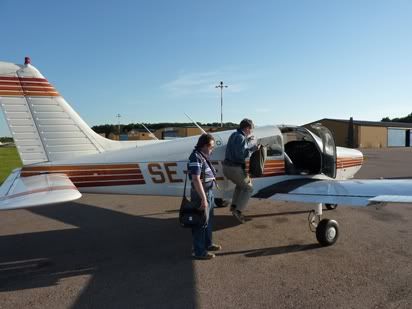
Peter Andersson and the club PA28
Peter was ‘cheating’ and giving all the calls in Swedish, but hey, why not, it’s his country! We were soon airborne and climbing towards the city centre and the normal cleared altitude for the ‘city tour’ of 2000’ – enough to glide clear in the event of engine failure (which would involve a swim in the river / estuary!). The views were great, especially in the evening sun and hovering there in the still of the evening.
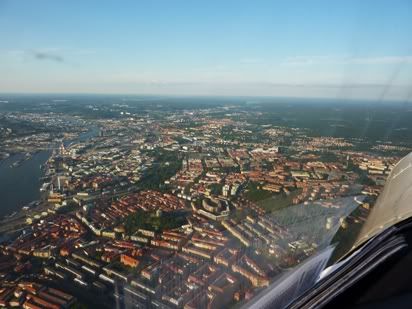
Goteborg city centre from 2000'
Then Peter set course for the archipelago of islands that shelter Goteborg and the mainland Swedish coast from the Kattegat, generally heading west and north. We descended to 1500’ as requested by the Tower (Goteborg Save control up to 1500’ in their zone, above that it is Goteborg Landvetter).
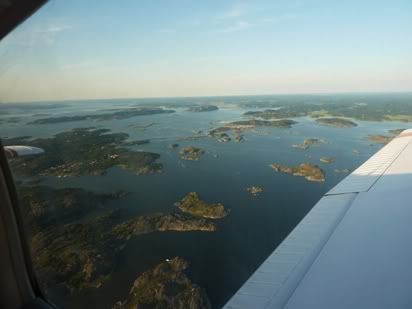
The numerous islands near Goteborg
Peter points out the islands that are only accessible by boat and those that ban all cars etc. The islands and the coast are obviously THE place to be for trendy and wealthy citizens of Goteborg. Some of the islands were sparsely populated while one we saw had houses on virtually every habitable square foot – strange.
Our tour came to an end and Peter rejoined for Goteborg Save. He flew a slightly strange base leg (seeming to fly diagonally away from the airport) but assured us that this was the local noise abatement procedure (ooops – I guess we blew it then on our approach!). We landed probably about 20:50 local with plenty of sun left yet. It was a lovely flight and well worth doing – thank you Peter!
Tuesday was our non-flying day set aside to do sightseeing around Goteborg. As this is a flying diary, I won’t say too much about it other than that it is a really nice and scenic city, probably especially presentable in the hot, sunny weather we enjoyed during our stay.
My contact in Goteborg, Peter Andersson was keen to take us on an evening sightseeing flight over the city and the archipelago after he finished work that day, and to take advantage of the long hours of daylight at these high latitudes (about the same latitude north as the very northernmost tip of mainland Scotland or Juneau in Alaska).
Peter picked us up at our hotel / hostel and drove us back to Goteborg Save airport. Peter is the Chairman of Aeroklubben I Goteborg, a large and successful flying club based at the airport. It is one of the oldest flying clubs in Europe, founded in 1918. The evening flight was a bit touch and go for a while there as the club had recently ‘lost’ two of it’s six aircraft to prop strikes in the last couple of weeks, but he managed to book a late slot in a PA28 from a pilot who was due to land at 20:00 local.
We had a look around the aeroclub. Reasonable sized clubroom, but with all the necessary facilities and a fun-looking booking system that displays bookings on a screen that make it look like commercial departures. We also had a look around their hangar, which was beautifully organised. It was arranged ‘end on’ with hangar doors on both sides, so that planes are parked ‘head to tail’ in their own specific spots each with their own ‘care station’ (bucket, sponge, desk, locker etc.).
While we were waiting for the PA28 to turn up, we showed Peter around our RV6, which he tried on for size. The PA28 we were hoping to use pulled in to the pumps at about 20:00 and Peter took possession. Peter gave the plane a check while I was filled with nostalgia as I trained on PA28’s and flew an Arrow for a couple of years, it was all coming back to me. We loaded into the PA28 in the required sequence through the single door on the right of the plane, so rear passenger first, pilot second and front seat passenger (i.e. me) last. The evening was warm with clear skies and very calm with little if any wind. The colour of the light from the sun which was lazily wending it’s way obliquely to the horizon was wonderful, I love that evening light!
Peter Andersson and the club PA28
Peter was ‘cheating’ and giving all the calls in Swedish, but hey, why not, it’s his country! We were soon airborne and climbing towards the city centre and the normal cleared altitude for the ‘city tour’ of 2000’ – enough to glide clear in the event of engine failure (which would involve a swim in the river / estuary!). The views were great, especially in the evening sun and hovering there in the still of the evening.
Goteborg city centre from 2000'
Then Peter set course for the archipelago of islands that shelter Goteborg and the mainland Swedish coast from the Kattegat, generally heading west and north. We descended to 1500’ as requested by the Tower (Goteborg Save control up to 1500’ in their zone, above that it is Goteborg Landvetter).
The numerous islands near Goteborg
Peter points out the islands that are only accessible by boat and those that ban all cars etc. The islands and the coast are obviously THE place to be for trendy and wealthy citizens of Goteborg. Some of the islands were sparsely populated while one we saw had houses on virtually every habitable square foot – strange.
Our tour came to an end and Peter rejoined for Goteborg Save. He flew a slightly strange base leg (seeming to fly diagonally away from the airport) but assured us that this was the local noise abatement procedure (ooops – I guess we blew it then on our approach!). We landed probably about 20:50 local with plenty of sun left yet. It was a lovely flight and well worth doing – thank you Peter!

Sunday, July 03, 2011
VFR Tour 2011: Hoganas to Gloucester via Odense and Texel
Friday 1st July 2011
Hoganas to Odense
Route: ESMH COAST TNO DCT HAVNEMARK DCT LUMBY DCT EKOD
Capacity: SNY (Self-loading freight)
Thursday morning in Hoganas was fabulous, CAVOK and warm, clear skies. But the front that threatened to come through from the west was slow moving and appeared to be over mid-Denmark. The METARs from the airfield near our planned destination of Samso island were not good, but it was not clear how much of the low cloud was due to early morning for burning off (the temperature and dewpoint were very close) and how much may be due to the front.
As the morning wore on the METARs improved, but only slightly. We may have been able to get through or certainly to divert to one of the many airfields en-route in Denmark, but should we? It wasn’t my leg to fly and we eventually settled on leaving it for today for the front to pass through where we were in Hoganas overnight. Instead it was take to the bikes and pedal along a coastal cycle path (converted railway) from Hoganas to the village of Molle near the tip of the peninsula some 11km away.
It was glorious sunshine until mid / late afternoon when the front finally came in and clouded over as the temperature cooled noticeably (fine by me, I don’t like it too hot) and the wind picked up. So far this entire trip, I had only worn polo-shirts, I didn’t need the fleece I brought with me.
The final planned day of our tour of Friday dawned with a modest wind and broken cloud at about 2000’. The front had passed and we were seeing the back end of it. We checked the weather and synoptics which confirmed this, but they also showed a ‘trough’ hanging around over northern Germany, but clearing nicely to the west of there. We decided to try to make it back to the UK in three or four hops, depending on the weather and ceiling in the North Sea. First leg was to fly to Odense to get a decent fuel load, then Odense to Texel, then if the North Sea was OK for weather and ceiling, direct across the North Sea to Gloucester, or if not route via Calais, then back to Gloucester.
The METAR’s indicated a ceiling of about 1000’ at Odense with a fair old wind, but good lateral visibility. We took off and flew this leg. The cloud was broken and thin and we could have got between layers, but carried on at 1500 – 1000’. We crossed to Fyn Island and picked up the airfield information. The wind was running at 280 / 18, nicely bisecting both the main hard runway and the secondary grass runway, so we would have a crosswind whatever we did. We made a nice crosswind landing on the main runway and parked up and refuelled. Odense is yet another huge regional airport that is practically deserted.
Odense to Texel
Route: EKOD DCT EDXF DCT EDXJ DCT EDXM DCT BEDERKESA DCT LANGWARDEN DCT VOSLAPP DCT SPIEKEROOG DCT FRISIAN ISLANDS DCT EHTX
Capacity: P1 (Pilot)
Logged time: 2.6 hours
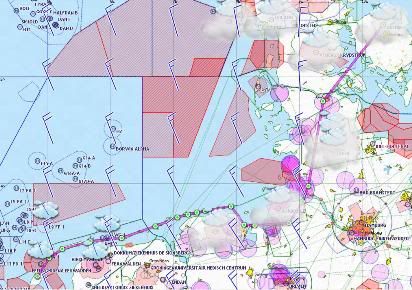
Route from Odense (Denmark) to Texel (Holland)
The next leg was mine and we planned to fly from Odense to Texel, which once past Flensburg, was virtually retracing our steps on the flight coming out. I did some more flight planning using the internet PC at Odense. The wind seemed to moderate a bit at Texel and was positively calm in the UK. It seemed the further west we went, the more the weather improved, so it was looking OK for a possible North Sea crossing. The METAR’s and TAFs were hedging their bets as usual in the trough around Northern Germany and talking about TEMPO CB etc. In my judgement, it was well worth a look as there were plenty of airfields to divert to en-route. I filed a flight plan and we loaded up again.
The wind was pretty much the same, not so much gusty as fairly steady at 280 / 18, so a 15kt crosswind component take off whichever runway I chose, I could see that it favoured 31 slightly, but I decided to stay with the hard runway on 24. Power checks complete, we lined up and were cleared for take off. I powered the engine up and held what I judged to be the correct amount of into wind aileron and danced on the rudder bars to stay pointed down the end of the runway and counteract the crosswind from the right. The tail came up quickly as I focused on a point at the end of the runway to keep the nose pointed at using the rudder.
Whether it was me or the wind (probably both) the nose swung a bit first one way then the other (possibly as I over-corrected), but it was OK, if not elegant. The plane started to hop quite early, so I started to ease her off, but I was premature and all she did was sit tail-down for a few seconds. Then bless her, just as I was about to level out again, she hopped into ground effect, so I held her there and was pleased that at least I got the aileron right as there was no wing dip or lift. She settled and I eased her into the climb, pretty glad to be away from the runway. Not one of my better take-offs, but we were away. The cloud was higher and we easily climbed to 1500’ for an orbit of the airfield for a few photographs.
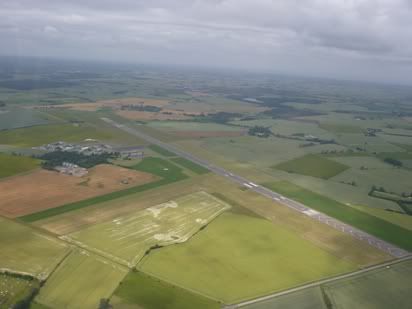
Odense airfield
I set course for roughly Flensburg and spoke to Skrydstrup Approach. I managed a climb to 2000’ and again held that for pretty much the rest of the trip. At some stages I could have gone higher, but at others I had to dip lower under small showers, so 2000’ was fine.
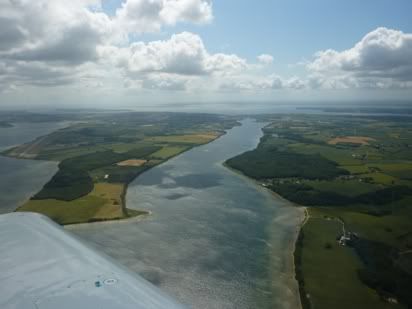
Denmark around Als Fjord near Sonderborg
Around the border between Denmark and Germany at Flensburg, I tried to contact Bremen Information, but no joy. It took three attempts over ten minutes to raisde them, not that I was worried at all, just keen to try to speak to someone during a border crossing.
I set course pretty much directly from Flensburg to St Michaelisdonn airfield just north of the Elbe estuary. From there I hopped across to Bederkesa Lake, then across the Weser estuary near Bremerhaven to Wilhelmshaven, then north west to pick up the Frisian islands.
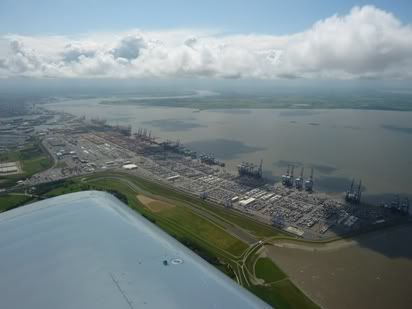
Bremerhaven
We followed the line of the Frisian islands, occasionally ducking to 1200' to get under a small shower cloud, other than that it was fine at 2000'
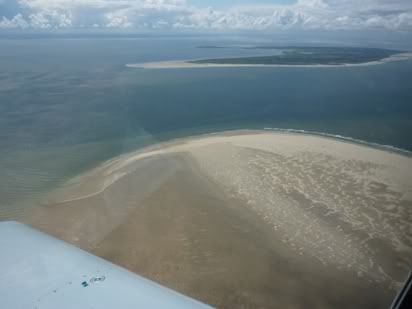
Frisian islands
It took a fair while and several attempts to get through to Dutch Military, I suspect that their reception at low level along the easternmost Frisian Islands is poor. They eventually cleared me through danger area R4A and on to Texel island.
Just coming on to Texel island, I spotted something that looked like a Fournier motor glider climbing up towards me. I took immediately evasive action, although it was not what I would call an airprox, but it would have been if I hadn't have moved and maybe worse. Another remonder if I needed one (which I don't) that visual flying means getting your head out of the cockpit!
I picked up the weather actuals and runway at Texel. They were using the shorter grass runway, 31 (630m so still plenty) and the wind - 310 / 18 - ouch! Thank heavens it was straight down the runway!
I joined base for runway 31 and managed to land first time and trundle to the end to park up at the pumps to fuel for the next leg. A rather nice 2.6 hour leg in reasonable weather. Enjoyed that!
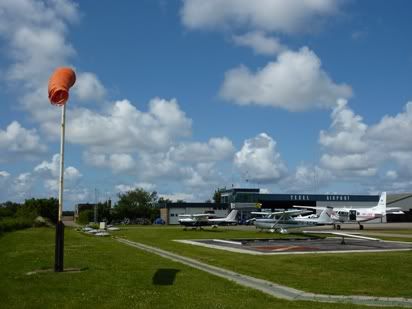
A fair old wind a Texel
Texel to Gloucester
Route: EHTX DCT RAVLO DCT NORWICH DCT DTY DCT EGBJ
Capacity: SNY (Self-loading freight)
This was the last leg of the tour and my group colleague was flying this one. It was pretty much a backtrack of our original route out as the weather over the North Sea looked fine enough to get a decent amount of height.
In the end, he went for FL45. We took off as soon as the planning, final met checks and flight plan were completed. We climbed en-route and leaned out for FL45 and the return via RAVLO, Norwich and Daventry.
The interesting part was some of the vertically developed cumulus clouds, so we avoided the taller ones, which were pretty well scattered anyway.
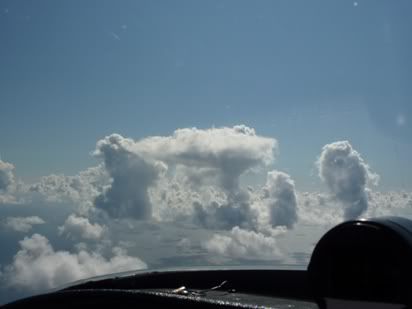
We'll be keeping clear of those then!
The wind had died down a lot over the UK, but then lateral visibility started to clag up a bit, still fine, but not gin-clear. We dropped to 3000' or so for the remainder of the track back into Gloucester.
On arrival at Gloucester at about 17:30 local, it was out with the water and sponges to get half the world's popultation of flies off of the leading edges of the plane and canopy.
The end of the 2011 Scandanavia Tour!
Hoganas to Odense
Route: ESMH COAST TNO DCT HAVNEMARK DCT LUMBY DCT EKOD
Capacity: SNY (Self-loading freight)
Thursday morning in Hoganas was fabulous, CAVOK and warm, clear skies. But the front that threatened to come through from the west was slow moving and appeared to be over mid-Denmark. The METARs from the airfield near our planned destination of Samso island were not good, but it was not clear how much of the low cloud was due to early morning for burning off (the temperature and dewpoint were very close) and how much may be due to the front.
As the morning wore on the METARs improved, but only slightly. We may have been able to get through or certainly to divert to one of the many airfields en-route in Denmark, but should we? It wasn’t my leg to fly and we eventually settled on leaving it for today for the front to pass through where we were in Hoganas overnight. Instead it was take to the bikes and pedal along a coastal cycle path (converted railway) from Hoganas to the village of Molle near the tip of the peninsula some 11km away.
It was glorious sunshine until mid / late afternoon when the front finally came in and clouded over as the temperature cooled noticeably (fine by me, I don’t like it too hot) and the wind picked up. So far this entire trip, I had only worn polo-shirts, I didn’t need the fleece I brought with me.
The final planned day of our tour of Friday dawned with a modest wind and broken cloud at about 2000’. The front had passed and we were seeing the back end of it. We checked the weather and synoptics which confirmed this, but they also showed a ‘trough’ hanging around over northern Germany, but clearing nicely to the west of there. We decided to try to make it back to the UK in three or four hops, depending on the weather and ceiling in the North Sea. First leg was to fly to Odense to get a decent fuel load, then Odense to Texel, then if the North Sea was OK for weather and ceiling, direct across the North Sea to Gloucester, or if not route via Calais, then back to Gloucester.
The METAR’s indicated a ceiling of about 1000’ at Odense with a fair old wind, but good lateral visibility. We took off and flew this leg. The cloud was broken and thin and we could have got between layers, but carried on at 1500 – 1000’. We crossed to Fyn Island and picked up the airfield information. The wind was running at 280 / 18, nicely bisecting both the main hard runway and the secondary grass runway, so we would have a crosswind whatever we did. We made a nice crosswind landing on the main runway and parked up and refuelled. Odense is yet another huge regional airport that is practically deserted.
Odense to Texel
Route: EKOD DCT EDXF DCT EDXJ DCT EDXM DCT BEDERKESA DCT LANGWARDEN DCT VOSLAPP DCT SPIEKEROOG DCT FRISIAN ISLANDS DCT EHTX
Capacity: P1 (Pilot)
Logged time: 2.6 hours
Route from Odense (Denmark) to Texel (Holland)
The next leg was mine and we planned to fly from Odense to Texel, which once past Flensburg, was virtually retracing our steps on the flight coming out. I did some more flight planning using the internet PC at Odense. The wind seemed to moderate a bit at Texel and was positively calm in the UK. It seemed the further west we went, the more the weather improved, so it was looking OK for a possible North Sea crossing. The METAR’s and TAFs were hedging their bets as usual in the trough around Northern Germany and talking about TEMPO CB etc. In my judgement, it was well worth a look as there were plenty of airfields to divert to en-route. I filed a flight plan and we loaded up again.
The wind was pretty much the same, not so much gusty as fairly steady at 280 / 18, so a 15kt crosswind component take off whichever runway I chose, I could see that it favoured 31 slightly, but I decided to stay with the hard runway on 24. Power checks complete, we lined up and were cleared for take off. I powered the engine up and held what I judged to be the correct amount of into wind aileron and danced on the rudder bars to stay pointed down the end of the runway and counteract the crosswind from the right. The tail came up quickly as I focused on a point at the end of the runway to keep the nose pointed at using the rudder.
Whether it was me or the wind (probably both) the nose swung a bit first one way then the other (possibly as I over-corrected), but it was OK, if not elegant. The plane started to hop quite early, so I started to ease her off, but I was premature and all she did was sit tail-down for a few seconds. Then bless her, just as I was about to level out again, she hopped into ground effect, so I held her there and was pleased that at least I got the aileron right as there was no wing dip or lift. She settled and I eased her into the climb, pretty glad to be away from the runway. Not one of my better take-offs, but we were away. The cloud was higher and we easily climbed to 1500’ for an orbit of the airfield for a few photographs.
Odense airfield
I set course for roughly Flensburg and spoke to Skrydstrup Approach. I managed a climb to 2000’ and again held that for pretty much the rest of the trip. At some stages I could have gone higher, but at others I had to dip lower under small showers, so 2000’ was fine.
Denmark around Als Fjord near Sonderborg
Around the border between Denmark and Germany at Flensburg, I tried to contact Bremen Information, but no joy. It took three attempts over ten minutes to raisde them, not that I was worried at all, just keen to try to speak to someone during a border crossing.
I set course pretty much directly from Flensburg to St Michaelisdonn airfield just north of the Elbe estuary. From there I hopped across to Bederkesa Lake, then across the Weser estuary near Bremerhaven to Wilhelmshaven, then north west to pick up the Frisian islands.
Bremerhaven
We followed the line of the Frisian islands, occasionally ducking to 1200' to get under a small shower cloud, other than that it was fine at 2000'
Frisian islands
It took a fair while and several attempts to get through to Dutch Military, I suspect that their reception at low level along the easternmost Frisian Islands is poor. They eventually cleared me through danger area R4A and on to Texel island.
Just coming on to Texel island, I spotted something that looked like a Fournier motor glider climbing up towards me. I took immediately evasive action, although it was not what I would call an airprox, but it would have been if I hadn't have moved and maybe worse. Another remonder if I needed one (which I don't) that visual flying means getting your head out of the cockpit!
I picked up the weather actuals and runway at Texel. They were using the shorter grass runway, 31 (630m so still plenty) and the wind - 310 / 18 - ouch! Thank heavens it was straight down the runway!
I joined base for runway 31 and managed to land first time and trundle to the end to park up at the pumps to fuel for the next leg. A rather nice 2.6 hour leg in reasonable weather. Enjoyed that!
A fair old wind a Texel
Texel to Gloucester
Route: EHTX DCT RAVLO DCT NORWICH DCT DTY DCT EGBJ
Capacity: SNY (Self-loading freight)
This was the last leg of the tour and my group colleague was flying this one. It was pretty much a backtrack of our original route out as the weather over the North Sea looked fine enough to get a decent amount of height.
In the end, he went for FL45. We took off as soon as the planning, final met checks and flight plan were completed. We climbed en-route and leaned out for FL45 and the return via RAVLO, Norwich and Daventry.
The interesting part was some of the vertically developed cumulus clouds, so we avoided the taller ones, which were pretty well scattered anyway.
We'll be keeping clear of those then!
The wind had died down a lot over the UK, but then lateral visibility started to clag up a bit, still fine, but not gin-clear. We dropped to 3000' or so for the remainder of the track back into Gloucester.
On arrival at Gloucester at about 17:30 local, it was out with the water and sponges to get half the world's popultation of flies off of the leading edges of the plane and canopy.
The end of the 2011 Scandanavia Tour!
VFR Tour 2011: Goteborg to Hoganas
Wednesday 29th June 2011
Goteborg to Hoganas
Route: ESGP COAST BAK COAST ESMT DCT ESMH
Capacity: P1 (Pilot)
Logged time: 1.3 hours
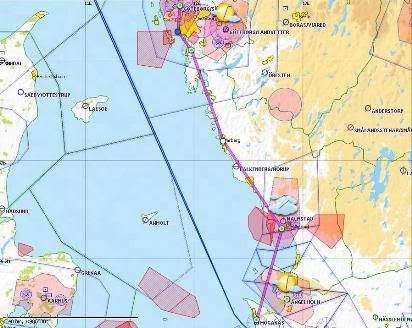
Route from Goteborg to Hoganas
Well, we were back on the original plan now and today headed out of Goteborg with a flight virtually due south to a small grass airfield in Sweden called Hoganas. Hoganas is located on the west coast of Sweden, about 10 miles north of Helsingborg on the Oresund, the narrow stretch of water that separates mainland Sweden from the Danish island of Sjaelland (the big island with Copenhagen on it). From Hoganas, the Danish coast is a only 7nm away, but from Helsingborg, it is a mere 3nm. Hoganas is well known in aviation circles and a lively GA airfield with many European events, including the European RV Rally. As an airfield, it punches well above it’s weight and we were strongly advised to visit this airfield on our trip.
Rather than make taxi drivers rich (and us poor by a similar amount), we decided to get the excellent public transport busses to the airport. However, this involved going in to Goteborg city centre first, then getting an airport bus back out to Save. We arrived at Save at about 11:00 and presented ourselves to the security gate we came out from. They asked for our pilots licences and photo id, then put us and our stuff through the security scanners. It was all very relaxed and good natured and didn’t feel terribly officious.
Once airside we asked about refuelling. We were advised simply to pull the plane across to the pumps and someone would come out and fuel for us. This is indeed what happened. A very cheerful and inquisitive pompier came out and filled the tanks to our specification, as it was only going to be a short run of just over one hour. We checked the plane out and loaded up and while I wandered over to the flying club to get weather actuals from the internet (there being no internet in the pilot reporting room), my fellow group member wandered off to pay the fuel bill. I filed a formal flight plan, as I don’t fancy flying over those forests and coast without some ‘insurance’.
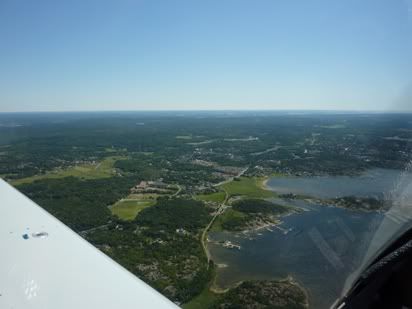
Airborne out of Goteborg at 1500'
I got the METARs for all relevant airfields and alternates from the clubhouse using the Orbifly website (an excellent site). Happy days, CAVOK all the way! Back at the plane, my fellow group member told me that there was no landing or parking to pay and that all we paid for was the fuel. Now I cannot believe that Goteborg Save thought that these heroic aviators who flew from Britain should be rewarded with such financial largesse, and I suspect that Peter Andersson had something to do with this!!! Anyway, thanks again Peter, a book by one of our other group member about his around the world flight in our plane will be on it’s way to you shortly!
We clambered in as I ran through the checklist, leaving the buttoning of the canopy until the last moment as we would cook! Sure enough we did as we trundled to an intermediate holding point for runway 19 (still stacks of runway left for the RV6). The wind was modest, with a slight crosswind component from the left IIRC. We were quickly cleared for take off and we powered down the runway, with the RV soon hopping about excitedly like a kid waiting for his turn on the roller-coaster! We climbed to the 1500’ we were cleared to by Goteborg Tower and were advised to remain west of the city for transit heading south just inland from the coast, initially for Varberg, then Falkenberg, then Halmstad, then across the Skalderviken to Hoganas.
We held at 1500’ until I was clear of the Goteborg Save zone. They advised us to contact Sweden Control, which we did. I requested a climb to 2000’ where we sat for the rest of the trip, there really being no need to climb any higher, and hey, the view and scenery were great.
The countryside was far more cleared and farmed than I had expected, with plenty of places for a forced landing if it came to it (yes, that is what private pilots think about a fair bit as they fly along, also always trying to keep track of the wind so they know what direction the land into). We kinda flew slightly inland and parallel to the coast until I realised that I was flying generally to the right of the main road that seems to change from the E6 to the E20 and back again as it heads south to Malmo, then across the bridge into and across all of Denmark to Esbjerg. So I basically flew between the coast and this main road.
We contacted Halmstad Tower to get clearance to fly through their zone, which they were fine about. WE could clearly see the huge runway of what looks like yet another deserted regional airport. We flew across the bay at Halmstad rather than route around the coast, then contact Angelholm Tower to get clearance to go through their zone. They were also quite happy and we routed across the Skalderviken bay on track to Hoganas.
Hoganas sort of sits at the south western base of a peninsula with a prominent range of hills at the tip of the peninsula, called the Kullabergs Naturreservat. It is quite unmistakeable as there ain’t many hills in these here parts stranger!!
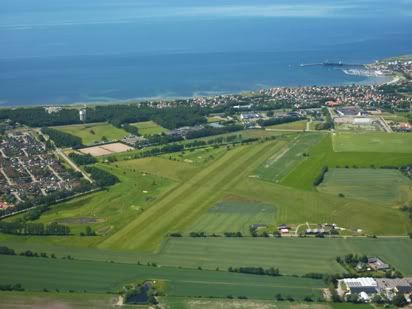
Hoganas Airfield
As we got within glide range of the land again, I switched from Angelholm to Hoganas Radio. I listened in for a bit to build up a picture as we approached, but it was silent. OK, so I called them – nothing. In line with the convention, I called them a total of three times, each time with no response. OK, check the frequency, no it is definitely correct. As it is only a ‘Radio’ service, they may well not be manning it. OK, no bother. I sort of know the wind as I have been tracking it during the flight and it is coming from the south or the south west. I start giving ‘blind calls’ for my position to ‘Hoganas Traffic’ and drop to 1500’ as we approach the town of Hoganas.
Then it is the ever popular game of ‘spot the airfield’, made all the more entertaining when it is a grass airfield. We know pretty much where it must be, it is just a case of actually seeing it. It is made harder here as many of the farmers fields are ‘strip-shaped’ – i.e. long and thin, unlike British fields. They don’t like overhead joins, so I start to set up for a wide orbit at above circuit height, then I spot it. We both look hard for a windsock, but can we see it? Can we buffalo! I am pretty confident about the wind which seems to favour runway 14, the longer of the two runways (runways 14 / 32 is 800m and runway 06 / 24 is 560m).
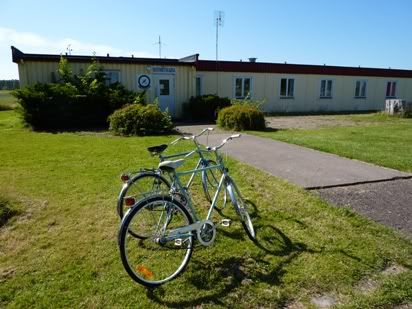
Hoganas clubhouse
I decide to do a left base join for 14 and start a descent to 1000’. This puts us out over the town of Hoganas and takes us a little out to sea before I turn final for 14. I try to feel for the wind, but there is very little crosswind, so I line up on 14. I am high, so I side-slip some of this off. I take a bit too much off and end up putting some power back in. Approach now good and airspeed OK, if a bit fast. Over the threshold, height good, power off and flare and hold off and off. She touches before I want her to so we hop a bit (not much) and she lands off the second touch. The runway is smooth and I let her run to slow to a taxi speed by herself, plenty of runway left. We slow to taxi speed by the runway intersection (about halfway along) and turn into runway 06 to trundle straight to the fuel pumps.
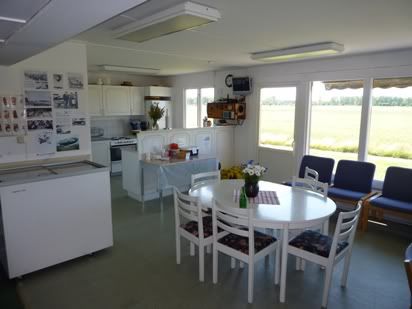
Hoganas clubhouse
We are greeted by Lasse, the airfields only employee who does everything. We load with a modest amount of fuel, as out next planned trip is a relatively short hop of about one hour to Samso island in Denmark. He is a very helpful guy and speaks reasonable English. There is no landing fee and bikes are provided free, but donations are accepted. So I pay up for the fuel. We are met briefly by the airfield owner, Olle (who is also an RV6 owner). He has to head off but may see us tomorrow.
We advise Lasse that we want to stay the night in one of the clubhouse bunkrooms, so after we park up and ties down, he shows us around the clubhouse. What a great clubhouse! It is a converted accommodation prefab they got from one of the local companies ten years ago, so it came with loads of bedrooms each with an en-suite toilet and sink and communal shower room. They took some of the room partitions down to create the club lounge, kitchen and flight planning room. They still have six bedroom available to rent for a modest GBP20 pppn. Many of the rooms have bunkbeds and you can rent sheets etc. It is nothing fancy, but is a huge step up from camping (which they are also quite happy for you to do by your aircraft.
The clubhouse operates an ‘honesty box’ and has a soda / beer fridge and an ice cream freezer that you can serve yourself from. The flight planning room has all the facilities you need, including an internet PC and a non-password WiFi that you can get from anywhere in the clubhouse.
He sorted us out two bikes and gave us a map of the town. It is about 2 miles so maybe a bit far to walk so we were happy with the bikes. The town isn’t up to much though, there is a beach and a marina, but very little in the way of bars or restaurants. But the airfield is fantastic, this is probably the best, most welcoming and relaxed airfield I have ever been to – a bit like the Carlbergs adverts – ‘If Carlsberg made airfields……’ – well, this is pretty close to what a Carlsberg airport would be!
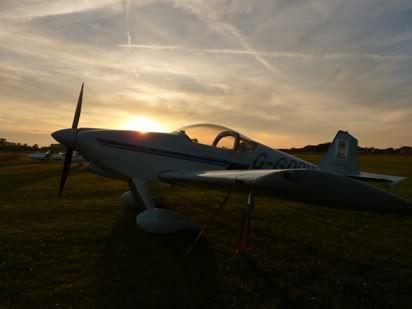
G-GDRV tucked up for the night at Hoganas
A really nice flight to an excellent airfield. However, we watched the slow progress of a weather front on the synoptics. It was due to pass slowly through maybe midday tomorrow coming from the west, so there might be time to get to Samso if we got up early enough – this being the only fly in the ointment.
Goteborg to Hoganas
Route: ESGP COAST BAK COAST ESMT DCT ESMH
Capacity: P1 (Pilot)
Logged time: 1.3 hours
Route from Goteborg to Hoganas
Well, we were back on the original plan now and today headed out of Goteborg with a flight virtually due south to a small grass airfield in Sweden called Hoganas. Hoganas is located on the west coast of Sweden, about 10 miles north of Helsingborg on the Oresund, the narrow stretch of water that separates mainland Sweden from the Danish island of Sjaelland (the big island with Copenhagen on it). From Hoganas, the Danish coast is a only 7nm away, but from Helsingborg, it is a mere 3nm. Hoganas is well known in aviation circles and a lively GA airfield with many European events, including the European RV Rally. As an airfield, it punches well above it’s weight and we were strongly advised to visit this airfield on our trip.
Rather than make taxi drivers rich (and us poor by a similar amount), we decided to get the excellent public transport busses to the airport. However, this involved going in to Goteborg city centre first, then getting an airport bus back out to Save. We arrived at Save at about 11:00 and presented ourselves to the security gate we came out from. They asked for our pilots licences and photo id, then put us and our stuff through the security scanners. It was all very relaxed and good natured and didn’t feel terribly officious.
Once airside we asked about refuelling. We were advised simply to pull the plane across to the pumps and someone would come out and fuel for us. This is indeed what happened. A very cheerful and inquisitive pompier came out and filled the tanks to our specification, as it was only going to be a short run of just over one hour. We checked the plane out and loaded up and while I wandered over to the flying club to get weather actuals from the internet (there being no internet in the pilot reporting room), my fellow group member wandered off to pay the fuel bill. I filed a formal flight plan, as I don’t fancy flying over those forests and coast without some ‘insurance’.
Airborne out of Goteborg at 1500'
I got the METARs for all relevant airfields and alternates from the clubhouse using the Orbifly website (an excellent site). Happy days, CAVOK all the way! Back at the plane, my fellow group member told me that there was no landing or parking to pay and that all we paid for was the fuel. Now I cannot believe that Goteborg Save thought that these heroic aviators who flew from Britain should be rewarded with such financial largesse, and I suspect that Peter Andersson had something to do with this!!! Anyway, thanks again Peter, a book by one of our other group member about his around the world flight in our plane will be on it’s way to you shortly!
We clambered in as I ran through the checklist, leaving the buttoning of the canopy until the last moment as we would cook! Sure enough we did as we trundled to an intermediate holding point for runway 19 (still stacks of runway left for the RV6). The wind was modest, with a slight crosswind component from the left IIRC. We were quickly cleared for take off and we powered down the runway, with the RV soon hopping about excitedly like a kid waiting for his turn on the roller-coaster! We climbed to the 1500’ we were cleared to by Goteborg Tower and were advised to remain west of the city for transit heading south just inland from the coast, initially for Varberg, then Falkenberg, then Halmstad, then across the Skalderviken to Hoganas.
We held at 1500’ until I was clear of the Goteborg Save zone. They advised us to contact Sweden Control, which we did. I requested a climb to 2000’ where we sat for the rest of the trip, there really being no need to climb any higher, and hey, the view and scenery were great.
The countryside was far more cleared and farmed than I had expected, with plenty of places for a forced landing if it came to it (yes, that is what private pilots think about a fair bit as they fly along, also always trying to keep track of the wind so they know what direction the land into). We kinda flew slightly inland and parallel to the coast until I realised that I was flying generally to the right of the main road that seems to change from the E6 to the E20 and back again as it heads south to Malmo, then across the bridge into and across all of Denmark to Esbjerg. So I basically flew between the coast and this main road.
We contacted Halmstad Tower to get clearance to fly through their zone, which they were fine about. WE could clearly see the huge runway of what looks like yet another deserted regional airport. We flew across the bay at Halmstad rather than route around the coast, then contact Angelholm Tower to get clearance to go through their zone. They were also quite happy and we routed across the Skalderviken bay on track to Hoganas.
Hoganas sort of sits at the south western base of a peninsula with a prominent range of hills at the tip of the peninsula, called the Kullabergs Naturreservat. It is quite unmistakeable as there ain’t many hills in these here parts stranger!!
Hoganas Airfield
As we got within glide range of the land again, I switched from Angelholm to Hoganas Radio. I listened in for a bit to build up a picture as we approached, but it was silent. OK, so I called them – nothing. In line with the convention, I called them a total of three times, each time with no response. OK, check the frequency, no it is definitely correct. As it is only a ‘Radio’ service, they may well not be manning it. OK, no bother. I sort of know the wind as I have been tracking it during the flight and it is coming from the south or the south west. I start giving ‘blind calls’ for my position to ‘Hoganas Traffic’ and drop to 1500’ as we approach the town of Hoganas.
Then it is the ever popular game of ‘spot the airfield’, made all the more entertaining when it is a grass airfield. We know pretty much where it must be, it is just a case of actually seeing it. It is made harder here as many of the farmers fields are ‘strip-shaped’ – i.e. long and thin, unlike British fields. They don’t like overhead joins, so I start to set up for a wide orbit at above circuit height, then I spot it. We both look hard for a windsock, but can we see it? Can we buffalo! I am pretty confident about the wind which seems to favour runway 14, the longer of the two runways (runways 14 / 32 is 800m and runway 06 / 24 is 560m).
Hoganas clubhouse
I decide to do a left base join for 14 and start a descent to 1000’. This puts us out over the town of Hoganas and takes us a little out to sea before I turn final for 14. I try to feel for the wind, but there is very little crosswind, so I line up on 14. I am high, so I side-slip some of this off. I take a bit too much off and end up putting some power back in. Approach now good and airspeed OK, if a bit fast. Over the threshold, height good, power off and flare and hold off and off. She touches before I want her to so we hop a bit (not much) and she lands off the second touch. The runway is smooth and I let her run to slow to a taxi speed by herself, plenty of runway left. We slow to taxi speed by the runway intersection (about halfway along) and turn into runway 06 to trundle straight to the fuel pumps.
Hoganas clubhouse
We are greeted by Lasse, the airfields only employee who does everything. We load with a modest amount of fuel, as out next planned trip is a relatively short hop of about one hour to Samso island in Denmark. He is a very helpful guy and speaks reasonable English. There is no landing fee and bikes are provided free, but donations are accepted. So I pay up for the fuel. We are met briefly by the airfield owner, Olle (who is also an RV6 owner). He has to head off but may see us tomorrow.
We advise Lasse that we want to stay the night in one of the clubhouse bunkrooms, so after we park up and ties down, he shows us around the clubhouse. What a great clubhouse! It is a converted accommodation prefab they got from one of the local companies ten years ago, so it came with loads of bedrooms each with an en-suite toilet and sink and communal shower room. They took some of the room partitions down to create the club lounge, kitchen and flight planning room. They still have six bedroom available to rent for a modest GBP20 pppn. Many of the rooms have bunkbeds and you can rent sheets etc. It is nothing fancy, but is a huge step up from camping (which they are also quite happy for you to do by your aircraft.
The clubhouse operates an ‘honesty box’ and has a soda / beer fridge and an ice cream freezer that you can serve yourself from. The flight planning room has all the facilities you need, including an internet PC and a non-password WiFi that you can get from anywhere in the clubhouse.
He sorted us out two bikes and gave us a map of the town. It is about 2 miles so maybe a bit far to walk so we were happy with the bikes. The town isn’t up to much though, there is a beach and a marina, but very little in the way of bars or restaurants. But the airfield is fantastic, this is probably the best, most welcoming and relaxed airfield I have ever been to – a bit like the Carlbergs adverts – ‘If Carlsberg made airfields……’ – well, this is pretty close to what a Carlsberg airport would be!
G-GDRV tucked up for the night at Hoganas
A really nice flight to an excellent airfield. However, we watched the slow progress of a weather front on the synoptics. It was due to pass slowly through maybe midday tomorrow coming from the west, so there might be time to get to Samso if we got up early enough – this being the only fly in the ointment.
VFR Tour 2011: Flensburg to Goteborg via Stauning
Monday 27th June 2011
Flensburg (Germany) to Stauning (Denmark)
Route: EDXF DCT EKEB DTC EKVJ
Capacity: P1 (Pilot)
Logged time: 0.9 hours
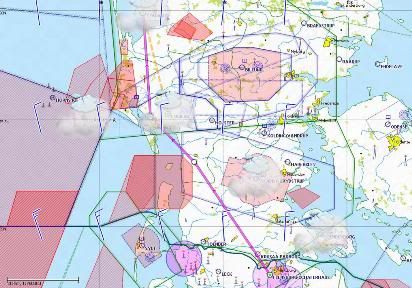
The route from Flensburg to Stauning
We woke early to be greeted by ‘Severe CAVOK’ and sunshine, at least in Flensburg, so it was off to the airfield. The METARS for Stauning were not encouraging, with OVC at 300’ and 3000m visibility, but a quick look at the temperature and dewpoint showed these to be damned nearly the same, so it was pretty clearly early morning coastal fog / mist that would lift and break up as the temperature rose.
We refuelled, at first struggling with a card at the pumps with instructions in German, until one of us had the inspiration to turn to card over and hey presto – instructions in English (DOH!). We got fuelled.
Note to self: refuel when you arrive, not when you want to depart, I did know this, but one gets lazy after a while).
The idea today was to change the original plan and bypass Aalborg as an overnight stop (which was only really a whim anyway), but to stop and Stauning for lunch and a mooch around the Danish Air Museum, then a single leg south of Aalborg, out to Goteborg in Sweden via the Danish island of Laeso to shorten the time over water out of glide to the land. I was to fly the first leg and the other group member was to fly the Stauning to Aalborg leg.
We filed out flight plan with the helpful guy on reception at Flensburg and the route was very simple. A check complete, we loaded up, buttoned up and trundled off as quickly as possible as it was already getting hot under the bubble canopy.
It was only a relatively short one hour or so hop to Stauning, routing via the airfield at Esjberg on the west coast of the Danish mainland, about ‘halfway up’. I climbed to around 2000’ which was fine for this hop and kept me below some airspace. We trundled along in wonderful clear weather in glorious sunshine. There was a slight breeze from the south, but nothing much to speak of. Well, Denmark certainly is flat and intensively cultivated. They too are fond of wind farms, which are useful when you are flying to get a gauge if the wind direction and strength.
Initially we spoke to Skrydstrup Approach for the border crossing from Germany to Denmark and for clearance through their airspace. Then we switched to Billund Approach then to Esbjerg Tower as we would be routing through their overhead. As it turned out they were spectacularly un-busy with only one other aircraft in the area.
The coast itself looked interesting, sandy with a shallow sea and lots of sand spits and bars.
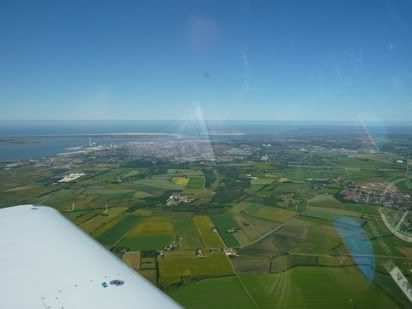
Esbjerg town (western Denmark)from the air
On approach to Stauning, we spoke to the tower and did an orbit of the airfield for photographs, then joined left crosswind for runway 27. We got a wind check and they reported it as 200/17! Well this shook me a bit but he cleared said ‘one – seven’ for the wind strength. I expected a slight crosswind based on my GPS groundspeed and the laconic spin of the wind turbines, but 17? We both heard him say this, but I asked again for a wind check and he said the same thing. Even the windsock didn’t seem too bothered, but maybe it was a 35kt windsock or something? OK - this could be an entertaining crosswind landing then. I decided to approach a bit faster than normal and set up for 80 kts, as the runway was plenty long enough and it would give me time to bleed the speed off in the flare and get properly set up for the crosswind or to abort if I really didn’t like it. On final, we didn’t seem to be getting pushed anywhere near as much as I expected.
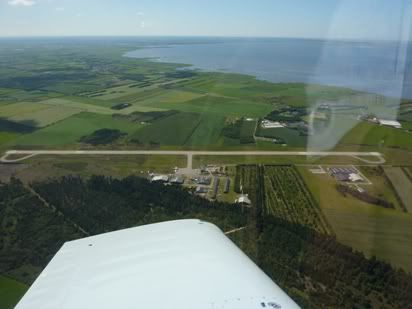
Stauning airfield - Denmark EKVJ
I rounded out and flared faster than normal and felt for the strong crosswind, but again, it just didn’t seem to be there. I was bleeding the speed off riding the rudder bars with into wind aileron, when we touched before the stall warner was solid, so of course I was ‘rewarded’ with a bounce, nothing major, just annoying. Held it off more and we touched and stayed touched. I taxied in and asked for fuel. This was at the pumps just past the tower. We filled up for the next leg and parked up just outside the tower.
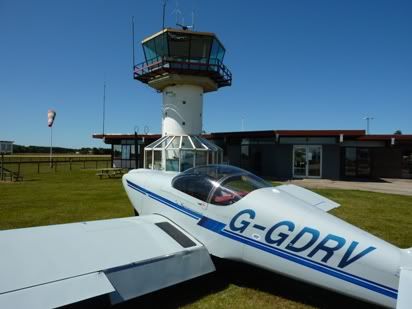
G-GDRV at Stauning Airfield (Denmark)
We checked the breeze on the ground and it was nothing like 17kts – 7 kts maybe, but 17 kts? No. I suspect there was some sort of English problem in the tower, as we both very clearly heard him say ‘one-seven’ twice (he then said the same thing again on take-off, I wonder if the only English number he knows is ‘one-seven’!).
The place was again deserted, although there were a couple of touch and go’s while we were there, but hardly anything moved on the apron. The airport staff were very helpful as usual. We made our way through the passenger terminal and walked the 400m or so down the road to the Danish Air Museum.
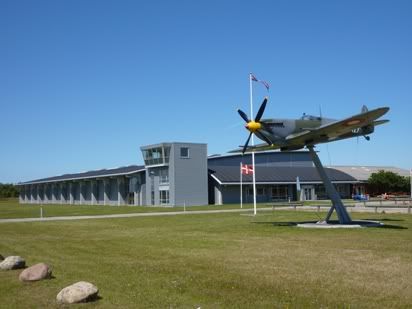
Danish Flight Museum at Stauning Airfield
This was a beautiful, modern and very well laid out building, but if they had more than 5 visitors when we were ther, I would be surprised. Admission was a modest GBP4.00 per person or thereabouts. A number of the exhibits must have been in flying condition as they had drip trays under the engines, but then they were in perfect condition, so I suspect that if they do fly, it isn’t very often at all and we couldn’t spot the route they would take out of the museum to the airfield. Some good stuff anyway, my favourite being the F104 Starfighter and the Saab Drakken. Unlike many museums, they were quite happy for visitors to touch the exhibits, just not clamber all over them that’s all.
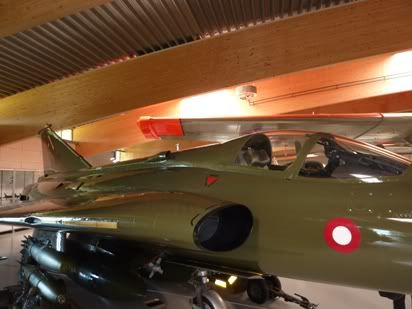
A very nice Saab Drakken at the flight museum
Our visit didn’t take too long and we made our way back to the airport to saddle up for the run to Goteborg in Sweden. I sent a text message to my contact in Goteborg who said he might be able to meet us, but would certainly want to hook up for the evening and promised us a local flight in return for the flight I gave him when he was visiting the UK.
Stauning (Denmark) to Goteborg (Sweden)
Route: EKVJ DCT LINDTORP DCT HALS DCT LYNGSA DCT LAESO DT RAVEN DCT ESGP
Capacity: SNY (Self loading freight)
The airport has free WiFi and free use of an Internet PC, so we checked the METARs. It was CAVOK, so we filed the flight plan and saddled up.
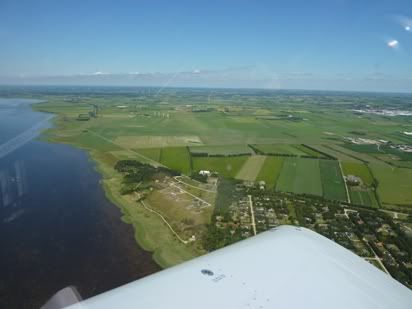
Danish west coast near Stauning
This was my turn as the passenger. We routed at around 2000’ south of Aalborg. We spotted what must be the only hills in Denmark, a small wooded spine of undulating ground (hills is too strong a description) that seems to run North / South for much of the mainland. At the east Danish coast we got approval from Aalborg Approach to climb to FL50 for the sea crossing from the Danish mainland to Goteborg across the Kattegat via the Danish island of Laeso.
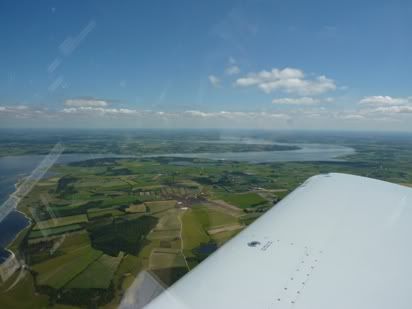
Danish countryside south of Aalborg
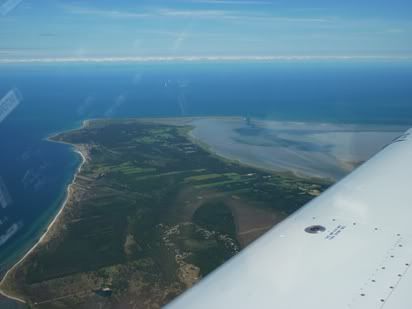
Danish island of Laeso
Copenhagen Information took over for the over-water part. They caused us a bit of concern when they asked if we had filed a flight plan. We confirmed we had and they seemed happy, presumably they found a copy of their advice. Copenhagen Information handed us over to Sweden Control (we were expecting to go straight to Goteborg, but we assumed that Copenhagen Information knew what they were doing).
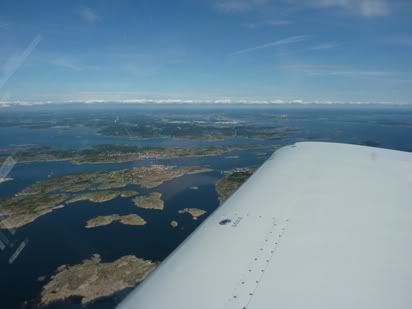
Numerous coastal islands around Goteborg in Sweden
Sweden control then advised us that Goteborg wanted us at no higher than 1500’ by their reporting point RAVEN. So we started a cruise descent. At RAVEN, Goteborg took over and advised us to approach the field due east and join right base for runway 19. The wind was minimal and what there was of it was straight down the runway.
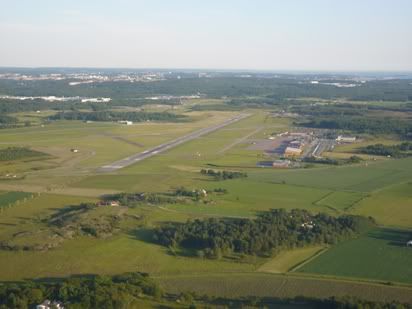
Goteborg Save airport
We spotted the airport in good time and landed on 19. We were transferred to a ground frequency who advised us to park on the grass to the north of the fuel ‘island’ which was pretty easy to see. We parked up as quickly as possible as it was getting hot with the canopy buttoned up and tied down. I sent a text to our Swedish contact who couldn’t meet us then, but would meet us at the hotel that evening to show us around the town.
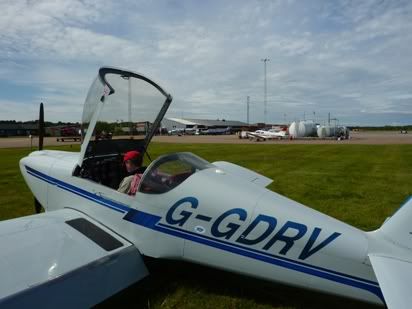
G-GDRV on the ground at Goteborg Save airport
We sorted ourselves out and reported where indicated. They weren’t interested until we wanted to leave so we took a cab to the accommodation we had pre-booked. Although it wasn’t far (probably no more than 5 miles) it cost around GBP 37 – ouch! IT also turned out that we were still quite a way out from the town centre, so taxi’s would be a bad idea.
Flensburg (Germany) to Stauning (Denmark)
Route: EDXF DCT EKEB DTC EKVJ
Capacity: P1 (Pilot)
Logged time: 0.9 hours
The route from Flensburg to Stauning
We woke early to be greeted by ‘Severe CAVOK’ and sunshine, at least in Flensburg, so it was off to the airfield. The METARS for Stauning were not encouraging, with OVC at 300’ and 3000m visibility, but a quick look at the temperature and dewpoint showed these to be damned nearly the same, so it was pretty clearly early morning coastal fog / mist that would lift and break up as the temperature rose.
We refuelled, at first struggling with a card at the pumps with instructions in German, until one of us had the inspiration to turn to card over and hey presto – instructions in English (DOH!). We got fuelled.
Note to self: refuel when you arrive, not when you want to depart, I did know this, but one gets lazy after a while).
The idea today was to change the original plan and bypass Aalborg as an overnight stop (which was only really a whim anyway), but to stop and Stauning for lunch and a mooch around the Danish Air Museum, then a single leg south of Aalborg, out to Goteborg in Sweden via the Danish island of Laeso to shorten the time over water out of glide to the land. I was to fly the first leg and the other group member was to fly the Stauning to Aalborg leg.
We filed out flight plan with the helpful guy on reception at Flensburg and the route was very simple. A check complete, we loaded up, buttoned up and trundled off as quickly as possible as it was already getting hot under the bubble canopy.
It was only a relatively short one hour or so hop to Stauning, routing via the airfield at Esjberg on the west coast of the Danish mainland, about ‘halfway up’. I climbed to around 2000’ which was fine for this hop and kept me below some airspace. We trundled along in wonderful clear weather in glorious sunshine. There was a slight breeze from the south, but nothing much to speak of. Well, Denmark certainly is flat and intensively cultivated. They too are fond of wind farms, which are useful when you are flying to get a gauge if the wind direction and strength.
Initially we spoke to Skrydstrup Approach for the border crossing from Germany to Denmark and for clearance through their airspace. Then we switched to Billund Approach then to Esbjerg Tower as we would be routing through their overhead. As it turned out they were spectacularly un-busy with only one other aircraft in the area.
The coast itself looked interesting, sandy with a shallow sea and lots of sand spits and bars.
Esbjerg town (western Denmark)from the air
On approach to Stauning, we spoke to the tower and did an orbit of the airfield for photographs, then joined left crosswind for runway 27. We got a wind check and they reported it as 200/17! Well this shook me a bit but he cleared said ‘one – seven’ for the wind strength. I expected a slight crosswind based on my GPS groundspeed and the laconic spin of the wind turbines, but 17? We both heard him say this, but I asked again for a wind check and he said the same thing. Even the windsock didn’t seem too bothered, but maybe it was a 35kt windsock or something? OK - this could be an entertaining crosswind landing then. I decided to approach a bit faster than normal and set up for 80 kts, as the runway was plenty long enough and it would give me time to bleed the speed off in the flare and get properly set up for the crosswind or to abort if I really didn’t like it. On final, we didn’t seem to be getting pushed anywhere near as much as I expected.
Stauning airfield - Denmark EKVJ
I rounded out and flared faster than normal and felt for the strong crosswind, but again, it just didn’t seem to be there. I was bleeding the speed off riding the rudder bars with into wind aileron, when we touched before the stall warner was solid, so of course I was ‘rewarded’ with a bounce, nothing major, just annoying. Held it off more and we touched and stayed touched. I taxied in and asked for fuel. This was at the pumps just past the tower. We filled up for the next leg and parked up just outside the tower.
G-GDRV at Stauning Airfield (Denmark)
We checked the breeze on the ground and it was nothing like 17kts – 7 kts maybe, but 17 kts? No. I suspect there was some sort of English problem in the tower, as we both very clearly heard him say ‘one-seven’ twice (he then said the same thing again on take-off, I wonder if the only English number he knows is ‘one-seven’!).
The place was again deserted, although there were a couple of touch and go’s while we were there, but hardly anything moved on the apron. The airport staff were very helpful as usual. We made our way through the passenger terminal and walked the 400m or so down the road to the Danish Air Museum.
Danish Flight Museum at Stauning Airfield
This was a beautiful, modern and very well laid out building, but if they had more than 5 visitors when we were ther, I would be surprised. Admission was a modest GBP4.00 per person or thereabouts. A number of the exhibits must have been in flying condition as they had drip trays under the engines, but then they were in perfect condition, so I suspect that if they do fly, it isn’t very often at all and we couldn’t spot the route they would take out of the museum to the airfield. Some good stuff anyway, my favourite being the F104 Starfighter and the Saab Drakken. Unlike many museums, they were quite happy for visitors to touch the exhibits, just not clamber all over them that’s all.
A very nice Saab Drakken at the flight museum
Our visit didn’t take too long and we made our way back to the airport to saddle up for the run to Goteborg in Sweden. I sent a text message to my contact in Goteborg who said he might be able to meet us, but would certainly want to hook up for the evening and promised us a local flight in return for the flight I gave him when he was visiting the UK.
Stauning (Denmark) to Goteborg (Sweden)
Route: EKVJ DCT LINDTORP DCT HALS DCT LYNGSA DCT LAESO DT RAVEN DCT ESGP
Capacity: SNY (Self loading freight)
The airport has free WiFi and free use of an Internet PC, so we checked the METARs. It was CAVOK, so we filed the flight plan and saddled up.
Danish west coast near Stauning
This was my turn as the passenger. We routed at around 2000’ south of Aalborg. We spotted what must be the only hills in Denmark, a small wooded spine of undulating ground (hills is too strong a description) that seems to run North / South for much of the mainland. At the east Danish coast we got approval from Aalborg Approach to climb to FL50 for the sea crossing from the Danish mainland to Goteborg across the Kattegat via the Danish island of Laeso.
Danish countryside south of Aalborg
Danish island of Laeso
Copenhagen Information took over for the over-water part. They caused us a bit of concern when they asked if we had filed a flight plan. We confirmed we had and they seemed happy, presumably they found a copy of their advice. Copenhagen Information handed us over to Sweden Control (we were expecting to go straight to Goteborg, but we assumed that Copenhagen Information knew what they were doing).
Numerous coastal islands around Goteborg in Sweden
Sweden control then advised us that Goteborg wanted us at no higher than 1500’ by their reporting point RAVEN. So we started a cruise descent. At RAVEN, Goteborg took over and advised us to approach the field due east and join right base for runway 19. The wind was minimal and what there was of it was straight down the runway.
Goteborg Save airport
We spotted the airport in good time and landed on 19. We were transferred to a ground frequency who advised us to park on the grass to the north of the fuel ‘island’ which was pretty easy to see. We parked up as quickly as possible as it was getting hot with the canopy buttoned up and tied down. I sent a text to our Swedish contact who couldn’t meet us then, but would meet us at the hotel that evening to show us around the town.
G-GDRV on the ground at Goteborg Save airport
We sorted ourselves out and reported where indicated. They weren’t interested until we wanted to leave so we took a cab to the accommodation we had pre-booked. Although it wasn’t far (probably no more than 5 miles) it cost around GBP 37 – ouch! IT also turned out that we were still quite a way out from the town centre, so taxi’s would be a bad idea.
VFR Tour 2011: Gloucester to Flensburg via Texel
Sunday 26th June 2011
Gloucester to Texel
Route: EGBJ DCT DTY DCT NORWICH DCT RAVLO DCT EHTX
Capacity: P1 (Pilot)
Logged time: 2.3 hours
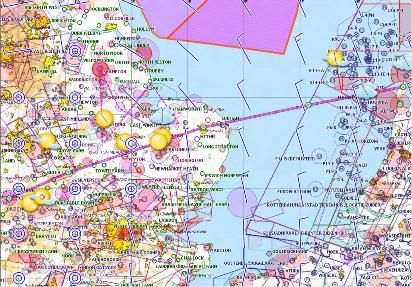
The route from Gloucester to Texel
As forecast, the weather was much better on the Sunday than the Saturday. METAR's were good for Texel and the cumulus was scattered at 4500' over the land and almost certainly minimal over the sea (as it tends to be on days like this), pretty severe CAVOK, but starting to get hot already. The plane was still prepped from yesterday, so it was a case of changing the GAR form at Gloucester, re-do the A-check, file the flight plan and away.
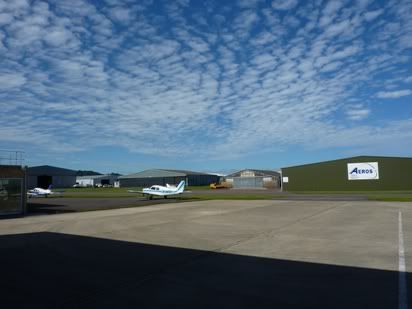
Gloucester weather on Sunday morning
So we saddled up and were away as quickly as we could be as with the bubble canopy of the RV and the bright sun leads to it getting pretty hot real quick until you get some airflow going through the blowers, and the only way to do that is to get airborne.
We climbed en-route to DTY VOR up to 4000', to stay below the tricky 4500' but of category A airspace around the VOR itself, it is very easy to miss this on the chart and we wouldn;'t want to get a nasty letter from the CAA now would we?
It was all pretty scenic then setting track to the overhead of Norwich airport, so we spoke to them out of courtesy and routed through their overhead at 4000'. Once past them, we climbed to FL55 for the North Sea crossing of some 130nm and coasted out and switched to Anglia Radar on 125.275 who gave us a transponder squawk.
We would obviously be well out of glide to land range in the event of engine failure, but at that height we would have plenty of time to get organised and get a good Mayday off if it came to it. We were of course suitably equipped, wearing lifejackets, I had a seat belt cutter and the PLB secured to my belt. There was a liferaft in the back that the passenger would reach and hold etc.
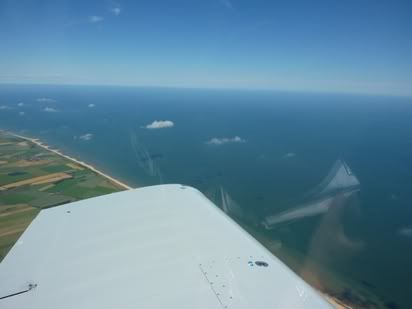
Coasting out over the North Sea near Norwich
The sea crossing was uneventful as we approached the FIR boundary at RAVLO. Anglia Radar gave us a handover to Amsterdam Information, who gave us a new squawk for the transponder. Amsterdam confirmed that the military danger areas we would be passing alongside were all 'cold' and we started a cruise descent to get in below the cumulus that hugged the land from about 15 miles out.
I switched to Texel Radio at 10nm out and built a picture of what was going on there in my head. The main grass runway of over 1000m was in use in direction of 22. The wind was giving a bit of a crosswind from the right, but nothing much to worry about.
We coasted in over the island and set about trying to spot the airfield. It is always a bit of a challenge to spot grass airfields and this was made a little more difficult as they definitely did NOT want you anywhere near the overhead as they had a lot of parachuting taking place. I did spot it and set myself up for a left crosswind join for 22.
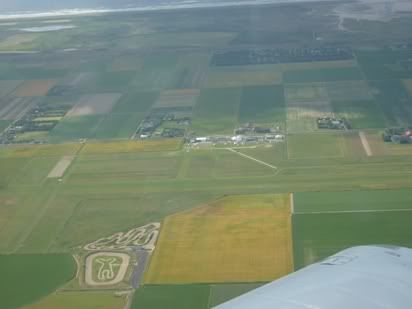
Texel Airfield (not obvious)
I tucked in behind another aircraft in the downwind and turned base and started slowing the plane down to deploy flaps. All going well and descent started, nicely spaced from the aircraft in front now on short final. Lined up on final with two stages of flap and speed where it should be. Then a PA28 at the hold lines up on the runway just as the plane I was following flares, then because the plane landing took a while to trundle off the runway, the aircraft sat on the runway to take off was blocking me and forced me to go around - thanks buddy - you knew I was there, what were you thinking!
OK, go around and this time I am following a motor glider (oh great), well I just couldn't stop from gaining on him, so again on final, even thoughb he was doing a touch and go, I decide to go around again rather than orbit in the circuit or try a land-after.
Texel Radio are by now feeling sorry for me and suggest a 'short circuit' to cut in front of the motor glider. I need no more encouragement, so pull around into a tight racetrack type circuit at probably 600' and position on final for the third time.
This time I get a clear run and flare and touch nicely for my first landing in both Holland and Texel! We trundle clear and ask for fuel. We are directed straight to the fuel pumps in front of the tower. I shutdown as quickly as I can as we are really cooking in the cockpit now, and I gratefully pop the canopy.
Refuelling is easy enough and we are soon joined by a few other RV owners who want to have a look and a chat. I go through the usual slightly embarassing explanations. No I didn't build it, it was originally built in Canada. No, I didn't fly it around the world, that was one of the other group members, Manuel, who now has a book out about it. etc.
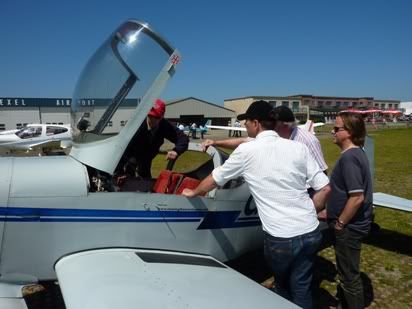
Other RV owners descend on us at Texel
We park up and head for some much needed refreshment at the airport cafe, which is buzzing, but service is surprisingly prompt and the food good.
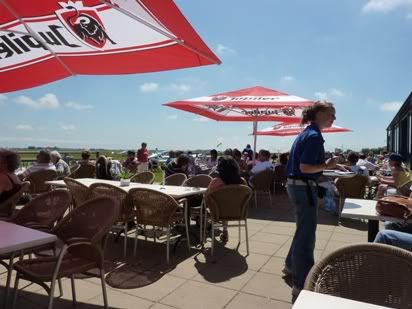
The busy but efficient airport cafe
I make my way to the tower and receive a very friendly greeting. The guys there can't do enough and they even apologise for the number of go-arounds I had to make. They said that the PA28 captain was a vastly experienced instructor and he was mortified at making us go around, he just diodn't think the landing aircraft would take as long as it did to vacate!
They have both an internet PC and WiFi in the tower for planning, so we check the weather for the next leg to Flensburg. Texel looks like a really nice place to stay and they offer us all sorts of help in the tower, from finding suitably priced accommodation to bicycle hire. They are excellent ambassadors for the island and I must come back here to stay for a few days sometime.
Texel to Flensburg
Route: EHTX COAST ISLANDS DCT WILHELMSHAVEN BEDERKESA DCT EDXM DCT EDXF
Capacity: SNY (Self-loading freight!)
This route was flown by the other group member, basically along the line of the very scenic Frisian islands, then cutting across the narrow bits of the Weser and Elbe estuaries in Germany. All of this was flown at around 2000'.
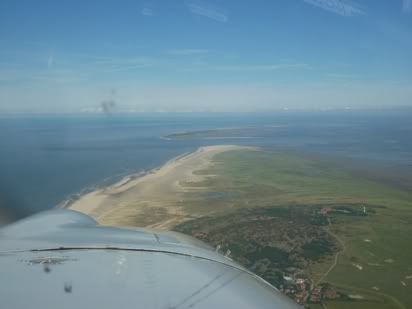
Hopping along the many Frisian Islands
I have to say that this part of Germany is definitely 'wind turbine central' with loads of them either in place of being built.
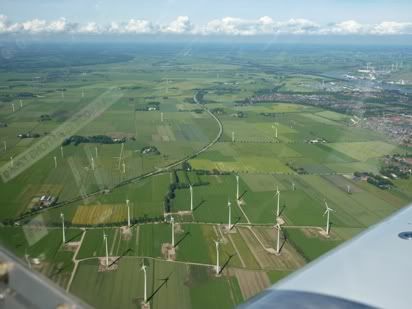
Northern Germany - wind turbine central!
We approached Flensburg at around 17:00 local and the airfield was pretty easy to spot. Again they do parachuting, so don't try any overhead stuff.
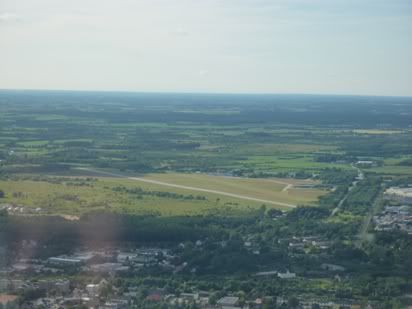
Flensburg airfield in Germany - EDXF
The airfield was very quiet, but friendly. We bumped into some locals who had just got back to Flensburg from a tour of their own to Denmark and picked up a few tips, like if there is no one on the published frequency or it is after hours, just land, they are quite happy (unlike both Germany and the UK!). They also gave us a lift to our cheap out-of-town Etap hotel.
We got freshened up and took a taxi into town. Flensburg is a small city / town. the most scenic bit is along the harbour and there is an excellent micro brewery there (Hansens) which also serves really good food, that certainly sorted ot our personal refuelling needs.
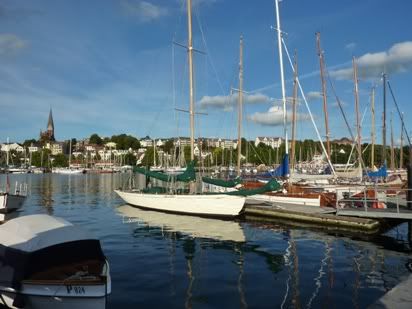
Flensburg at the harbour front
Well, we were off on the tour good and proper now, albeit one day behind schedule. As we had accommodation already booked and too late to cancel in Goteborg, we decided to skip Aalborg tomorrow and do two legs to get to Goteborg and back on the planned schedule.
Note to self: Don't book things that can't be cancelled same day, just take a chance and ask at the airport on arrival, they can usually sort you out.
Gloucester to Texel
Route: EGBJ DCT DTY DCT NORWICH DCT RAVLO DCT EHTX
Capacity: P1 (Pilot)
Logged time: 2.3 hours
The route from Gloucester to Texel
As forecast, the weather was much better on the Sunday than the Saturday. METAR's were good for Texel and the cumulus was scattered at 4500' over the land and almost certainly minimal over the sea (as it tends to be on days like this), pretty severe CAVOK, but starting to get hot already. The plane was still prepped from yesterday, so it was a case of changing the GAR form at Gloucester, re-do the A-check, file the flight plan and away.
Gloucester weather on Sunday morning
So we saddled up and were away as quickly as we could be as with the bubble canopy of the RV and the bright sun leads to it getting pretty hot real quick until you get some airflow going through the blowers, and the only way to do that is to get airborne.
We climbed en-route to DTY VOR up to 4000', to stay below the tricky 4500' but of category A airspace around the VOR itself, it is very easy to miss this on the chart and we wouldn;'t want to get a nasty letter from the CAA now would we?
It was all pretty scenic then setting track to the overhead of Norwich airport, so we spoke to them out of courtesy and routed through their overhead at 4000'. Once past them, we climbed to FL55 for the North Sea crossing of some 130nm and coasted out and switched to Anglia Radar on 125.275 who gave us a transponder squawk.
We would obviously be well out of glide to land range in the event of engine failure, but at that height we would have plenty of time to get organised and get a good Mayday off if it came to it. We were of course suitably equipped, wearing lifejackets, I had a seat belt cutter and the PLB secured to my belt. There was a liferaft in the back that the passenger would reach and hold etc.
Coasting out over the North Sea near Norwich
The sea crossing was uneventful as we approached the FIR boundary at RAVLO. Anglia Radar gave us a handover to Amsterdam Information, who gave us a new squawk for the transponder. Amsterdam confirmed that the military danger areas we would be passing alongside were all 'cold' and we started a cruise descent to get in below the cumulus that hugged the land from about 15 miles out.
I switched to Texel Radio at 10nm out and built a picture of what was going on there in my head. The main grass runway of over 1000m was in use in direction of 22. The wind was giving a bit of a crosswind from the right, but nothing much to worry about.
We coasted in over the island and set about trying to spot the airfield. It is always a bit of a challenge to spot grass airfields and this was made a little more difficult as they definitely did NOT want you anywhere near the overhead as they had a lot of parachuting taking place. I did spot it and set myself up for a left crosswind join for 22.
Texel Airfield (not obvious)
I tucked in behind another aircraft in the downwind and turned base and started slowing the plane down to deploy flaps. All going well and descent started, nicely spaced from the aircraft in front now on short final. Lined up on final with two stages of flap and speed where it should be. Then a PA28 at the hold lines up on the runway just as the plane I was following flares, then because the plane landing took a while to trundle off the runway, the aircraft sat on the runway to take off was blocking me and forced me to go around - thanks buddy - you knew I was there, what were you thinking!
OK, go around and this time I am following a motor glider (oh great), well I just couldn't stop from gaining on him, so again on final, even thoughb he was doing a touch and go, I decide to go around again rather than orbit in the circuit or try a land-after.
Texel Radio are by now feeling sorry for me and suggest a 'short circuit' to cut in front of the motor glider. I need no more encouragement, so pull around into a tight racetrack type circuit at probably 600' and position on final for the third time.
This time I get a clear run and flare and touch nicely for my first landing in both Holland and Texel! We trundle clear and ask for fuel. We are directed straight to the fuel pumps in front of the tower. I shutdown as quickly as I can as we are really cooking in the cockpit now, and I gratefully pop the canopy.
Refuelling is easy enough and we are soon joined by a few other RV owners who want to have a look and a chat. I go through the usual slightly embarassing explanations. No I didn't build it, it was originally built in Canada. No, I didn't fly it around the world, that was one of the other group members, Manuel, who now has a book out about it. etc.
Other RV owners descend on us at Texel
We park up and head for some much needed refreshment at the airport cafe, which is buzzing, but service is surprisingly prompt and the food good.
The busy but efficient airport cafe
I make my way to the tower and receive a very friendly greeting. The guys there can't do enough and they even apologise for the number of go-arounds I had to make. They said that the PA28 captain was a vastly experienced instructor and he was mortified at making us go around, he just diodn't think the landing aircraft would take as long as it did to vacate!
They have both an internet PC and WiFi in the tower for planning, so we check the weather for the next leg to Flensburg. Texel looks like a really nice place to stay and they offer us all sorts of help in the tower, from finding suitably priced accommodation to bicycle hire. They are excellent ambassadors for the island and I must come back here to stay for a few days sometime.
Texel to Flensburg
Route: EHTX COAST ISLANDS DCT WILHELMSHAVEN BEDERKESA DCT EDXM DCT EDXF
Capacity: SNY (Self-loading freight!)
This route was flown by the other group member, basically along the line of the very scenic Frisian islands, then cutting across the narrow bits of the Weser and Elbe estuaries in Germany. All of this was flown at around 2000'.
Hopping along the many Frisian Islands
I have to say that this part of Germany is definitely 'wind turbine central' with loads of them either in place of being built.
Northern Germany - wind turbine central!
We approached Flensburg at around 17:00 local and the airfield was pretty easy to spot. Again they do parachuting, so don't try any overhead stuff.
Flensburg airfield in Germany - EDXF
The airfield was very quiet, but friendly. We bumped into some locals who had just got back to Flensburg from a tour of their own to Denmark and picked up a few tips, like if there is no one on the published frequency or it is after hours, just land, they are quite happy (unlike both Germany and the UK!). They also gave us a lift to our cheap out-of-town Etap hotel.
We got freshened up and took a taxi into town. Flensburg is a small city / town. the most scenic bit is along the harbour and there is an excellent micro brewery there (Hansens) which also serves really good food, that certainly sorted ot our personal refuelling needs.
Flensburg at the harbour front
Well, we were off on the tour good and proper now, albeit one day behind schedule. As we had accommodation already booked and too late to cancel in Goteborg, we decided to skip Aalborg tomorrow and do two legs to get to Goteborg and back on the planned schedule.
Note to self: Don't book things that can't be cancelled same day, just take a chance and ask at the airport on arrival, they can usually sort you out.
VFR Tour 2011: The day that didn't happen
Saturday 25th June 2011
The forecast wasn't good, but it seemed that the weather would clear by midday and we may still be able to get to Texel, but probably only via Calais.
There was initially quite low cloud (1000' max) and fairly high winds. So we packed the plane and prepped it and waiting for the weather to improve.
Improve it did at Gloucester as the sunshine broke through, but still with pretty high winds. But continued looks at the METARs (weather actuals) for various channel and French airfields was far from encouraging as the low cloud seemed to cling to the channel coast.
So by mid-afternoon, we reluctantly called it a day, as the forecast for tomorrow was really very good, and at this stage the best we could hope for was a hop to Calais. I am sure we would have made it, but to what purpose?
Not a great start!
The forecast wasn't good, but it seemed that the weather would clear by midday and we may still be able to get to Texel, but probably only via Calais.
There was initially quite low cloud (1000' max) and fairly high winds. So we packed the plane and prepped it and waiting for the weather to improve.
Improve it did at Gloucester as the sunshine broke through, but still with pretty high winds. But continued looks at the METARs (weather actuals) for various channel and French airfields was far from encouraging as the low cloud seemed to cling to the channel coast.
So by mid-afternoon, we reluctantly called it a day, as the forecast for tomorrow was really very good, and at this stage the best we could hope for was a hop to Calais. I am sure we would have made it, but to what purpose?
Not a great start!
VFR Tour 2011: The Plan
Well the plan was simple. Myself and another pilot from the aircraft group were to fly from Gloucestershire airport in the UK and tour a few destinations in Denmark and south-western Sweden then return home in a week.
As we were going to tour VFR (Visual Flight Rules), we needed weather the was good enough for us to see where we were going, to be able to always see the ground and sensible winds as strong winds and flying a taildragger is not a good combination.
Of course there was slack and spare time planned in and corners we could cut, you simply cannot be rigid with VFR flying as you may well get ‘weathered in’ or have to divert in-flight, but that is all part if the game.
The plan was:
Saturday 25th June 2011
This was to be the main ‘get somewhere’ day, with two legs planned.
Gloucestershire Airport to Texel (Holland) via a 130nm crossing of the North sea if the weather was good enough to allow us 5000’ for the crossing, or the alternate was to fly to Calais, clear customs, then on to Texel, then continue as planned, so a three leg day instead of two.
Texel (Holland) to Flensburg (Germany) which is a couple of miles from the Danish mainland. Stay in Flensburg overnight.
Sunday 26th June 2011
Another two leg day, but shorter legs this time.
Flenburg to Stauning (about halfway up the Danish mainland on the west coast), stop for lunch and peruse the Danish Flight Museum at Stauning.
Stauning to Aalborg, the northern-most major city in Denmark, for an overnight stay and a poke around the city. We had deliberately decided to avoid Copenhagen as a destination as we had both been or were about to go there.
Monday 27th June 2011
One leg, this time from Aalborg in Denmark to Goteborg on the west coast of Sweden, crossing the Kattegat, the stretch of water that separates Denmark from Sweden, about a 35nm sea crossing.
Tuesday 28th June 2011
Non-flying day. Stay around Goteborg and have a look around the city. Hopefully meet uop with a Flyer Forum contact who is also a pilot and we may be able to get an evening sightseeing flight around the city.
Wednesday 29th June 2011
Flying along the western Swedish coast from Goteborg to Hoganas. Hoganas is opposite the narrowest bit of sea that separates Sweden from Denmark.
Thursday 30th June 2011
Hoganas in Sweden to the small island of Samso in Denmark for an overnight stay if we could find accommodation, or if not a second flight to the city of Odense in Denmark on the large island of Fyn.
Friday 1st July 2011
Our return home day with two legs if the weather was good or three if not.
Samso in Denmark to Texel in Holland.
Texel in Holland back to Gloucestershire in the UK.
The alternate was again to route instead from Texel to Calais, then from Calais home.
Saturday 2nd July 2011
Contingency day if required.
Sunday 3rd July 2011
Super contingency day (plane not actually booked and would cause problems with other bookings, but if worst came to worst….
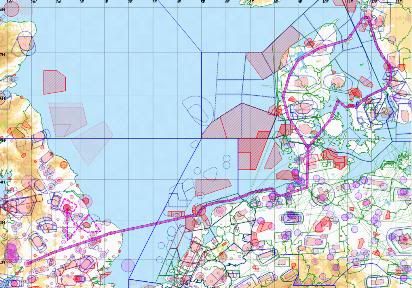
The planned route
Well that was the plan, but then the course of VFR touring in Europe, especially northern Europe rarely runs smoothly does it?
As we were going to tour VFR (Visual Flight Rules), we needed weather the was good enough for us to see where we were going, to be able to always see the ground and sensible winds as strong winds and flying a taildragger is not a good combination.
Of course there was slack and spare time planned in and corners we could cut, you simply cannot be rigid with VFR flying as you may well get ‘weathered in’ or have to divert in-flight, but that is all part if the game.
The plan was:
Saturday 25th June 2011
This was to be the main ‘get somewhere’ day, with two legs planned.
Gloucestershire Airport to Texel (Holland) via a 130nm crossing of the North sea if the weather was good enough to allow us 5000’ for the crossing, or the alternate was to fly to Calais, clear customs, then on to Texel, then continue as planned, so a three leg day instead of two.
Texel (Holland) to Flensburg (Germany) which is a couple of miles from the Danish mainland. Stay in Flensburg overnight.
Sunday 26th June 2011
Another two leg day, but shorter legs this time.
Flenburg to Stauning (about halfway up the Danish mainland on the west coast), stop for lunch and peruse the Danish Flight Museum at Stauning.
Stauning to Aalborg, the northern-most major city in Denmark, for an overnight stay and a poke around the city. We had deliberately decided to avoid Copenhagen as a destination as we had both been or were about to go there.
Monday 27th June 2011
One leg, this time from Aalborg in Denmark to Goteborg on the west coast of Sweden, crossing the Kattegat, the stretch of water that separates Denmark from Sweden, about a 35nm sea crossing.
Tuesday 28th June 2011
Non-flying day. Stay around Goteborg and have a look around the city. Hopefully meet uop with a Flyer Forum contact who is also a pilot and we may be able to get an evening sightseeing flight around the city.
Wednesday 29th June 2011
Flying along the western Swedish coast from Goteborg to Hoganas. Hoganas is opposite the narrowest bit of sea that separates Sweden from Denmark.
Thursday 30th June 2011
Hoganas in Sweden to the small island of Samso in Denmark for an overnight stay if we could find accommodation, or if not a second flight to the city of Odense in Denmark on the large island of Fyn.
Friday 1st July 2011
Our return home day with two legs if the weather was good or three if not.
Samso in Denmark to Texel in Holland.
Texel in Holland back to Gloucestershire in the UK.
The alternate was again to route instead from Texel to Calais, then from Calais home.
Saturday 2nd July 2011
Contingency day if required.
Sunday 3rd July 2011
Super contingency day (plane not actually booked and would cause problems with other bookings, but if worst came to worst….
The planned route
Well that was the plan, but then the course of VFR touring in Europe, especially northern Europe rarely runs smoothly does it?
Monday, June 13, 2011
Throckmorton and 'Help for Heroes'
An ex-member of our aircraft group unexpectedly got in touch with me three months ago and asked if I would be interested in flying in to the disused Throckmorton airfield near Pershore for a Help for Heroes day. Well I wasn’t about to pass up the chance to go to an airfield that I hadn’t been to, especially one where you are not normally allowed to land, so of course I said yes. The day of the show arrived on Saturday and I invited Neil along as we need to get used to flying together for our coming big trip to Denmark and Sweden.
I checked the plane out nice and early at Gloucester. I find it relaxing to be able to do this in a leisurely fashion as you don’t miss anything and it helps to set the tone for the coming flight, especially if you do not feel rushed or pressured. The plane was in good shape and the paintwork felt good, it had obviously been properly polished (we pay for this to be done once a month or so). Neil helped as we wheeled the plane out of the hangar, then I booked out with Gloucester as usual.
A trip to the pumps was necessary, so I took advantage of this and made sure that we had the sort of overall load we will be using in our touring at the end of June, just to get used to the weight and handling of the plane at these weights. The weather was excellent, scattered cumulus with minimal wind, but the forecast was for the Cu to build and to have scattered showers from midday onwards, with the sort of gusts associated with showery Cu’s.
Suitably refuelled, we carried out power checks and called ready for departure. The circuit was quiet and we were cleared for a right turnout after noise abatement on 27, then en-route to the north north east to Throckmorton, a mere 20 miles of so distant – by the time I levelled out in the cruise, it would be time to start the descent! Lined up and power up and we trundle away. I get the tail up and ‘feel’ for the direction with the rudder bars. I hold her down as she starts hopping on the runway, then ease off and she pretty much flies herself off, no positive ‘rotate’ action as such really. I wait until the end of the runway, then put in the required ten degree noise abatement turn and start a moderate climbing turn onto track.
I get up to 2000’ and start to establish the plane in the cruise, remembering that we are still running it at a fairly high power of 65% as we are still running in one of the cylinders. By the time we finish changing frequencies and getting settled in the cruise, we can see past Bredon Hill and can definitely see Defford disused airfield. From that landmark, at about 2 o’clock we can make out what must be Pershore, then from there, we look again at 2 o’clock and see what I am pretty sure must be Throckmorton. I keep my eye on that as I change frequency and try the special frequency allocated for the day with the call-sign Pershore Radio (although why we think in the UK that we must have a frequency and speak to someone at an airfield eludes me, the US system of self-announcing on a UNICOMM of MULTICOMM, then each pilot sorting themselves out vis-à-vis each other just works and works really well, we would do well to emulate this!).
I get no response to my initial three calls, but they may be on a low powered Icom, so we continue. I hear another plane coming in from Wellesborne direction also calling Defford on the same frequency, but he seems to be speaking instead to another ground station who was clearly annoyed that someone was using ‘his’ frequency (I rest my case!). As we close in to the overhead, I hear no other traffic and the Wellesborne one is still several miles out. I can see the airfield clearly now, it is the classic three triangular runway wartime type configuration. Two of the runways are being used for the show and only a small part of runway 08 / 26 is being used (pretty much the bit between where the two other runways intersect) giving about 550m of runway, short by some standards, but plenty long enough for the RV, even if heavily laden.
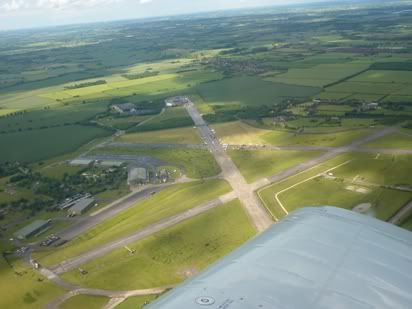
Throckmorton airfield, runway at the bottom between the intersection of the other two
I try the radio again and this time get a response. I am given the runway in use (26 as I expected) and the QFE. I decide to join high along the runway at 1500’, then descend onto left crosswind etc. This will allow me to see a bit of the runway, only part of which is in use. I fly along and note what Lyndon had said, that one of the biggest landfill sites in the area is located to the south, with an attendant massive bird strike hazard. As this is in the direction of the circuit, I make a point of flying quite a wide circuit so I can get well outside the dump. I give position calls on every leg and turn base. Power down a lot and bleed the speed off to the flap limiting speed. Click on two stages of flaps and stabilise the speed and descent.
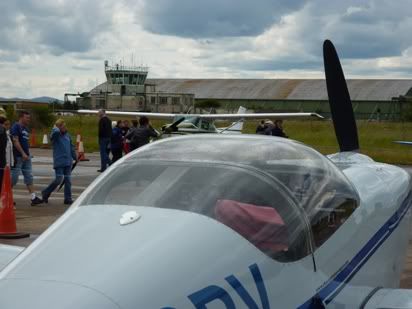
G-GDRV on the ground at Throckmorton
Turning final for 26 now and the picture is good. I note a few cones on the runway (it is technically a disused airfield after all, although local rumour has it that there are strange Hercules night flights there from time to time) which mark the rough ‘displaced threshold’ area. Do I am aiming for a small part of the runway a good one-third into the actual runway concrete. Speed good, picture good. Keep it coming down. OK, chop the power and round out. Hold her off, stall warner starting to pip. Hold her off more, settling a bit, off a bit more. Stall warner constant now. She touches, slightly tailwheel first. Mains down, feeling a little light, not a bounce, not even a hop really, just floating slightly, hold off more and we are definitely down for what in the RV must qualify as a smooth landing – I am tickled with that!
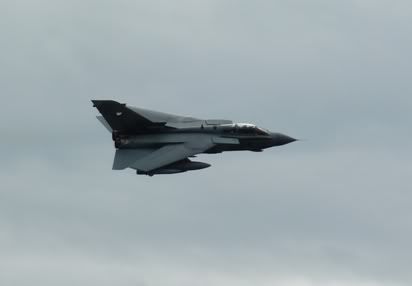
A Tornado flyby - noisy!
We are marshalled (as expected) very professionally to the static display line of aircraft. We are only the second to arrive. We trundle in and shutdown where indicated. A very short flight, but lots of fun as you are obviously kept very busy and there is the fun of a ‘new’ airfield, especially one with a limited runway length.
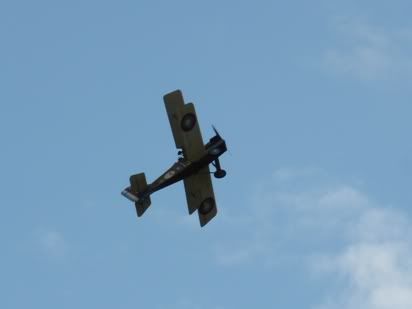
SE5 replica
The show was very well attended with an eclectic mix of displays. Quite a few interesting visiting and displaying aircraft, including two scaled SE5 biplanes, a Stearman, an RAF ‘Huey’, two Belgian Air Force Augusta’s, a couple of Chippes, etc. There were also static displays from a Triumph TR car club, loads of gleaming HGV’s, Fire engines and police static displays (Throckmorton is some sort of police centre), vintage and current military vehicles and battle tanks etc. There was of course an air display, with the SE5’s, Brendan O’Brien and his crazy antics in the Cub, a Cap 10 doing aerobatics, a paid of Twisters doing synchronised aerobatics etc. We had a flyby by two Tornados, a Spitfire and a Seafire.
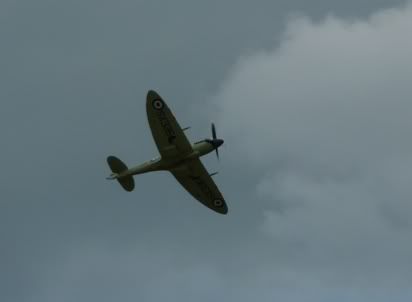
Seafire flyby
All in all a really nice day, with a weird mix of things going on. We both contributed generously to Help for Heroes, I can at least spare the sort of landing fee I would otherwise pay! There were two convincing showers, and we chose to huddle in the RV with the canopy down.
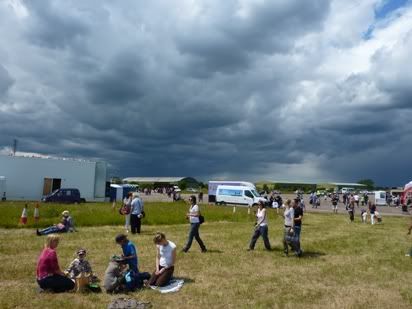
Armageddon is on it's way!
Neil flew back once we were cleared to leave after the final display at 16:30. All the departing planes sorted themselves out and we chose to leave pretty much last. As a backtrack was involved, we intelligently backtracked three aircraft at a time, then lined up as each departed in turn. It is amazing what pilots can do without being ‘told’ to by someone on the radio you know!
I checked the plane out nice and early at Gloucester. I find it relaxing to be able to do this in a leisurely fashion as you don’t miss anything and it helps to set the tone for the coming flight, especially if you do not feel rushed or pressured. The plane was in good shape and the paintwork felt good, it had obviously been properly polished (we pay for this to be done once a month or so). Neil helped as we wheeled the plane out of the hangar, then I booked out with Gloucester as usual.
A trip to the pumps was necessary, so I took advantage of this and made sure that we had the sort of overall load we will be using in our touring at the end of June, just to get used to the weight and handling of the plane at these weights. The weather was excellent, scattered cumulus with minimal wind, but the forecast was for the Cu to build and to have scattered showers from midday onwards, with the sort of gusts associated with showery Cu’s.
Suitably refuelled, we carried out power checks and called ready for departure. The circuit was quiet and we were cleared for a right turnout after noise abatement on 27, then en-route to the north north east to Throckmorton, a mere 20 miles of so distant – by the time I levelled out in the cruise, it would be time to start the descent! Lined up and power up and we trundle away. I get the tail up and ‘feel’ for the direction with the rudder bars. I hold her down as she starts hopping on the runway, then ease off and she pretty much flies herself off, no positive ‘rotate’ action as such really. I wait until the end of the runway, then put in the required ten degree noise abatement turn and start a moderate climbing turn onto track.
I get up to 2000’ and start to establish the plane in the cruise, remembering that we are still running it at a fairly high power of 65% as we are still running in one of the cylinders. By the time we finish changing frequencies and getting settled in the cruise, we can see past Bredon Hill and can definitely see Defford disused airfield. From that landmark, at about 2 o’clock we can make out what must be Pershore, then from there, we look again at 2 o’clock and see what I am pretty sure must be Throckmorton. I keep my eye on that as I change frequency and try the special frequency allocated for the day with the call-sign Pershore Radio (although why we think in the UK that we must have a frequency and speak to someone at an airfield eludes me, the US system of self-announcing on a UNICOMM of MULTICOMM, then each pilot sorting themselves out vis-à-vis each other just works and works really well, we would do well to emulate this!).
I get no response to my initial three calls, but they may be on a low powered Icom, so we continue. I hear another plane coming in from Wellesborne direction also calling Defford on the same frequency, but he seems to be speaking instead to another ground station who was clearly annoyed that someone was using ‘his’ frequency (I rest my case!). As we close in to the overhead, I hear no other traffic and the Wellesborne one is still several miles out. I can see the airfield clearly now, it is the classic three triangular runway wartime type configuration. Two of the runways are being used for the show and only a small part of runway 08 / 26 is being used (pretty much the bit between where the two other runways intersect) giving about 550m of runway, short by some standards, but plenty long enough for the RV, even if heavily laden.
Throckmorton airfield, runway at the bottom between the intersection of the other two
I try the radio again and this time get a response. I am given the runway in use (26 as I expected) and the QFE. I decide to join high along the runway at 1500’, then descend onto left crosswind etc. This will allow me to see a bit of the runway, only part of which is in use. I fly along and note what Lyndon had said, that one of the biggest landfill sites in the area is located to the south, with an attendant massive bird strike hazard. As this is in the direction of the circuit, I make a point of flying quite a wide circuit so I can get well outside the dump. I give position calls on every leg and turn base. Power down a lot and bleed the speed off to the flap limiting speed. Click on two stages of flaps and stabilise the speed and descent.
G-GDRV on the ground at Throckmorton
Turning final for 26 now and the picture is good. I note a few cones on the runway (it is technically a disused airfield after all, although local rumour has it that there are strange Hercules night flights there from time to time) which mark the rough ‘displaced threshold’ area. Do I am aiming for a small part of the runway a good one-third into the actual runway concrete. Speed good, picture good. Keep it coming down. OK, chop the power and round out. Hold her off, stall warner starting to pip. Hold her off more, settling a bit, off a bit more. Stall warner constant now. She touches, slightly tailwheel first. Mains down, feeling a little light, not a bounce, not even a hop really, just floating slightly, hold off more and we are definitely down for what in the RV must qualify as a smooth landing – I am tickled with that!
A Tornado flyby - noisy!
We are marshalled (as expected) very professionally to the static display line of aircraft. We are only the second to arrive. We trundle in and shutdown where indicated. A very short flight, but lots of fun as you are obviously kept very busy and there is the fun of a ‘new’ airfield, especially one with a limited runway length.
SE5 replica
The show was very well attended with an eclectic mix of displays. Quite a few interesting visiting and displaying aircraft, including two scaled SE5 biplanes, a Stearman, an RAF ‘Huey’, two Belgian Air Force Augusta’s, a couple of Chippes, etc. There were also static displays from a Triumph TR car club, loads of gleaming HGV’s, Fire engines and police static displays (Throckmorton is some sort of police centre), vintage and current military vehicles and battle tanks etc. There was of course an air display, with the SE5’s, Brendan O’Brien and his crazy antics in the Cub, a Cap 10 doing aerobatics, a paid of Twisters doing synchronised aerobatics etc. We had a flyby by two Tornados, a Spitfire and a Seafire.
Seafire flyby
All in all a really nice day, with a weird mix of things going on. We both contributed generously to Help for Heroes, I can at least spare the sort of landing fee I would otherwise pay! There were two convincing showers, and we chose to huddle in the RV with the canopy down.
Armageddon is on it's way!
Neil flew back once we were cleared to leave after the final display at 16:30. All the departing planes sorted themselves out and we chose to leave pretty much last. As a backtrack was involved, we intelligently backtracked three aircraft at a time, then lined up as each departed in turn. It is amazing what pilots can do without being ‘told’ to by someone on the radio you know!
Sunday, May 15, 2011
Shobdon
I had tried twice since my last flight to go flying at the weekends, only to be frustrated by the weather. Both times it was cloudy and threatening rain with very high winds. I booked the Saturday as a joint flight with one of the other group members, hoping for good weather and maybe a longer run to say Plymouth, where he would fly pone leg and I would fly the other.
Well, the weather still didn’t want to play ball. We turned up and if was broken cumulus with maybe the odd small gap in the cloud, but quite windy. The forecast wasn’t great and the wind was from the west or slightly to the north west. That ruled out a few of the airfields we looked at as they were single runway and generally oriented to the south west. I didn’t fancy taking on 10-15 kt crosswinds if I could avoid it, se we decided to stay closer to home and go to good old Shobdon again.
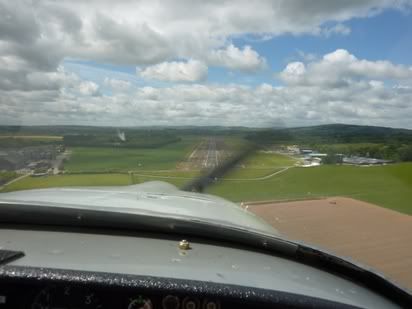
Final on 27 at Shobdon
I checked the plane while Neil got the now essential PPR after Shobdon got a b*ll*cking from the CAA for being ‘overloaded’, especially with the helicopter training now taking place at the airfield. Neil flew the leg going out and I flew coming back. The wind at Gloucester on take off was being given as 310 / 10, but it seemed stronger than that. At Shobdon, we indulged in lunch and had a chat with a few of the members of the G-EGBS RV12 group, as they spotted us landing in our ‘world famous’ RV6 (nowt to do with me, all down to Manuel who flew around the world in it).
They have a very interesting aircraft in that it is equipped with a Wilksch 3 cylinder 2 stroke engine that runs on Jet A1. In truth it is underpowered for the RV and gives a mere 110 kts in the cruise. But it does run on far cheaper fuel and even then barely sips that. They do have problems with the pre-combustion chambers and have to replace these every 50 hours, although this problem has now been fixed in the latest version of the engine (which also delivers more horse power, now up to a really useful 140 hp!). They also showed us there rather nice home made control lock, something we could definitely use on the RV6 (such are the exciting topics of conversation once pilots really start letting their hair down – boy, we really know how to party!). I can’t help but think that AVTUR engines are the way forward as AVGAS get more expensive and harder to come by at any price, but that time is not yet here. We will know that AVTUR engines have arrived when the notoriously conservative (and probably rightly so) flying schools start to switch over. I would guess this will be in 5 years time or so.
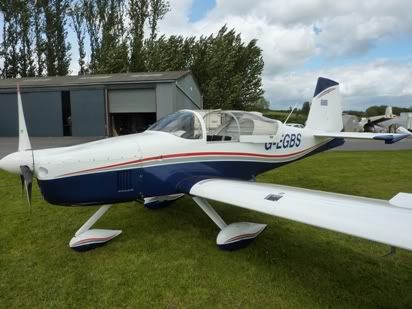
The Wilksch powered RV, a face that only a mother could love!
We also went into one of the hangars to have a look at the restoration work taking place on the Swallow – a very old and early monoplane with huge wings, exposed cockpits and an exposed radial engine.
We clambered in for my flight back. The wind seemed fairly stiff now, but it was at least straight down runway 27. Power checks complete, we waited for the glider tug to tow a glider aloft and for another glider to land on the grass runway. I trundled across to the hard runway, lined up and we were away. Neil used to fly out of Shobdon, so was very familiar with the airfield and helped me on the local noise abatement and to avoid the noise sensitive areas.
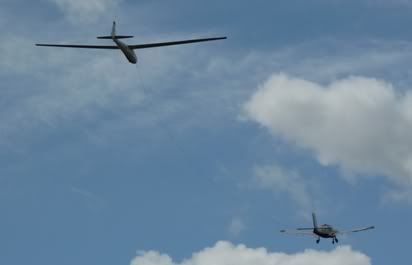
Busy with glider tow launches that day
I set course for Gloucester at around 2800’ as it wasn’t worth climbing to go ‘over’ the clouds for such a short hop. We are still running in the new cylinder, so we are flying the engine fairly hard, at least 65% power, but this is a bit more comfortable than the 75% power we were using for the first 25 hours at least! I diverted a little to the Malverns to have a quick play with them. I called up Gloucester, got the ATIS and was given the standard overhead for 27.
The plane was handling fine and I was feeling quite comfortable, despite not having flown for nearly a month. At three miles we were cleared to the downwind and warned of traffic also joining overhead. Neil and I both spotted the traffic and Neil kept an eye on it as I descended on the deadside (it is very easy to lose sight of the traffic as it appears below the horizon and is easily lost in the ‘ground’. We seemed to be spaced OK. I turned downwind as he was well downwind and tried to slow the RV up some more.
I turned base as he was on final and followed him around slightly further out than I would have flown myself. Power to nearly idle to bleed the airspeed off to the flap limiting speed. Flaps out and turn onto final and settle the airspeed down. The windsock seemed to show the wind only slightly off the centreline. Gloucester were giving 280 / 10, but I swear it seemed to be blowing more than that. I was settled on final as the traffic in front crossed the threshold so I called final. After a pause, I was cleared to ‘land-after’ as it was clear the traffic in front had missed the early turnoff and would roll to the end. I was quite happy to take a land-after as there is stacks of length on 27.
Over the displaced threshold, airspeed a bit above the normal 70kts IAS (the indicator over-reads slightly), so I knew I was in for a fair old hold off. Down and flare and hold off, and off and off. Stall warner starting, don’t let it land yet, make it holler (getting the usual conflicting visual clues from the strong wind where we seem to be crawling along the ground, but of course it is airspeed that matters!). Then we touch and stay touched – OK, pleased with that! I just miss the early turnoff as I don’t want to hammer the brakes and call for a short backtrack which is granted.
We trundle back to the ramp and park up, taking care on taxi doe to the winds. It ain’t over with a taildragger until it’s locked up in the hangar or chocked and tied down (preferably both!).
Nice flight, but a short one. Still it will do for now. Next definite booking is 11th June to Pershore.
Neil and I went into a huddle in Cotswold Aero club planning the route of our joint tour around Denmark and Sweden at the end of June. We got the legs finalised and agreed who would fly what leg and who would plan what leg. We bought all but one of the required Jeppesen charts and Neil will have first go with them and the planning. At home that evening, I finally purchased the full version of Sky Demon and effortlessly planned all of the legs just for fun – boy this program really makes it easy! Looking forward to it already – pray for the weather (as usual)!
Well, the weather still didn’t want to play ball. We turned up and if was broken cumulus with maybe the odd small gap in the cloud, but quite windy. The forecast wasn’t great and the wind was from the west or slightly to the north west. That ruled out a few of the airfields we looked at as they were single runway and generally oriented to the south west. I didn’t fancy taking on 10-15 kt crosswinds if I could avoid it, se we decided to stay closer to home and go to good old Shobdon again.
Final on 27 at Shobdon
I checked the plane while Neil got the now essential PPR after Shobdon got a b*ll*cking from the CAA for being ‘overloaded’, especially with the helicopter training now taking place at the airfield. Neil flew the leg going out and I flew coming back. The wind at Gloucester on take off was being given as 310 / 10, but it seemed stronger than that. At Shobdon, we indulged in lunch and had a chat with a few of the members of the G-EGBS RV12 group, as they spotted us landing in our ‘world famous’ RV6 (nowt to do with me, all down to Manuel who flew around the world in it).
They have a very interesting aircraft in that it is equipped with a Wilksch 3 cylinder 2 stroke engine that runs on Jet A1. In truth it is underpowered for the RV and gives a mere 110 kts in the cruise. But it does run on far cheaper fuel and even then barely sips that. They do have problems with the pre-combustion chambers and have to replace these every 50 hours, although this problem has now been fixed in the latest version of the engine (which also delivers more horse power, now up to a really useful 140 hp!). They also showed us there rather nice home made control lock, something we could definitely use on the RV6 (such are the exciting topics of conversation once pilots really start letting their hair down – boy, we really know how to party!). I can’t help but think that AVTUR engines are the way forward as AVGAS get more expensive and harder to come by at any price, but that time is not yet here. We will know that AVTUR engines have arrived when the notoriously conservative (and probably rightly so) flying schools start to switch over. I would guess this will be in 5 years time or so.
The Wilksch powered RV, a face that only a mother could love!
We also went into one of the hangars to have a look at the restoration work taking place on the Swallow – a very old and early monoplane with huge wings, exposed cockpits and an exposed radial engine.
We clambered in for my flight back. The wind seemed fairly stiff now, but it was at least straight down runway 27. Power checks complete, we waited for the glider tug to tow a glider aloft and for another glider to land on the grass runway. I trundled across to the hard runway, lined up and we were away. Neil used to fly out of Shobdon, so was very familiar with the airfield and helped me on the local noise abatement and to avoid the noise sensitive areas.
Busy with glider tow launches that day
I set course for Gloucester at around 2800’ as it wasn’t worth climbing to go ‘over’ the clouds for such a short hop. We are still running in the new cylinder, so we are flying the engine fairly hard, at least 65% power, but this is a bit more comfortable than the 75% power we were using for the first 25 hours at least! I diverted a little to the Malverns to have a quick play with them. I called up Gloucester, got the ATIS and was given the standard overhead for 27.
The plane was handling fine and I was feeling quite comfortable, despite not having flown for nearly a month. At three miles we were cleared to the downwind and warned of traffic also joining overhead. Neil and I both spotted the traffic and Neil kept an eye on it as I descended on the deadside (it is very easy to lose sight of the traffic as it appears below the horizon and is easily lost in the ‘ground’. We seemed to be spaced OK. I turned downwind as he was well downwind and tried to slow the RV up some more.
I turned base as he was on final and followed him around slightly further out than I would have flown myself. Power to nearly idle to bleed the airspeed off to the flap limiting speed. Flaps out and turn onto final and settle the airspeed down. The windsock seemed to show the wind only slightly off the centreline. Gloucester were giving 280 / 10, but I swear it seemed to be blowing more than that. I was settled on final as the traffic in front crossed the threshold so I called final. After a pause, I was cleared to ‘land-after’ as it was clear the traffic in front had missed the early turnoff and would roll to the end. I was quite happy to take a land-after as there is stacks of length on 27.
Over the displaced threshold, airspeed a bit above the normal 70kts IAS (the indicator over-reads slightly), so I knew I was in for a fair old hold off. Down and flare and hold off, and off and off. Stall warner starting, don’t let it land yet, make it holler (getting the usual conflicting visual clues from the strong wind where we seem to be crawling along the ground, but of course it is airspeed that matters!). Then we touch and stay touched – OK, pleased with that! I just miss the early turnoff as I don’t want to hammer the brakes and call for a short backtrack which is granted.
We trundle back to the ramp and park up, taking care on taxi doe to the winds. It ain’t over with a taildragger until it’s locked up in the hangar or chocked and tied down (preferably both!).
Nice flight, but a short one. Still it will do for now. Next definite booking is 11th June to Pershore.
Neil and I went into a huddle in Cotswold Aero club planning the route of our joint tour around Denmark and Sweden at the end of June. We got the legs finalised and agreed who would fly what leg and who would plan what leg. We bought all but one of the required Jeppesen charts and Neil will have first go with them and the planning. At home that evening, I finally purchased the full version of Sky Demon and effortlessly planned all of the legs just for fun – boy this program really makes it easy! Looking forward to it already – pray for the weather (as usual)!
Friday, May 06, 2011
Solway Aviation Museum at Carlisle Airport
I had a road trip planned to Edinburgh for a long weekend with the wife, as she has never been to that lovely city. On the way back, we decided to visit a section of Hadrian’s Wall near Carlisle. On the way to this, I saw signposts to Carlisle Airport. As we came to the turnoff, the car unaccountably turned off the main road and headed towards the airfield – I got a severe ‘rolling of the eyes’ together with a theatrical ‘looking at the watch’ from the war department for that!
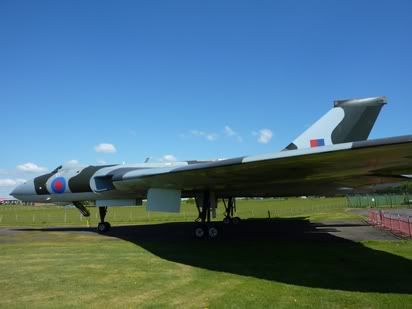
The mighty Avro Vulcan
It was a lovely sunny day, but very windy, not a great day for flying a taildragger with anything other than an into-wind runway, so in some ways, I was pleased that I hadn’t flown in as I would be worrying about the plane being tied down and any later take-off I would have to make (shades of the very sporting wind that I came across in Avignon – aaargh!).
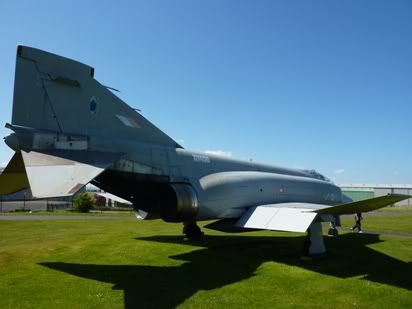
McDonnell Douglas Phantom
As we approached I saw the distinctive outline of an Avro Vulcan bomber and signs to the Solway Aviation Museum - this just gets better and better! I had a quick poke around the entrance to the airfield, then drove to the Vulcan bomber. It was open and encouraged you to climb up inside and sit in the cockpit, but only if you paid at the museum first. So we drove around the corner to the museum and paid a modest £4.50 per person for admission. Unfortunately, I didn’t have much time, so I had to dash around the static exhibition, which I am sure would have warranted at least an hour slowly reading my way around, but I just didn’t have the time. So out into the yard to have a look at the static aircraft on display.
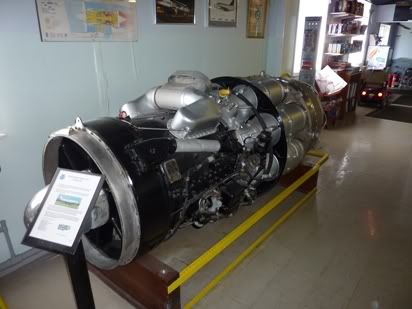
Jet engine
And quite a collection they have too. I had to climb into and sit in the cockpit of the Canberra bomber, the first time I have been so close to this classic jet bomber. The a quick walkaround and photos of the Hawker Hunter, the McDonnell Douglas Phantom (ex-British Navy carrier specimen as indicated by the arrestor hook), the English Electric Lightning, the Vampire, a rather modified and ugly Meteor and a few other bits besides.
Jet engine
English Electric Lightning
I really wasn’t aware that Carlisle airport had a museum and such a good one at that. I would say it was well worth a proper, leisurely visit sometime.
Hadrian’s Wall? Edinburgh? Yeah, they were OK I guess!
The mighty Avro Vulcan
It was a lovely sunny day, but very windy, not a great day for flying a taildragger with anything other than an into-wind runway, so in some ways, I was pleased that I hadn’t flown in as I would be worrying about the plane being tied down and any later take-off I would have to make (shades of the very sporting wind that I came across in Avignon – aaargh!).
McDonnell Douglas Phantom
As we approached I saw the distinctive outline of an Avro Vulcan bomber and signs to the Solway Aviation Museum - this just gets better and better! I had a quick poke around the entrance to the airfield, then drove to the Vulcan bomber. It was open and encouraged you to climb up inside and sit in the cockpit, but only if you paid at the museum first. So we drove around the corner to the museum and paid a modest £4.50 per person for admission. Unfortunately, I didn’t have much time, so I had to dash around the static exhibition, which I am sure would have warranted at least an hour slowly reading my way around, but I just didn’t have the time. So out into the yard to have a look at the static aircraft on display.
Jet engine
And quite a collection they have too. I had to climb into and sit in the cockpit of the Canberra bomber, the first time I have been so close to this classic jet bomber. The a quick walkaround and photos of the Hawker Hunter, the McDonnell Douglas Phantom (ex-British Navy carrier specimen as indicated by the arrestor hook), the English Electric Lightning, the Vampire, a rather modified and ugly Meteor and a few other bits besides.
Jet engine
English Electric Lightning
I really wasn’t aware that Carlisle airport had a museum and such a good one at that. I would say it was well worth a proper, leisurely visit sometime.
Hadrian’s Wall? Edinburgh? Yeah, they were OK I guess!
Subscribe to:
Posts (Atom)