Saturday, October 20, 2007

Aerobatics - Spinning

Well the weather was perfect for aerobatics today. High pressure (1034 mb!) and clear(ish) skies, bit hazy but probably fine above the inversion.

I rocked up at the airport to find a TV camera and loads of police wandering around. At first I thought it might be some sort of minor VIP arriving, but as I was checking the plane out, three police wandered past airside, so I asked them what was going on – ‘There’s a protest at the proposed runway extension and we think they might try a runway incursion’. What? All because Gloucester are extending the runway by some 20 metres and bulldozing the house at one end of the runway so they can get back some of the displaced threshold? Just how wrong can local NIMBY’s and so-called environmentalist’s get their facts? The will never be any 737’s in garish orange livery at Gloucester – chill! The runway is simply and never will be long enough!

Anyway, I check the plane and despite a clear note in the booking folder to leave it half-full maximum, some ‘helpful’ joker had filled it to the brim, thus making it too heavy for controlled aerobatics. I met Max and gave him the bad news, but he took it well – and in his finest Gloucestershire burr said ‘I knew that would happen sooner or later – but that’s OK, we can do spinning instead’. Apparently, the Robin won’t spin with less that ¾ of a tank.

So I had a good briefing from Max. The Robin is apparently very marginal and very hard to spin properly, so far so good I guess? Then he goes on to explain ‘…..and if you DO get it into a spin and hold it in for more than three rotations, the engine cuts out, so you have to exit the spin and restart the engine’!!!! Uhhhh – is it just me or doesn’t that sound too good? ‘Oh, it’s no problem, just press the restart button and it gets going again fine’. Yeah right!

So it also spins better to the right than to the left and if you don’t get it right, it will go into a spiral dive – c’mon Max, you’re just trying to cheer me up now!

So we go through the spin entry, which is power to 1800 and pull back in classic ‘slow flight’ manner until the stall warner, then progressive right rudder and pull fully back and away she goes. Hold it in the spin with rudder and back pressure, then recover on his command, probably after two rotations so the engine doesn’t cut by power off, then full (or near full) opposite rudder and unload the back pressure on the stick to neutral – wait for the spin to stop then pull to level - don’t push forward or you will push it past the vertical. Oh, and look up to the horizon to establish the spin direction, NOT along the line of the nose or you will get a ‘plug-hole’ effect and get mesmerised by the spin. Oh yes, and things will happen pretty quickly.
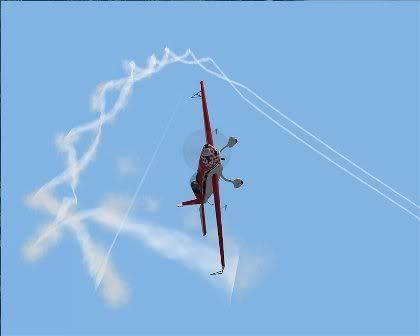
OK - so it's and Extra 300 - but you get the idea!

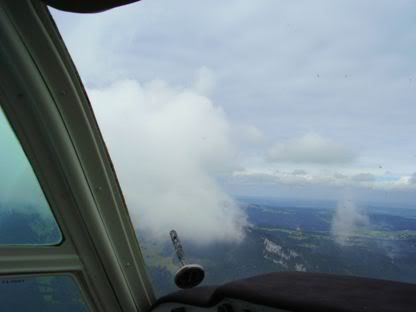
OK, got all that as I mount up. We trudge out the long march to runway in use 09 and take-off. She flies herself off as I set course to the north east for our favourite stomping ground around Evesham. Climb past the inversion layer at 3500’ to 5000’. A few puffy cumulus along the inversion layer, but some big clearings so no worries.

Usual HASELL checks and Max demonstrates the first one and talks it calmly through. All I can say is ‘Holy cr*p Batman’ as the world rotates rapidly around me with us in a steeply nose down position as I watch the ‘plug-hole effect exactly like he told me not to do – DOH!

‘OK – did you follow all that’ he asks as he climbs back up to height and explains what he did, when and why as I try desperately to clear my head and figure out what the hell happened – my first spin – WOW! ‘OK – do you fancy a go’ he asks about as casually as you would if you had just shown someone something on a spreadsheet! Someone else in the cockpit with a voice very similar to mine answered with a confident sounding ‘Yep – let’s give it a crack eh?’ – can’t have been me, I was still trying to figure out what the hell happened!

So I give it a go. A bit slower and more considered on the controls with a more sluggish entry and exit and some intervention from Max as a result. But I did the right things in the right sequence and even managed to look in the right direction this time, so I get the idea.

Anyway, we do a total of three (or maybe four) to the right then three to the left. I have to say, I really think I got it in the end there and began to lose my fear (but not my respect) for the spin and the recovery.

The cloud is starting to box us in and we are still with ¾ fuel – so no quick aeros, instead a steady crawl back to Gloucester for a standard overhead join for 09. Landed long on the runway (as is normal for 09 – or you have a long taxi to the exit and make the guy behind you go-around).

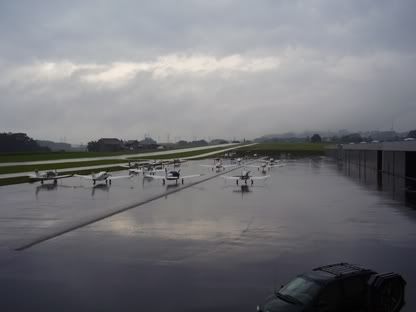
On taxi past the western apron, I noticed four Cabair DA40’s parked in formation. Max explained that on a day like this, the often sent studes out for their QXC one behind the other, so they could ‘follow’ each other on the radio.

Taxi in and shut down. Debrief was good. I really think I got it then and look forward to getting back to ‘normal’ aerobatics next time. But I have to say, I managed to get a nice headache and was wired on adrenaline for the next three hours. Spinning is pretty terrifying at first, but once you have got the hang of it, it’s just another aerobatic manoeuvre, albeit one that chews through the altitude.

Wow – really enjoying this stuff!!!

Monday, October 08, 2007

Aerobatics - Lesson 4.5

Fourth full lesson on aerobatics. The weather didn’t look too clever. Fully overcast, but not too low. Before setting out, I estimated cloudbase at anywhere between 3000’ and 3500’, so could be marginal whether I fly aerobatics or not.

Turned up and saw Max. He said the cloudbase was 3400’ and probably rising as the day wears on, so we should be OK – so out to check out the plane. Filled to just over ‘one tick’ on the gauge (four ticks is full). I checked with Max and he confirmed that with us two larger guys, that would be ideal. Usual start-up, taxy and take-off. Again headed to the ‘aerobatics playground’ to the north-easy, not far from Evesham. Base is at 3600’ but opoor horizon as it is fairly ‘high pressure murky’. Usual HASELL check and off we go.

Rolls
First one not so good, but I think due to a mis-understanding. He had told me earlier to pull up to 45 degrees and that is what I was doing checking the wing angle against the horizon. In fact it should be 30 degrees. Tried again with much better results. Now flying alternate left and right rolls so I don’t become ‘handed’ and always favour one side. I am feeling pretty comfortable with simple ballistic rolls now.

Loops
I am now flying all aspect of the loop, including judging when to pull the power. First loop was not great – I saw a clear roll angle relative to the horizon in the inverted. Max thought I had not pulled straight, apparently a common fault. Next loop was better, but we only just ‘got around’ as I didn’t pull hard enough at the start. It was also interesting as at the top of the loop we entered some cloud! The rest of the loops seemed OK. I think I am starting to get there slowly on these.

Stall Turns
First couple were Max doing the throttle and aileron and telling me when to hit the rudders. They went fine. Then as I hoped for, my turn to do the lot, including deciding when to reverse the rudder.

Off we went. Hard pull up to the vertical, full power then centralise pitch. Check vertical by reference to the angle of the horizon (such as it is) against the wing. Feed in more right rudder as the slipstream coils tighter around the fuselage with reduced airspeed. Am I out of right rudder? What’s next? Oh yes, hard reverse rudder to full left and simultaneous right aileron. Looking for the point at which the aircraft is horizontal (called ‘knife’), before pulling off the power and centralising controls for the vertical dive back down, then…...

……..WHAP!

I think the aircraft was coming around to ‘knife’ when very suddenly the ground and horizon did something very peculiar as it took a second or so to register with me – all I could think is a rather feeble ‘this isn’t normal!’. The aircraft had stalled part-way through and flicked onto it’s back and in a heartbeat we were nose straight down picking up speed. Before I could figure out what was happening and manfully chicken-out with a ‘you have control’, Max stepped in with an ‘I’ll take it’ and recovered.

OK – interesting that one!

Max explained that he had done so many stall turns that he found it fairly hard to deliberately cock them up to show students what to do when it goes ‘pear-shaped’, so he thought the best way was to give me a go! Well any time you want help screwing something up Max, just let me know – I’m your man!

Max explained that what had happened is that I was late in reversing the rudder and not quick enough in the reversal. As a result the aircraft had become too slow and had stalled part way around, flopped over on its back and headed vertically down. Max simply closed the throttle and carried out a standard pull to horizontal. I would probably have got there, but not before the aircraft ‘red-lined’!

OK, learned a lot there! I was thinking too hard and running what I was about to do through in my mind first causing me to be too leisurely about the whole thing. I am somewhat comforted by the AOPA book saying that the stall turn was probably the toughest of the basic moves. Well, I have a lot to learn yet, but got some valuable experience from that one.

On the 15 miles back to the airfield, the fuel light started to blink menacingly. Max was fine with it but did say when it went solid red, get a straight in approach and land immediately. As it happened, we were given a standard overhead join as the scheduled flight to the Isle of Man was landing. Max had me carry out a flapless landing what went pretty well, except that the Robin really does not have much room between the relatively slight nose-up flare required and scraping the tail protector, I can tell you!

Again, another good lesson from my point of view, not my performance you understand, but what I have learned.

Monday, October 01, 2007

Aerobatics - Lesson 3.5

The forecast didn’t look at all promising, but as ever in the UK, you really don’t know until the day itself. Looked out on Sunday morning and saw what looked like alto-stratus, fairly thin and I estimated at least 4000’ – so looks like I am on for aerobatics!

Rolled up for a 10:00 session and Max was on time as usual. Got another brief on – you guessed it, rolls, loops and stall turns!

Checked the aircraft out and cleared out all loose fittings – it wouldn’t do to have a fuel tester loose in the cockpit!

Started up and cleared to taxy. Minimal wind but runway 09 in use. Unusually, it was so quiet at Gloucester (despite the METAR giving CAVOK), that I was given a full backtrack on 09, with approval for power checks on the active runway itself – why so quiet?

Off we went and the Robin quite happily flew itself off as usual. Climbing at 75kts initially and set course for the north east and the lower land between the triangle formed by Bredon Hill, Evesham and Broadway – using the Toddington railway line as a linear feature to line up for the aerobatics.

We made 4000’ easily and I would guess there was another 1500’ before the thin cloudbase.

Rolls
First one not good. I didn’t pull up far enough and was a bit leisurely with full aileron input, so as a result, I was ‘punished’ with a significant nose down exit. On the up side, I knew what I had done wrong before I was half way around. Next roll of course I pulled too much, bled off too much airspeed and yes, nose down exit. But again, I knew what I had done. The next couple were good. Oh well! You learn more from your mistakes etc….

Loops
The first two were with me doing most of it, but with Max pulling the power off as we started to loop back down. Then the third loop, I got to do the whole thing myself – which I thought went well – certainly, I rolled out on the direction of the railway line I started on. I was warned to pay more attention to starting with wings level and pay more attention to keeping it that way.

Stall Turns
He is nursing me into this, and I can certainly see and understand what he is doing. But of course, there are quite a few things to do at the top of the climb in fairly rapid succession. I was doing the pull-ups and the vertical climb. On the last of them, I was whacking in full opposite left rudder when he told me to, to get used to the speed at which you have to do it. I fancy next time I’ll be doing most of it.

All too soon, back to the airfield, calms down a bit and get the ATIS. Given left base approach for 09 not below 1500, and slot in behind the PA28. I saw the PA28, (500’ below) which was a bit too close to slot in behind, so started an orbit. About half way around, there was a flexwing microlight, happy as larry, bimbling along the Severn at 1700’ (yes, inside the ATZ). So keeping a close eye on him, we orbited underneath. Hopefully he realised that bumbling around inside at ATZ of a busy airfield is not such a hot idea.

Back to the circuit and a nice floaty and slow landing, long on 09 to save the long taxy to the end.

Well, probably one step back then two forward this lesson. Rolls were not as good as last lesson until the last two, but then that is the nature of learning – certainly, I can now see what I am doing wrong and correct. I guess I would hate to ‘accidentally’ get it right every time, then when I solo, have it all go pear-shaped.

I will internalise all that I learned during the coming week by ‘flying at the coffee table’ – yep, with my eyes shut, hands on imaginary stick and throttle and feet pressing imaginary rudder bars and mouth mumbling through what I am doing. Give it a try – it really works.

Sunday, September 23, 2007

Aerobatics - Lesson 2.5

Well, this is my third lesson, but the first lesson was only a half hour 'aerobatics experience', so call it 2.5!

The weather behaved again this weekend - just. I rocked up at the airfield watching nice big holes in the cloud disappear and wondered if we were on at all. Checked out G-BGBA, the Robin 2100 and climbed in with my instructor.

We took off from runway 22 at Gloucester and again headed for his favourite training area, the ‘bends in the river’ just south west of Gloucester.

There were no decent sized holes in the overcast, but it was higher than it looked. The Robin climbed gamely on at a stately 500 fpm as we climbed past 3000’. ‘Go for 4000’ if the overcast will let us’ Max said. At 3500’ it was clear that we would have the room and I levelled off at 4000’ with probably a couple of hundred feet to spare – phew!

On the menu today? Well, the basics again – ballistic rolls, loops and stall turns. Max’s way of teaching is to really cement things in and ‘layer’ things on as your confidence and experience grows.

First I do a ballistic roll to the left. I didn’t have enough of a climb angle and pay for it with the ‘sacred circle’ being just below the horizon. So I try again with a much better result. I do a third as Max wonders if it was a fluke, again with good results – I think I have got it, I really do.

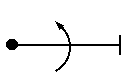
Aresti Roll notation

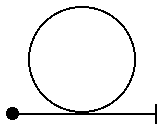
The onto a couple of loops. First with me doing everything except pulling the power back crossing from inverted. He wants me to see when to do this. I spot it, it is basically when the nose of the aircraft passes back through the horizon into the green. We do another the same way. Then we do a third with me pulling the power back. On the last loop there was the distinctive 'bump' as we pulled back up to level flight of the aircraft going through it's own wake - I must be doing something right! I think I am not far from ‘getting’ the loop and feeling more comfortable with it.

Artesti Loop notation

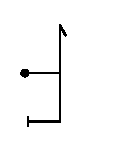
Then we do some stall turns. I do the pull up and fly vertical, then Max takes over and talks me through and hand back control for me to recover to altitude. I can feel what he is doing and I think I understand it. I don’t do one myself this lesson, but I think I will be able to next lesson as the control movements are becoming clearer to me.

Aresti Stall Turn notation

All too soon, we break off and Max give me a good tip – never charge back into the circuit immediately after aerobatics, give yourself 5 or 10 minutes to collect your thoughts and let the adrenaline come down a bit.

Standard overhead join for 22 as I fly the circuit and do one of the characteristic flatter landing in the Robin so as not to tailstrike. The attitude and method is very similar to the floatplane I flew in Canada earlier this year, a bit like a ‘three-pointer’ attitude you might fly in a taildragger. Good landing and taxy back.

I feel I am making progress and that Max will ‘layer’ more on and get me to do more ‘fine tuning’ on the basic moves. If the weather is good next time and we can get to 5000’, maybe some spins!

This aerobatics stuff really is huge fun – I find myself grinning like an idiot all the way home in the car!

Monday, September 17, 2007

More Aerobatics

After my first formal (but somewhat short) aerobatics lesson last weekend, I spent most of the next week in the office looking at perfect flying weather. This year in the UK has been abysmal weather-wise as the jetstream was not forced north in the summer as it usually is until about September! I have been looking forward to my second lesson, where Max said that if the weather was up to it we would do ‘some spinning’.

The weather on Sunday was OK-ish. Quite gusty and varying from scattered but fairly well developed cumulus to near overcast. My lesson was at 16:00, so I made my way to the airfield in the afternoon. The weather looked good enough with a few large ‘holes’ in the cloud we could probably use.

Max arrived and gave me a longer briefing, but not spinning today, we would again concentrate on the basics, loop, roll and a few more stall turns. I had read the book he supplied and we discussed the ‘sacred circle’ that the nose of the aircraft describes relative to the horizon during a roll. A lot more discussion on rudder usage which ties back in to the primary and secondary effect of controls that I learned on the basic PPL – it really comes into its own here as we will be carrying out many moves at low airspeed and high engine power.

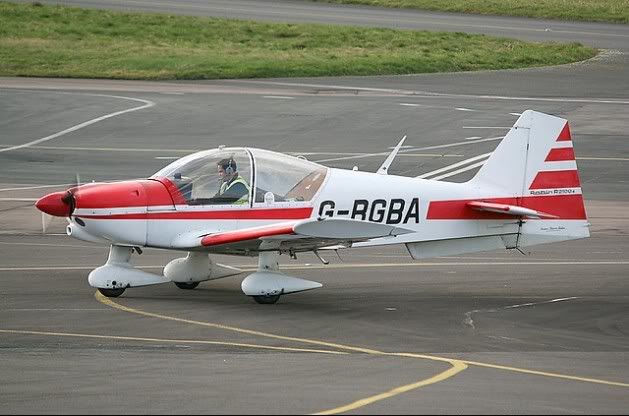
G-BGBA - The Robin 2100 aerobatic trainer

It was the older Robin 2100 this time, G-BGBA. I grabbed a checklist and did a proper ‘by the book’ walkaround. We emptied loose articles in the aircraft (a fuel drain tester loosely stowed in a semi-enclosed shelf would have made a nice missile rattling around the cockpit and would inevitably try to wedge itself in the root of the control stick!).

We climbed in and I started up, again by the book. It is always fun hunting around the panel for unfamiliar switches and uniquely French ways of doing things – this is only the second time I have flown a Robin, so a learning experience until things start to ‘fall to hand’. The aircraft was left half-full of fuel, which put us in the ‘aerobatics’ weight and balance category. So off we trundled.

I was conscious of the fact I was with an instructor, so I deliberately slowed my taxy speed down to the ‘officially approved’ fast walking pace – we all pick up bad habits and I guess a reasonably brisk taxy speed is a common one.

E2 for 22 was the hold as I did the power checks and pre-take off’s. ‘It’s not so much a rotate speed as it starts flying’ Max advised, warning again about avoiding Cessna type angles of attack close to the ground and the likelihood of a tailstrike in the Robin. So off we went, she picked up speed reasonably and as advertised, started to get ‘floaty’ then flew itself off. Climb at 75 kts to 300’ AGL then FEAT – Flaps, Engine, Attitude, Trim.

Climb at 75 kts on extended runway heading, so to the south west over Gloucester. I eventually got to a nice hole in the clouds at 4000’, pretty much over the ‘bends in the river’ on the Severn south-west of Gloucester. A good HASELLL check, transponder to 7004 and we are set to go.

First up is a ballistic roll to the left. This I do with the standard entry to 110 kts, stabalise then pull up to about 45 degrees, check to neutral pitch then ailerons fully over as the ground rotates around me. I looked carefully at the circle described by the nose of the aircraft, some of which was below the horizon. Roll out, regain 110, hard climb as speed bleeds back to 80 kts, then full power and nose down to a full power climb at 70 kts.

A few mistakes to work on. I am not quite getting the nose high enough to start, also I am not properly checking the pitch so enter the roll with back pressure and finally, rolling out a little too soon.

We do a few more over the space of the lesson and I pretty much get it all now, but not 100% yet on checking the pitch. I think it is a lack of confidence that I have attained the correct pitch. The way Max is teaching me is to stick with the basics until I have them through my head, then to ‘layer in’ other stuff until I put it all together. So once I have the ballistic roll off pat, I will go onto barrel roll’s and ailerons rolls and bring in the elements of rudder. Sounds like a good plan.

The loops were great fun. I started doing the pull up to vertical, then Max would take over and talk through what he was doing which I would mimic. By the end of the loops, I was doing all of the stick-work, but Max was still controlling the power. I have got the idea of looking at each wingtip on the pull-up and seem to be pulling up properly (i.e. not favouring one side or the other). I am looking up and over for the reappearance of the ground in the inverted. I have got the hang of easing back to near neutral in the inverted but I am maybe a bit slow to pull out in the vertical downwards.

I realise that Max is not troubling me with rudder inputs, as I can see the effect in the vertical of not doing this. I suspect he will cover this next time as he ‘layer more on’.

Max demonstrates the stall turn probably three or four times. There seems a fair bit to remember here, but I am starting to get the idea of what he is doing and hopefully I won’t cock it up too much when I try it.

Probably to test me out, Max gives me a mild dose of negative ‘G’ with a ‘half Cuban’ – with both of us suspended by the straps inverted for several seconds while bits of dirt and dead flies flutter ‘down’ to the top of the canopy – the quote from Top Gun occurs to me:

‘…….is this your idea of fun Mav?’

OK, this is hardly an F14, but you get the idea! Anyway, no problem with me with negative g.

Max asked me several times if I was OK and explained that repeated g forces make you tired and when tired, your concentration driops off and you learn less etc. I reassure him I am not the least bit tired (too much adrenaline) and I am fine with the g.

We head back to Gloucester and I take the plane for a standard overhead join for 22 and land off right hand circuits. The landing is pretty good and I keep a relatively shallow angle (as opposed to the normal ‘fully stalled’ landing) to avoid tailstrike. I think I am getting a feel for the aircraft, after all it is a pretty simple aircraft, it’s just where everything is and flying a stick as opposed to a yoke.

We taxy back and debrief. Next lesson, next Saturday at 16:00. If the weather is good, spins and if not, then a formal check-out on the type with PFL’s, steep turns, slow flight and circuits etc.

I only hope the weather holds for the next couple of months – probably a forlorn hope!

Thursday, September 13, 2007

Canada Touring?

My ‘bestest buddy in the whole-wide-world’ (so he tells me!) lives in Ottawa. We like to meet up at least once and better still twice a year. Me being a pilot and him a keen wannabe, I also like to tie one of these visits in with some serious touring, a few sights and lots of beer.

For 2008 I may well visit Canada twice, once in February for a week for winter sport (and the famous Ottawa ‘Winterlude’) and maybe for a week in late summer for a flying trip, renting a plane from somewhere in Ottawa. The only snag is that I don’t have a Canadian licence! I have a JAA PPL and a full FAA certificate, but no Canadian one.

The ever useful Flyer Forum helped a lot when I asked for advice. It seemed that the best options were either:

1. Go the JAA route.
2. Go the FAA route.

The JAA route would entail me taking the full Canadian multi-choice Transport Canada exam, then carrying out a full flight skill test.

The FAA route had changed at the end of 2006 and now meant that all I would have to do is shortened exam which focused on the differences between the FAA and Canadian regulations and fill out lots of bits of paper.

No contest – I would go the FAA route. No flight test and cheaper.

My FAA medical is and will be still in date. Only drawback is that I got my FAA ticket over three years ago and am now overdue for a BFR. So what I will do is a BFR here in the UK before Christmas, then sort the formalities at my chosen flying club in Ottawa when I get there in February. I have found a spoke to a suitable FAA examiner here in the UK and he is only in Oxford, so that shouldn’t be a problem. Of course while I am in Ottawa, I will take a plane up anyway (with an instructor) for a bit of fun in February.

This will mean that I will get my Canadian licence sorted out by March 2008, in plenty of time for aircraft hire from Ottawa for late summer 2008.

I have also had an email conversation with Rockcliffe Flying Club who were extremely helpful. The confirmed that I could do all the formalities there and subject to a checkride, could hire one of their C172s for a few days and take it into the USA if I wanted to do this. There is a minimum 3 hours per day but they indicated some flexibility over this.

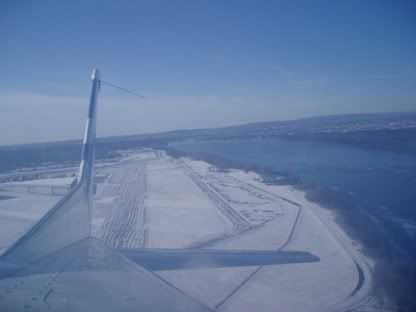
Rockcliffe airfield in winter

So maybe there will be two decent tours for me in 2008, one in Europe with my wife and one in Canada with my buddy.

I don’t want to get ahead of myself here, but I am already dreaming up a roundtrip – maybe the Atlantic provinces of Canada or maybe New York to visit my sister and stooge around the USA and back via Toronto. I’ll talk it through with the guys at Rockcliffe, see if they have any ideas – nice problems to have!

Monday, September 10, 2007

Aerobatics Training

I have been thinking about some formal aerobatics training for some time now. I have flown aerobatics, but only on ‘extra special treat’ type flights on three occasions now. Once, before I learned to fly, in a Jet Provost at Norwich, then once I had passed my PPL, an awesome days flying with Air Combat in LA in an Extra 300. More recently, in a T6 Harvard at Shoreham. That, and the opportunity to fly and be checked out in an aircraft that I haven’t flown yet, proved to be sufficient incentive to give it a go.

Next questions is where? I checked with a few people I know, and they unanimously agreed that ‘Ultimate High’ in Kemble were the dogs b*ll*cks.

I spoke to Ultimate High and yes, they do the AOPA course, but really only as a four day intensive programme on Monday to Thursday, with two sorties a day in a Bulldog. I would have been very happy with this, but just one snag…. I don’t have enough holiday this year and probably won’t next year either!

So plan B. My preferred local flying club, Cotswold Aero Club (based at Gloucester), do the AOPA Basic Aerobatics certificate, albeit in a Robin R2112 (not as nice apparently as a Bulldog). However, I could do this at weekends as and when I could find a training slot, so this looked just the ticket.

I booked what I thought was the first full lesson of the AOPA certificate, but the lady I spoke to assumed I only wanted an ‘aerobatic experience’ and only booked a half hour slot, so that was disappointing, but not the end of the world.

I didn’t see Max first, instead I saw a student he had just finished with (or probably an air-experience ‘victim’) wander unsteadily back to the club looking somewhat the worse for wear. ‘Did you enjoy it?’ his friend asked sticking a video camera into his face from short range, grinning. ‘Uh, yeah, uh sort of, yeah I guess so’ said the ‘victim’ as his eyes wobbled visibly like a cartoon character! ‘I thought it might be cold up there, mebbe I shouldn’t have worn the extra sweatshirt’ he rationalised. Thinks hmmmm….. aerobatics and feeling warm? Not a good combination – I suspect he ‘tossed his cookies’.

My instructor introduced himself as Max and briefed me on the three manoeuvres we would be looking at – the ballistic roll, loop and stall turn. He talked through the limiting RPM (actually a speed at this is not a VP aircraft), the entry technique and what to do at each stage.

Max gently enquires what experience I have and in particular what experience I have had of positive and negative ‘G’. Like a sensible aerobatics instructor, he is digging for how likely I am to ‘toss my cookies’ and therefore how readily available he needs to have a sickbag! I reassure him on this front that I have not yet ‘lost it’ with my limited but relevant aerobatics experience at the hands of a couple of people, including Air Combat USA in the mighty Extra 300 (closes eyes briefly as I think back to that great day two years ago or so).

Then off we went. As I am also new to the Robin, he saved time and started up, taxied out and did the take-off. I took over in the climb as we climbed at a not very impressive 500fpm at 75 kts.

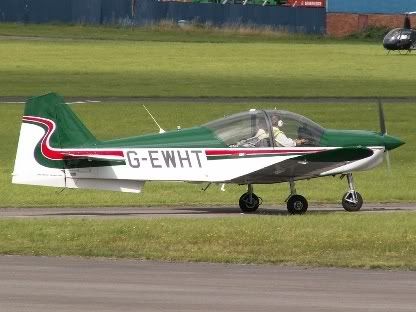
G-EWHT - Robin 2112

We climbed and headed for the best of the weather to the north east around Bredon Hill and Damien Hirst’s house along the Cotswold ridge. He explained that he was cleared for aerobatics to well below 3000’, but that I must treat 3000’ as the ‘hard deck’ and never finish aeros below this height (to allow enough room to recover if it all goes pear-shaped).

We got to altitude and Max first showed me the ballistic roll. He explained that this was not an aileron roll, nor a barrel roll, but a bit of a mixture of the two, with an almost bullet-like movement about the longitudinal axis. First he showed me twice then I copied with a couple of rolls to the left. First the HASELLL check, then standard entry.

Standard entry consists of throttle to 2300 rpm, then nose down attitude to get 110 kts (from a rather stately cruise of 80 kts!), nose up a bit to an attitude that maintains 110 kts – this is basically the standard entry for all the simple manoeuvres I would be trained on.

From the standard entry, nose up sharply then stick fully over to the left and hold while the ground rotates around you (bizarre, but that’s how it feels!). Hold it hard over until the ground is the right way up, then stop the roll. The nose will be down by now and assuming the attitude to maintain 110 kts – so basically back to the standard entry position (this is quite deliberate as it means you can go straight into another manoeuvre in a sequence (altitude permitting of course!).
That was fun. If anything on one of them, he thought I rolled out a bit early, but said that was a typical beginners mistake.

Then onto a loop. He talked me through it again and demonstrated two. I didn’t have a go as we were again tight for time. Instead (probably due to the altitude loss and the time to climb back up) I did another roll.

All too soon, we had to head back. But on the way back, he demonstrated two ‘stall turns’ (aka Hammerhead in the USA). Basically this consists of a standard entry, followed by a pull up to the vertical, with rudder one way and ailerons the other (IIRC) as the plane then turns left or right at the top of the vertical until it is pointed straight down.

WOW!!!!!!! REALLY ENJOYED THAT ONE!!!!!
Unfortunately, that’s all we have time for, so back in the circuit as he hands over to me to land from late downwind. I am initially confused as I have been flying a stick aircraft with my right hand and using the vernier throttle on the left with my left hand (the Robin has two throttle). Now I have to fiddle with trim and carb heat on the right. The trick is apparently to fly aeros with the right hand, but in the circuit with your left hand – OK, cool – all part of learning a different aircraft.

I wander a bit on base as I get the fell for the plane and the power settings, height loss, trim etc. I get set up at the required 65kts approach speed for runway 09. He again warns me NOT to try the ‘nose high – stall buzzer’ landing common in most training aircraft as the Robins are very easy to tail-strike. I land at a shallower angle than normal and as we fast taxi with the nose in the air, Max shows me how easy it is to tail-strike (there is of course a protective tailskid). I am amazed at how easy it is to do – lesson rammed home I guess.

Park up and shut down as he charges off to prep another student, I head back to the clubhouse and complete the logs and bills etc. I get a debrief and book the next lesson – a full one this time next Sunday at 16:00 (very few slots in the aircraft left by then). He says next time, weather permitting, well do spins and spin recovery (which, like most UK PPL’s, I have never done).

I buy a specific aerobatics book that Max prefers from him and of course trot into Transair next door to buy another (the AOPA basic aerobatics book).

THAT’S IT! I’M HOOKED!!!!!
I will do the AOPA basic certificate and aim to do aeros on my own (or with a passenger of course) by renting the Robin, in addition to flying a non-aerobatic share (of course a share in an aerobatic plane that can also tour would be ideal, but none of those at Gloucester – where is a Bulldog when you need one?).

Monday, August 06, 2007

Big Trip 2007 - Reprise

Well, that is my ‘big trip’ for 2007. This year, I had to ‘pivot’ around seeing our friend and neighbour in Lausanne, Switzerland. A quick look at the map for the one week trip showed the options to be limited, given that we wanted to spend at least one, preferably two days in each location and to try to avoid two leg days.

Given these constraints, I decided on Koblenz (as I had heard so much about it) and Dan fancied Chateau Chambord, so Blois in the Loire Valley was the other destination.

With hindsight, we didn’t need as many days in Koblenz and could have tried for a night somewhere else in Germany headed towards Switzerland, but there you go.

I accumulated to total of 9 hours ‘loggable’ flying time over a total of four legs over one week. The longest leg was just over 2.5 hours and there was plenty of fuel left. I would be quite confident of flying a three hour or a three-and-a-bit hour leg in the Bonanza now (yes, its got a fuel flow wotsit, but it is a real confidence builder to eyeball and dip the remaining fuel).

This was the first time I have flown in a small plane to either Germany or Switzerland and certainly my first time getting up close and personal to some serious mountains.

All in all, it was a great trip. Maybe not a ‘epic’ as the 2006 Flyer Forum trip to Italy, but then it was never planned to be.

Well since Dan is ‘banned’ from coming back to Europe next year without his wife and I don’t want to play ‘gooseberry’, I think my big trip next year may have to be with my wife (she might come) or maybe a fellow pilot. I’ll look out to see what Flyer Forum may have planned and maybe hook up with that. Mind you, the wife is talking about a tour of northern Spain, so flying may be a good option. Wait and see really.

I hope to get a trip to Deauville / Honfleur with the wife and may try to take my neighbour on a battlefields tour of the Normandy beaches.

Sunday, August 05, 2007

Big Trip 2007 - Le Touquet to Gloucester

1.6 hours logged
LFAT DCT ALESO DCT SFD DCT GWC DCT EGBJ

Well I have done this route a few times now! The weather was excellent, clear skies and probably the best visibility I have ever seen over the channel.

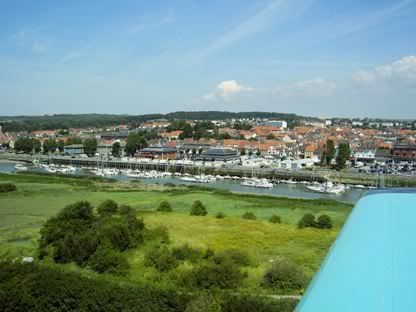
French coast on climb out from Le Touquet

Took off and climbed to 4500’ and proceeded to sit there for the whole trip. I was expecting clouds over the UK and that is what it looked like, but it was only the effect of looking ‘edge-on’ at the cloud layer, when I got to where the clouds should be, they weren’t there, but further on and so on.

Blighty on one of the clearest days I have seen over the channel

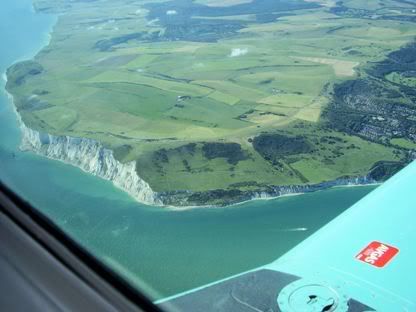
Beachy Head

Farnborough Radar were frantically busy and I barely managed to get the call in. I really do take my hat off to UK controllers – they do a fantastic job (oh, and Langen Info as well, although they were far from busy).

Asked for and got a transit through the western edge of Brize Zone to stay well clear of parachuting at South Cerney.

Check the Gloucester ATIS and got a standard overhead join for 27. Good approach, but a bit fast and was penalised with a ‘floaty’ hold-off and a landing past the first intersection.

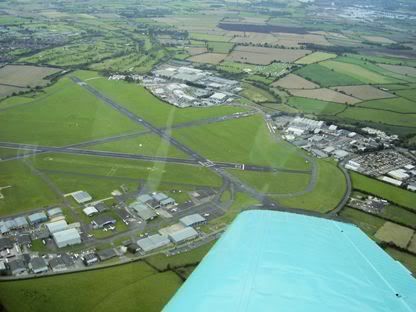
Gloucester from the overhead

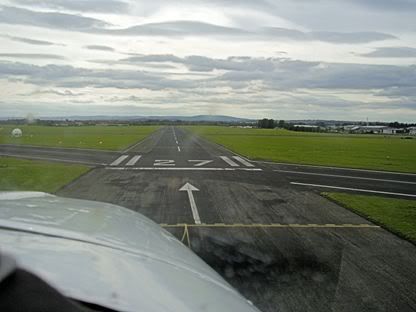
Short final for 27 at Gloucester

We parked up and pushed back into the hangar. While I completed the logs and other formalities, Dan unloaded and cleaned to perspex and leading edges of the wings (by now these we covered in fly-splats).

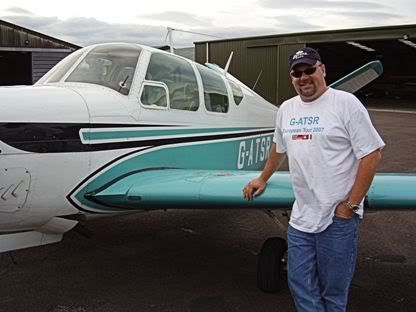
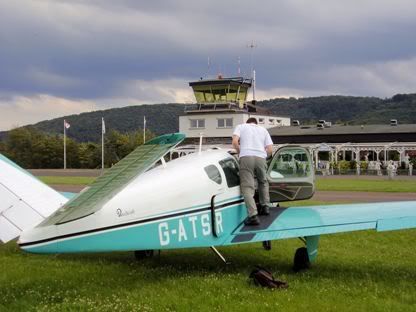
Dan poses by G-ATSR, frantically holding his stomach in!

The very nice lady on reception at Gloucester was quite taken with our, by now pretty smelly, team t-shirts and Bavarian hunting hats (note to self..... get more than one t-shirt made up for each of us next time!).

A nice easy run back into Gloucester on the planned date.

Big Trip 2007 - Lausanne to Le Touquet

2.6 hours logged
LSGL DCT YVERDON DCT RLP DCT CTL DCT LFAT

We had only planned to stay in Switzerland for two nights, departing early Thursday to go to Blois in the Loire Valley to see Chateau Chambord. The Wednesday in Switzerland was fantastic, warm and sunny with a clear sky and great visibility. When I checked the forecasts on the internet, I got conflicting views. The BBC said clear and sunny the next day, but Swiss Meteo said cloudy with thunderstorms. Our host said that it rarely ‘socked in’ for a day and that if there were storms, they often broke up quick with good weather or at least very large breaks between. So we decided to try for it. We contacted Blois and arranged customs clearance (as this was a prior notification airfield) the previous day.

Thursday dawned tipping down stair-rods with thunder and dramatic fork-lightning. Thinking this might break up, we got a lift to the airfield and waited. And waited and waited and waited.

I wanted a break with higher clouds and a clear view of the Jura ridge we had to cross. I probably saw this once, but with lightning still around and more low cloud about to roll through, there was no way I was even going to start prepping the plane, let alone take off.

I was astonished to see a small plane fly over the airfield not more than 1000’ above with lightning going off all around and I was hardly surprised to see him land 4 minutes later. I guess he was a local Swiss guy, but why he took off in the first place eludes me!

Thunder and lightning at Lausanne

By 12:30, if anything it was worse and rather than lose a whole day, we decided to give it up and hire a car and do our own thing. So that was the last part of the trip cancelled. I only had the plane booked for Friday (not Saturday) and had to have Dan back in the UK by Saturday at the latest for his Sunday flight back home, so re-planning was called for. I legged it out to the aircraft, only to be beaten back once out on the apron by frequent fork lightning all around and me realising what a great target I was all alone on a high airfield on a nice, flat apron!!

I planned a route back to ‘good old’ Le Touquet then on from there to Gloucester. By way of recompense for not staying in France, we thought we would have lunch in Le Touquet if the weather was OK. So I re-planned the route accordingly. Pretty much a straight line following VOR’s to the North West.

Next day, the weather was much better. Not brilliant sunshine, but cloud that was clear of the ridge anyway. I printed the weather off for Europe and the UK from the house on the internet (UK Metoffice site) and went to the airfield again. I paid up, and completed the customs departure form.

To file a flight plan, you have to use one of the two dedicated internet terminals permanently connected to the Austo-Swiss site. The logon and password are pasted onto the terminal and completing the flight plan was simplicity itself – why can’t we have this in the UK??

I checked the plane and emptied most of the water ballast as we were taking yet more goodies and Swiss wine back. I added 1 Qt of oil and carefully checked the fuel tanks for water several times from the fuel drains after the previous days downpour. Not a trace, how wonderful!

Again, Launsanne was operating like an uncontrolled airfield (only this time they mentioned it on the ATIS!). So I started up and taxied out. There was little wind, but take off was to be uphill on 36 (probably the preferred runway for noise abatement reasons). I gave the usual blind calls, did the power checks, checked the circuit and final approach track carefully and lined up on 36.

I started the take-off run and noted the manifold pressure was not as high as normal. I immediately realised that this was due to the pressure altitude, which while not that high, was clearly high and hot enough to affect this. I decided it was not pronounced enough for me to abort the run and try leaning for take-off so elected to continue – making a large mental note to think this carefully through beforehand next time!

Climb out from runway 36 at Lausanne

Heading uphill, I nursed the plane into the air with the odd ‘chirrup’ from the stall warner as I was keen to get the gear up to reduce drag (not too close to the ground mind you!). This had the desired effect and I was climbing away nicely.
I switched to Geneva Info who could again hardly conceal their lack of interest! After picking me up on my pronunciation of Yverdon (apparently it should be EEEE – VARE – DONN with an emphasis on ‘DONN’ – are all French speakers a pain in the butt like this?), they asked me to report at the Swiss border.

OK, I am going to have a rant! Why is it that French speakers insist on perfect grammar and pronunciation before they will deign to understand you? I spoke my very poor German in Germany and was usually rewarded with a charming smile and a nod of understanding and with them offering to speak English to put me out of my misery – the French? Oh No!!! Even Dan get a similar response – and French is his native language (OK, OK Quebecois), but really!! To be fair, the French in La Rochelle were an exception.

Up to 4500’ at Yverdon on the shores of Lake Neuchatel and spotted the airfield there. Climbed to 5000’ and spotted the same valley in the Jura that I came through, so let’s use that! Parts of the ridge had some scattered cumulus sitting on them (cumulus granitus!), but the bit I was aiming for was mercifully free of such entertainment. I squeezed through the valley and seven minutes later as the ground was dropping slowly away, crossed the border into France.

Crossing the Jura ridge

As the land dropped away, so too did the cloudbase. I had to descend to 3500’, then 3000’ then 2500’ bumping my head on the clouds. We chugged along at about 145kts airspeed and 155kts groundspeed according to the GPS and played my favourite airborne version of ‘knock knock, ding-a-ling, cheers’ by seeing who could spot the airfield first – my how the time flies!

I spoke initially to Reims Info on 124.10 then past RLP to Paris Info on 126.10. Both of whom were very helpful.

It was a nice, easy run and we were soon in the Champagne district with loads of fields of vines everywhere and large, imposing chateaus.

French chateau in the Champagne region

With 25 miles to run, the weather improved and I could see ahead to the coast that it was clear skies – WOO HOOO!. So I contacted Le Touquet – HORROR! The dreaded female controller was on!!

They were busy, I’ll grant you. But she was up to her old tricks of unnecessary and detailed parking instructions and other trivia, clogging up the airwaves so few people could get a word in. Mind you, some of the pilots on frequency need to listen out and pick up their calls first time, that added to the congestion.
Runway 32 was in use and I was approaching on what was a very long final. She helpfully asked me to hold at 10 miles for an extended final approach – fine by me, that’s what I was hoping for. So I took up right hand orbits. I did about three and with Dan starting to look a little green, finally got a call from her asking me where I was (thinks.... where you left me – where do you think!). I replied I was orbiting at 10 miles and she directed to me approach and report at 3 miles. This I did and got a straight to final approach.

The town of Etaples on short final at L2K - must visit there sometime!  Maybe with Martin?

Made a good approach and landing, taxied and parked up. No customs, no hassle as we got a taxi into town for a stroll and a nice pavement lunch at one of the many cafes in town. Bought yet more wine and chocolate (for the wife you understand!) and headed back to the plane about 15:30 local in glorious sunshine.

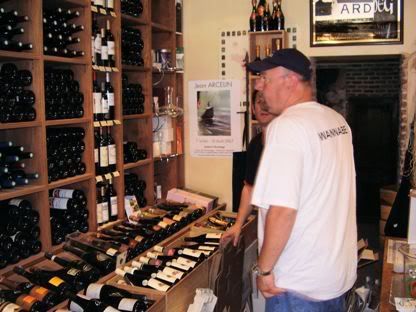
MMmmmmmmmm.....Wine......

So, small recompense for missing out on Blois and the Loire Valley (note to self – I need to do a serious tour of the various towns and airfields in the Loire Valley). Le Touquet really is a very nice town and well worth a visit in it’s own right and not simply to get the charade of clearing customs over with then dash on to your destination.

So disappointing not to make Blois, but I was worried about getting out of Switzerland. I certainly wasn’t going to chance anything with thunderstorms about. Having said that, without a full IR (I am IMC only), that is what touring in Europe means, go for it, but give yourself flexibility to deal with the weather.

Big Trip 2007 - Koblenz to Lausanne

1.9 hours logged
EDRK DCT KIR DCT GTQ DCT LUL DCT LSGL

While in Koblenz, we got back late one night (actually, make that early one morning!) and of course decided on a beer or three for a nighcap. We got chatting to the guy on the ‘graveyard shift’ at the hotel who served us and it turns out he too is an avid pilot. We talked about the next leg and he had been to Switzerland and Lausanne several times and rates it as his favourite destination. He was extremely helpful and brought in prints of plates and maps showing alternate route into Switzerland the next day that we talked through. Anyway, thank you so much for your help Rainer, it is always good to talk to someone who has actually been to where you want to go and pick up valuable tips – you made it easy for me!

We made our way to the airfield and loaded up.

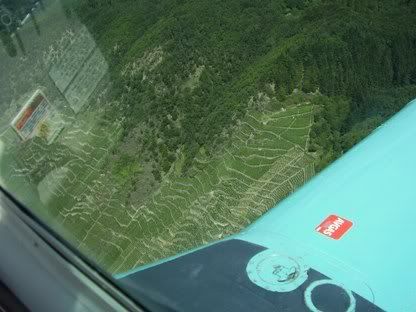
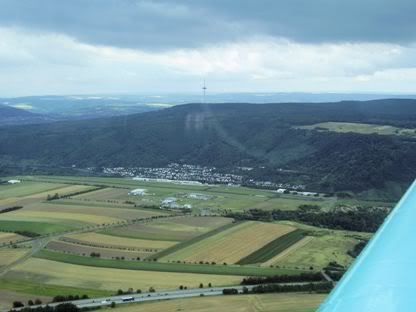
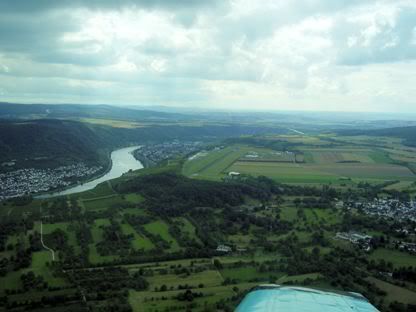
Vine terraces in the Moselle valley on take off from Koblenz

I refuelled and paid up in the tower. I asked about weather (having checked it on the internet at the hotel) and they kindly printed the forecast and en-route TAFs and METARs. The weather for Switzerland was excellent, with clear skies and 40km visibility – just what I was hoping for for this, my first trip into Switzerland and some serious mountains (thinks, hmmmmm – when is a mountain not serious?).

I let out some of the water ballast to compensate for the various pressies we had bought (and no doubt the pounds we had put on in weight).

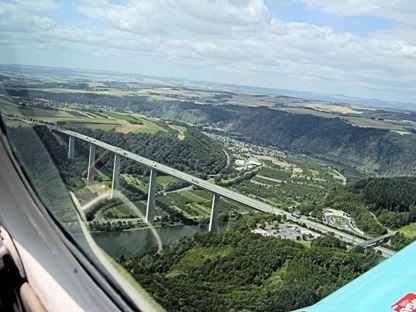
Rather nice bridge on take-off from Koblenz

Just for the hell of it and because it is such a great approach, I asked for a take-off followed by a low approach and go-around, which they agreed to (my guess is that this is not an unusual request!). this I did while Dan snapped away furiously all the way around. I raised the gear and flew over the runway giving the tower a ‘waggle of the wings’ (I thought a victory roll inappropriate in a non-aerobatic plane!).

Right base for Koblenz airfield

I set track for the KIR VOR, but swung deliberately east a bit to avoid Frankfurt Hahn controlled airspace.

The weather was good with high-ish broken cumulus and I was up to 4000’ easily. I could have gone ‘on-top’ but I was enjoying the view of the ground and was plenty high enough anyway, so why bother? I spoke to Langen Info on 123.52. It was a different controller this time, but again, very professional and helpful.

Approaching the border, I switched to Metz Approach on 125.90 and agreed a zone transit at 4300’. By now, the cumulus had changed to thin scattered cumulus and it was getting thinner and more scattered as I went south as predicted. I recall saying to Dan in Koblenz that just once, it would be nice to fly in a cloudless sky – someone must have been listening as that is what was happening!

I flew on past the GTQ VOR and contacted Reims Info. They immediately suggested I call Luxeuil instead. By the time I cut through their accent and found Luxeuil on the map, I was into their airspace with the airfield in sight – this was one I had missed somehow on the map in my planning! They were gracious about it and granted an immediate (and presumably retrospective) transit rather than scramble the Mirages!

I heard a familiar voice on the airwaves from another aircraft. It was Manuel Quieroz in his RV6, G-GDRV. I asked for and got an ‘air-to-air’ and said a quick hello. Manuel must have had trouble hearing the lady controller who asked several times for his full registration, so I relayed, deciding to help out this clearly inexperienced pilot – you really should get some hours in flying abroad Manuel (Manuel of course recently flew around the world in the RV6 in ‘Chasing the Morning Sun’!!!).

I went back to Reims Info as the ground got closer to the plane despite me flying at 4700’. It was getting more rugged as we approached the Jura Mountains. Reims got rid of me with 50nm to run to Lausanne and while still well inside France (cheers pal!). So I called Geneva Info on 126.35 who promptly suggested I contact Reins Info! I stayed on listening watch and Geneva Info couldn’t care less until you enter Swiss airspace (seems reasonable I guess).

The Jura mountain ridge ahead, but hey! great weather!

I was aiming for a ‘notch’ in the Jura Mountains ahead of me now. As usual, from this distance, it looked like I needed more altitude. I decided to climb to 5000’ and see where we went from there, as I would only have to lose it again fairly quickly to get into Lausanne, only about 25 miles inside the border (I didn’t want a repeat performance of getting into Cannes last year where I was at 8000’ when the mountains fell away to reveal Cannes airfield at sea level with 30 miles to run!). Closer still, I decided on 5500’ for the crossing. We saw Mont Blanc sticking up clearly through the inversion layer on the horizon.

Flying through a valley in the Jura

Mont Blanc on the horizon

The ‘notch’ in the ridge turned out to be a small ‘pass’, so I used that and crossed the Jura Mountains with mountains above me on either side. By now, I was talking to a somewhat dis-interested Geneva Info who advise me to report at Yverdon on Lake Neuchatel.

Yverdon with the airfield runway at the bottom

I passed Yverdon and changed to Lausanne ATIS, picked up the ATIS and called the tower frequency. I heard a lot of calls, but no reply from the tower.
Descended to 3700’ as per the approach plates and approached for a left downwind join for runway 36 in use. I was still giving blind calls. While about 2 miles from downwind, I had a ‘close encounter of the brown trouser kind’ with a lovely yellow Piper Cub – only it wasn’t so lovely at the time. A classic case of ‘high wing below / low wing above’. I am sure neither saw the other until he had passed underneath!

I carried on giving blind calls and realised that everyone else was doing the same, so despite the ‘Tower’ designation, it appeared to be operating as an uncontrolled airfield – not a problem, just not what I was expecting – and boy, was it busy! The weather could not have been better, with clear blue skies and unlimited visibility.

Lausanne airfield left downwind for runway 36

This was another interesting airfield. At 1800’ it is the highest I have been to. It is on the northern edge of the town or Lausanne on the shores of Lake Geneva. The runway is not overly generous at about 850m and has an interesting 2.5 degree upslope on runway 36 – so I was glad I wasn’t landing on 18!

Final for 36 at Lausanne

The approach is again very scenic, over the town while Dan was snapping away. I was ready for the optical illusion of an up-sloping runway and I mad e the final approach and gave my last blind call. This was rewarded by a good landing. As we wanted to get away early in two days time, I taxied straight to the pumps. Of course we had to get the keys from the tower, so Dan went off at a trot to collect the keys. He returned and we completed the refuelling easily enough and parked up on the carefully marked areas.

Parked up at Lausanne

I checked into the reporting point in a smart, new terminal building where we filled out a customs arrival form. The lady told Dan (in French) that we had to wait for 30 minutes and if the customs officers didn’t show, we were free to go. There was a nice restaurant / bar downstairs, so it wasn’t a hardship. However, 10 minutes later, the lady appeared and explained that I might not have parked carefully enough. So she took me back to the plane in a car and inspected where the wheels were in relation to the ramp markings. Sure enough, I had missed the yellow line by about one foot, but she shrugged and said that was close enough – in broken English she explained that it was hard to see exactly from the tower and that space on the ramp was very tight.

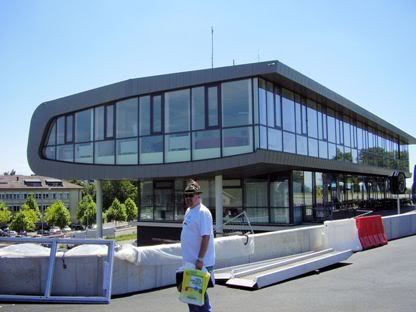
Dan in front of the smart terminal

We were met by our mutual erstwhile next-door neighbour who now works for the Olympic federation in Lausanne. We had arranged to stay with him and his family nearby and by coincidence, the next day was also Swiss National day with fireworks all over Lake Geneva.

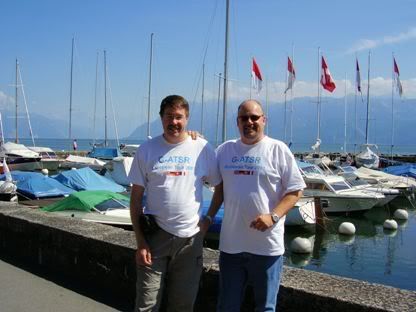
Team t-shirts at Lake Geneva

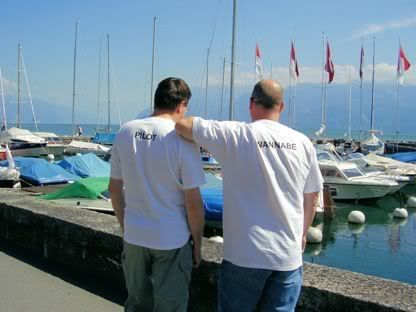
I couldn't resist the slogans at the back!

The landing fee was SFr 32.00, Passenger Tax was SFr 6.10, Parking for 3 days was SFr 38.70 and there were minor charged for customs. All at a rate of around GBP 1.00 to SFr 2.35. Fuel was a bit cheaper but not hugely so.

My first trip in a small plane to Switzerland and my first bit of ‘serious’ mountain flying (no – I don’t count the Lake District or the welsh Hills), although I could hardly have chosen better weather for it, so not a huge challenge. But what a beautiful country and what fun it would be to land at other Swiss airfield – maybe next time!

Saturday, August 04, 2007

Big Trip 2007 - Gloucester to Koblenz

2.7 hours logged
EGBJ DCT BNN DCT LAM DCT DVR DCT MK DCT HUL DCT SPI DCT EDRK

So, this was the start of the ‘big trip’ for 2007. My buddy, Dan had arrived from Canada the previous week and seen a number of friends around the local area of Gloucester (yes, during the floods)! So we were both a bit relieved to be leaving the Gloucester area on a flying holiday – at least we could have more than a facecloth wash every night!

We rocked up at Gloucester airport on Saturday 29th July at about 10:30. I filed the flight plan with the reception desk (having filed the GAR the previous day). We unloaded and Dan carried the two 15l collapsible plastic camping containers full of precious water to act as ballast in the baggage compartment to counter-balance us two hefty guys in the front and keep us within the balance graph.

We loaded up and I taxied out to the pumps. As I was filling up, a rather nice looking Piper Meridien pulled up behind us and it was a fellow ‘Flyer Forumite’ Steven in his flashy mini-airliner – very nice too! We filled up and pulled forward so Steven could pull in behind and fill up while we faffed around.

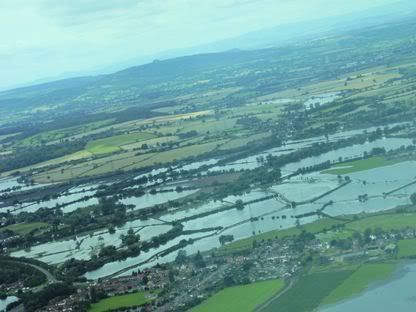
Flooding in Gloucester after take off

We were soon airborne. Dan was busy taking pictures of all the flooding in the local area, while I did a left turnout from runway 27 to set course direct to the BNN VOR and through Brize airspace.

I requested and got transit through Brize with a controller who was very interested that we were heading for Koblenz. He said he was posted there for a few years and were we going for the ‘Rhine on fire’ festival? I confess I had never heard of this and said no. He said it was on about now, so we may have struck it lucky.

I levelled out at 2700’ – no point in going any higher as we would only have to descend again to below 2500’ to stay under the London TMA. My attention wandered and I climbed a further 200’. Just as I was about to correct, a PA28 passed diagonally underneath us about 200’ below! No, probably neither of us saw each other.

We watched carefully to the north east for the NOTAM’d glider competition at Bicester. We spotted on which was no conflict. Clear of Brize zone, I changed to London Information on 126.40. They were very quiet indeed for a Saturday. Got FIS and ran the low level ‘corridor’ to the north of London under the TMA at 2400’. I stayed with London Info for the short channel crossing from Dover to Calais, but climbed to 4000’ for the crossing. The weather was good with few clouds and good visibility over the channel.

At the FIR, I changed to Lille Info on 120.27 and stayed with them until near the Belgian border. Around the coast at Calais, I had to descend to 2200’ to remain VMC, but as is common, once further inland, this lifted and I was able to climb to 3000’.

Changed to Brussels Info on 126.90. I heard him, but he said I was unreadable, so I should remain clear of controlled airspace. I wasn’t due to go near any for a while yet, so stayed on listening watch for now. I tried again later and was reported as strength 3, but still no FIS. I finally got through to him near the town of Kortrijk at 3700’ with category C airspace 15 nm ahead starting at 3500’. I asked for transit and he replied ‘you remain clear of controlled airspace unless you have approval for transit’ in his best petulant ‘I am a controller - what does this idiot think he is doing’ tone of voice!

I said that I knew that and that is why I was requesting transit! He responded with a terse ‘you call Brussels Approach on XXX.XX’. I don’t often come across unhelpful ground stations, but this guy was a real pl*nker! I was not sorry to switch.

In contrast, Brussels Approach were relaxed and very helpful. I got transit approval at 3900’ and was also advised that Beauvechain was closed, so no transit was required for them.

Once clear of their airspace, I switched to Liege Approach on 119.27 and got immediate transit approval through their airspace to the south on a direct track from HUL to SPI VOR’s.

The landscape changed from carefully tended fields to large forested areas – so we were in the Belgian Ardennes – scene of the famous ‘Battle of the Bulge’ from WW2. I knew this was rugged terrain from the road-trip we took last year. I spotted the Spa airfield easily and decided to follow the road to the infamous town of Malmedy.

I changed to Langen Info on 123.52 and crossed into German airspace for the first time. They were great and warned me about an active danger area and gave me vectors to avoid – ooops! That’ll teach me to take unscheduled detours!

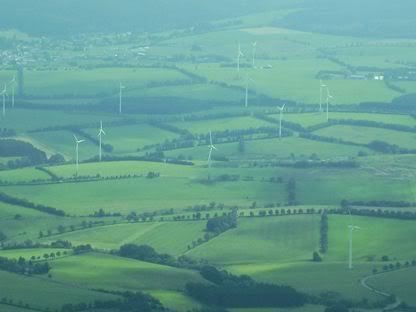
You could tell when we crossed the border into Germany for all the windfarms!

Then, it was a straight and easy run into Koblenz. It took a while for either of us to spot the airfield as we were approaching it from ‘the back’. I got it at 5 miles.

Joined downwind for runway 24 with right hand circuits. I was a bit close in. I turned base and saw the amazing sight of Koblenz in the valley that dropped sharply away from the airfield – so this is the ‘aircraft carrier’ airfield I had read so much about – a good analogy, except of course, there was plenty of tarmac!

Koblenz airfield - downwind right for 24

I was so carried away by the view and misjudged the strong crosswind, that by the time I checked again, I had badly over-cooked the base leg and cranked the plane around hard to regain a sensible final approach track. I really should have gone around, but thought it might be fun to rescue it instead. The crosswind was something, it must have been a full 20 kts – given that, it was a reasonable crosswind landing.

Right base for Koblenz 24

I taxied in and parked up on the grass. We unloaded, locked up and put the cover on the plane. Dan and I then walked past some onlookers outside the tower who stared in disbelief at our ‘team t-shirts’ complete with Bavarian green hunting hats festooned with badges (yes, we really did wear these during the trip and out on the streets – more of this later). Have these people no sense of style or taste?

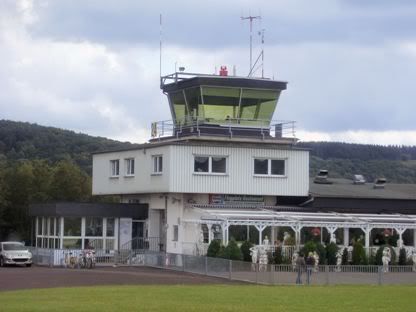
Koblenz tower with incongruos greek restaurant complete with statues!

Me farting around unloading while Dan takes photos at Koblenz

I went up to report to the tower and the guy up there was fantastic and very helpful indeed and suggested I pay on departure. He closed the flight plan and called a taxi.

As this is a flying blog and not a travelog, I won’t say much about Koblenz, except that we stayed in the Accor Ibis in the centre of Koblenz. The Accor hotels are a pilots dream as you can book on-line and cancel the same day either on-line or by phone, making them ideal for pilots who get weathered in (as I was to find out later).

Dan with his 'trip shirt' on - more of those later!

Koblenz itself was great and it is a bustling, working town. The ‘Rhine on fire’ wasn’t for two weeks yet, so we would miss that. We saw pretty much all the sights you could see on foot and enjoyed the fine food and especially the local wine and beer!

So, my first trip in a small plane to Germany and it was pretty easy. Belgian airspace can look intimidating, but once past the tw*t on Brussels Info, transits were easy to get. German airspace was very easy and Langen Info very professional and helpful.

Koblenz is a very scenic airfield and has a spectacular approach that make it very well worth visiting – just watch out for that crosswind!

The costs at Koblenz? Landing fee EUR 24.00, 3 days parking EUR 17.55 – while not ‘dirt cheap’ French prices, certainly pretty reasonable. Fuel was a bit more expensive than in the UK though.

Sunday, July 22, 2007

Flooding and Sea Kings at Gloucester

Where I live in on the Gloucestershire / Worcestershire border was the subject of ‘biblical’ rains on Friday. It started the Thursday evening and didn’t let up to drizzle until Saturday morning. When I say ‘biblical’, I mean it was the sort of rain that would get you very wet dashing from the back door to jump in your car in the driveway! The weathermen said we got 2 months average rainfall in 24 hours and I for one believe them!

Few of the local houses were flooded, but there was a near river running down Gretton Road outside my house covering the entire road up to the top of the kerb. They say there used to be a small stream there in the old days and it would seem that nature has a better memory than man!

My wife took three hours to drive back from her work in Gloucester (about 15 miles) and even then had to park at Cheltenham Racecourse and walk 4 miles, once wading up to her thighs to get home.

I was due to pick up my buddy from Canada on Saturday morning from Heathrow and was really worried I wouldn’t be able to make it. The alarm went off at 05:00 and it was still raining, but not as hard. So I set out hoping to get through. I expected empty roads at this time of the morning, but was greeted by traffic I would normally expect on a normal weekday!

I made it to Bishops Cleeve (1.5 miles!) and stopped dead in a traffic queue backing up from the flooded Smiths Industries roundabout. I did a u-turn and used my local knowledge to drive past the school to Southam and Prestbury. There were loads of abandoned cars at all angles along the main road. In Prestbury, the main road was closed, but I diverted around the back streets and made it through. Once on the A40, it went well. Around Oxford, it stopped raining and the clouds lifted a bit. By the M25, it was broken cloud and sun! Needless to say, Dan was early and made it through from the time the aircraft switched off engines to arrivals in 15 minutes – a new world record.

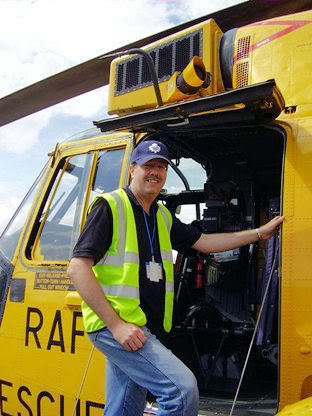
Sunday was a much better day locally. Although by midday it was threatening rain again, we decided to take a trip to the airfield for lunch and maybe a local to look at the extent of the flooding. We got there to be greeted by the site of two RAF rescue Sea King helicopters and their crew taking lunch in the Aviator. It took a while to get served, but all the while the weather improved and we even spotted a few blue bits, then the sun poked through! The weather was improving all the time.

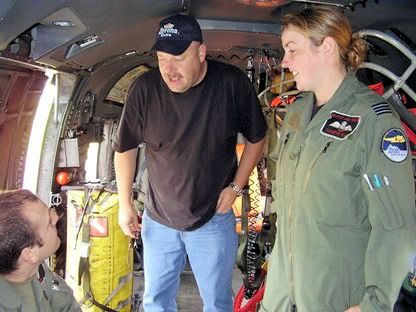
Lunch cleared away, we went airside to take some photos of the Sea Kings. While doing so, a couple of the crew arrived and kindly offered to show us around. We had a good look around and I was astonished to learn that the pilots had to climb through the gap in the seats to sit up front, there were no doors – only one precarious spot to plant your foot on some blanking plates. Put a foot wrong and you would wipe out some expensive looking avionics – but the lady pilot merely shrugged and said ‘you get used to it’.

Me being invited in to the RAF Sea King

Dan telling them he is a crack helicopter pilot

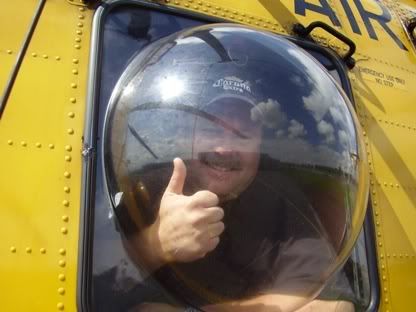
The goldfish bowls in the side of the Sea King

They really are big, solid beasts.

I went back to the terminal to book out and met the SATCO at the desk. Darren told me that Gloucester was the centre of the rescue effort on Friday and Saturday and that they had put people winched out of their home up in the terminal overnight and that it was just starting to wind-down now. The Sea Kings were due out later and were likely to impose restricted airspace around Tewkesbury and Upton to protect their flying operations.

Unfortunately, when I got to the aircraft, there was no key for the ignition on the coaming as I expected. Last week, the other owner of the plane had a problem with the ignition and mag’s barrel that the key goes into and couldn’t select both mags. With a local repair in France he made it back to the UK and immediately got Aeros (our maintenance organisation) to take a look. They confirmed it was shot (it is a 1959 aircraft after all) and replaced it, hence my need of a new key.

So unfortunately, no flying today. But we did get the unexpected bonus of having a look around some rescue Sea Kings and a chat to the crews.

I think Gloucester airfield did a lot of good for themselves the way the worked for the community in this recent crisis. It served as an ideal base for the rescue effort with all the facilities already on site that the Sea Kings would need. And let’s face it, Tewkesbury, Upton and most other places on the Severn often get a pasting from floods on a yearly basis – although there is no doubt that this is the worst that anyone can remember.

Perhaps the planners and NIMBY locals should remember this before they decide that the airport would be far better as a massive housing estate!

Thursday, July 19, 2007

Canada Dan's third 'official' lesson

Some of the Flyer Forum guys will remember the 'larger than life' Canada Dan. He was a regular flying companion with me and a very good 'auto-pilot'. When he went back to Canada, I bought him an introductory flying lesson at his local airport in Ottawa, Canada. Well he finally got around to taking this flight and I couldn't resist publishing his email here.

Wow! That was really awesome! Nice day with lots of huge white clouds, some bursting into rain. I told the instructor, young man in his mid 20s, that I had some experience flying before in the UK and Europe. He had a quick look at the two entries in my pilot log book and seemed puzzled at the unusual entries... circuit flying and aerobatics! Still, it seemed to be enough for him to let me take the controls from the time we sat in the plane until we returned from this "intro" flight.

I must admit when he told me to taxi to the departure point and get the plane into the wind for system checks, I became a bit nervous. I had only once before touched the brake pedals and I didn't want him to know that I was unfamiliar with them. I also quickly found out why you always had an easier time than me to swivel the plane around, much easier when you are in control of the brakes.

VQQR C-172 was identical to GBRI you took out in December, so that helped me a little. I knew where the throttle, trim and flaps were and also remembered there were no variable pitch prop. So I think I was confusing him further because of the little experience in the log book, but still seemed to know my way around the cockpit.

So it is with full throttle and slight pressure on the right rudder that I initiated my 30 minute flight over Ottawa and the Gatineau hills. I rotated at 55 kts and maintained a climbing speed of 70 kts as instructed by Andrew. I did remember what you told me about the Cessna... it wants to take off on it's own with sufficient velocity.. and I did notice it as I hardly touched the yoke and off the ground we were. I started to turn right immediately after take-off as I still had my foot on the right rudder, but that was ok because this was normal protocol to avoid flying over local residences... so again, it just looked like I was doing all the right things.

"Aim for those smoke stacks and climb to 1700ft"... this is when I started to realize he was going to let me fly the whole way and already, my mind was starting to go through circuit and landing motions... well, the ones I saw you go through, over and over again. Then we went port side toward Meach lake, and always wanting to impress him, I initiated a 30 degree turn, leading with left rudder while staying level. Again, I surprised the crap out of myself because the turn seemed so smooth and level. Andrew wasn't saying much at this point [Steve - were his eyes bulging from the suppressed scream in his throat?] other than pointing out some scenic landmarks (lakes, ridges etc.).

We climbed to 3000ft then turned back East heading for the airport. Descended back to 1700ft where we flew over the runway to check for circuit traffic as this is an uncontrolled runway (don't remember exact term). One plane in the circuit on base, so there wasn't much to worry about at this point... well, maybe worrying a bit about what was coming next. "I want you to turn right and descend to 1200ft". As I was descending 500ft and doing a 30deg starboard turn and leveling while in turn, I said to Andrew: "descending, leveling in a turn while getting ready to land, can I do anything else?" I guess my way of saying: bring it on! I can handle it.

By this time, I'm on a high and filled with anticipation. I know what's coming next as we are turning downwind. I heard his downwind radio announcement then he starting going through the "breaks, undercarriage, mix, pump, fuel etc..." and I knew next turn was base and flaps were next. "10 deg flaps he said". So I reached over without really looking at the switch and lowered it one notch. He didn't say anything so I assumed that was 10 degs. "Another 10" he asked and we are turning right for final.

A million things are going through my head at this point... I kept hearing your voice saying "picture, picture, picture" and I kept reminding myself that "throttle controls the altitude and the yoke speed". I kept the plane at 70 kts, as requested and the picture was right. I mean, it was dead on! Beginner's luck I guess. Over runway 27 markings (yes, same as Gloucester), I started to pull, maybe a bit early as I felt a bit of flaring... oops. But the Andrew said that's fine, "just hold and try to prevent the plane from touching ground" - Where did I hear that before? ;-)

No stall warnings, but a landing straight in the middle of the runway, which felt awesome! Grinning from ear to ear, I asked the instructor if at any time he felt worried to have given full controls to someone with almost no experience... he said that I have "a "knack for it, especially not having flown for over a year". I realize that he has to say that to try to get me into spending a few bucks at the club [Steve - No, really, I think you do - you are a lot more 'natural' than me]. Nevertheless, I still think I did extremely well... all thanks to you, Steve!

Yesterday, was like everything was coming together, from the take-off to the flying around to the landing. What a feeling!!! All I need now, is a few bucks to complete the training.

Steve, thanks for the wonderful gift.

My pleasure, glad you enjoyed it buddy. See you Saturday and I look forward to our flying trip at the end of July!

Sunday, July 15, 2007

RIAT 2007

I like to get to RIAT at least once every two years and this year I was due. Spoke to my Canadian neighbour and after a few gulps at the price (converted to Canadian Dollars), he decided to go with his step-son.

Originally, we decided on Sunday as my wife was due at an all day conference for her work. But on checking the weather forecast, Saturday looked do-able and Sunday look truly horrible- solid rain with severe weather warnings. So I had a quick chat with Martin and we decided to make it Saturday instead.

I packed the lunch and we packed up the ‘camp’ – chairs, binos, lunch, airband scanner – all of life’s little essentials! On the road from just north of Cheltenham at 0830 – we hit traffic just crossing the bridge from Cirencester – from my previous experience, this didn’t bode well! So it transpired! We crept along slower than someone would walk and finally parked up at 10:45. I don’t understand how two years ago it flowed so smoothly and this year it was such a cock-up – you would have thought that if they got it right once, they could just copy the traffic flow for following years – and no, it wasn’t particularly because all of Sunday’s crowd had made it Saturday – the crowds there looked like a regular sized RIAT crowd to me. Almost make me wish I had decided to fly-in, but then I thought about the £250-odd landing fee – no, I can’t bring myself to pay that!

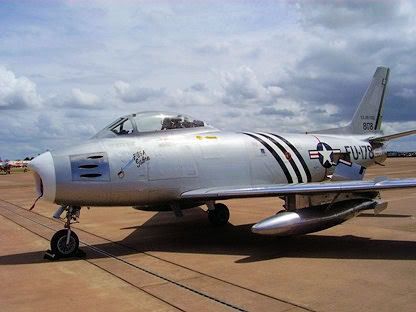
While queuing, the airshow had started and I glimpsed what I though at first might have been a Hunter, or was it a Mig 17? No, I eventually decided it was an F86 Sabre – I was fuming at missing this! We also saw a Chinook in the distance doing amazing things.

We eventually parked up and pitched camp. We watched the American display team in F16’s, the Thunderbirds. A lot fewer aircraft than the Red Arrows and a good display. I didn’t think it quite as good as the Red Arrows, but the impressive manouver they did was a formation ‘all-aircraft-as-one’ flick roll – wow, that was impressive!

We wandered around the static park. Martin of course noticed an unusual RCAF aircraft and wandered over to speak to the guys. This was ¼ of the total strength of the RCAF navigation training wing who had flown in from Winnipeg. They were purely here for the airshow and were flying back at the end – seemed a bit mean to me – why not give them a few days in the UK to do some navigation training in Europe and to see some sights?

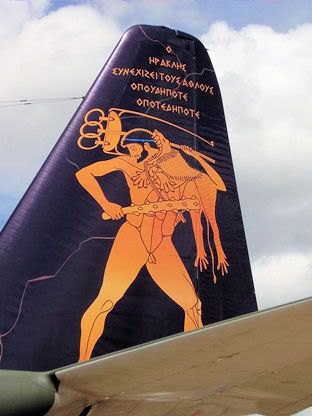
Loads of Hercules around, but the winner had to be the Greek Air Force Hercules, complete with appropriate tail art. I think the Greek writing translates roughly as ‘big plane – small willy!’.

Appropriate Greek Air Force tail art on a Hercules

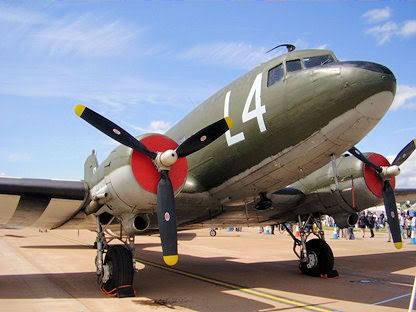
Saw the F117 and some lovely vintage aircraft, including a Chance Vought F8 Crusader, various C47 Dakotas, Mustangs and the lovely F86 Sabre.

C47 Dakota

F86 Sabre

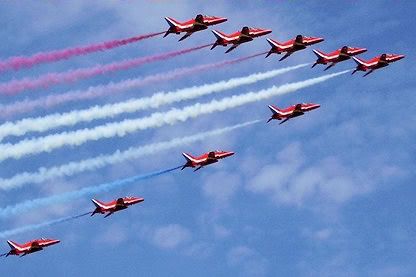
The weather improved to be about the best day for 7 or 8 weeks as the Red Arrows managed their ‘full height’ display – probably for the first time this year. They really are excellent, with a lot going on.

The Red Arrows

The four ship Spitfire flight was great and even better was the formation flypast of the Red Arrows with three spitfires.

The B1B and F15 shook the ground by liberal use of afterburners.

Personally, I think the best individual display should go to the beautifully painted F16 of the Belgian Air Force – that silver, black and gold scheme is a real head-turner.

We left just gone 16:00 to beat the traffic. A really good day and got my ‘spotter’ fix for the next year or so. I also got the required ‘airshow sunburn’ on my face and now look like a Racoon!

Saturday, July 07, 2007

Wye Valley and the Flyer Summer Bash

With the Flyer Summer Bash being held this year at my home airfield, Gloucester, I could hardly fly in. So rather than feel a fraud, I decided the least I could do was to go for a local flight in the morning – that and the fact that the weather has stopped me flying anywhere near as much as I would like to.

I wandered down to the airfield early, about 08:50 to find the terminal closed, so I used the side gate. Opened up the hangar and pulled the plane out. I gave her a decent walkaround check and prepared her for flight. I saw that my fellow groupie had taken her to Dinard during the week and she had plenty enough fuel for a local.

I spot a lovely De Havilland Dove aircraft parked outside one of the hangars and cannot resist having a look and taking some photos – God! Am I turning into a spotter??!!

I wandered back to the terminal to book out only to find it brimming with people (looks like a charter for the KingAir on stand 1). The very harassed receptionist takes my details and back I trek.

She starts up easily, I take the ATIS and taxi to A2 for 27. Quite a few aircraft are on the move now and I am No 2. After power checks, I get clearance and take-off on 27 with a 10 degree right noise abatement turn.

The weather is very good. Scattered cumulus with bottoms at 2500’ and tops at 4500’. The visibility is superb. All of the terrible recent weather has cleared the air and visibility is about as unlimited as it gets in the UK.

I climb to 2400’ and head SW along the Severn and along the ‘bends in the river’. The river is at low tide, exposing large mud flats. I decide to check out Upfield Farm near Newport, so head to the Severn bridges. Past that and I spot the cream coloured concrete runway from distance away. I will land there one day, it is plenty long enough, just a bit narrow for me personally to try it in anything other than conditions of light wind.

I spot what looks like a biplane landing underneath me as I give the airfield one orbit before tracking back to Chepstow for a trip along the Wye Valley.

The Wye Valley looks lovely and I am seized with a desire to descend and fly along it at 500’ with the valley side towering above me. But I resist and wimp along at 2400’ instead!

The Wye Valley

I follow the river as it twists and turns, craning in steep-ish turns just for the sheer joy of it. I start to fantasize about doing a slow roll – but as neither I nor the aircraft is cleared for aerobatics, perhaps not! I am not sure how much longer I can resist the lure of doing a basic aerobatics rating.

I head up to Hereford, taking care to avoid the restricted areas to the north west – certain gentlemen in barracks there might not like it – and I wouldn’t want to p*ss them off!

I head on over to the Malvern ridge aiming for North Camp on the northern tip of the ridge. For the fun of it, I fly down the western edge of the ridge at 2000’ for Midsummer Hill near the southern end, then for the joy of it, I crank in a steep turn over the iron-age hill fort there.

I do another circuit of the Malverns then dial in the Gloucester ATIS and call for a rejoin.

Flooding on the River Severn

I am given a standard overhead join for 27 as they are busy. Descending deadside, I spot an aircraft rolling for take-off and keep a good eye on him to make sure I avoid him on the crosswind. I call mid-downwind and am told I am No 4! I spot the diminutive Robin ATL in front, but quickly lose him again while I am doing the downwind checks.

I try to spot him but fail, so turn base and call for a traffic update. He must have cut a much closer base leg than me as he is now on 1 mile final. I turn final and bring the plane under control for height and airspeed.

Reasonable approach, with minimal wind and no crosswind. I flare a try to hold off for as long as I can. I am surprised at how slow it seems to fly when the stall warner chirps and we touch. I manage to brake sensibly and again the plane is well under control by the first intersection. For a plane that runs the approach at 80 kts, it is surprising how short you can land it when you want to (I wasn’t particularly trying, but it beats the TB10 and the Arrow).

I taxi in and shut down. The chief mechanic at Aeros is kind enough to help me put her back in the hangar – she is a heavier aircraft than the TB10 and the Arrow and does tend to leave me puffing!

It was such a lovely day and I felt so good and carefree about flying that even something as tame as a local along the Wye Valley made me feel quite uplifted and satisfied.

I mooch along to Transair and pick up the two maps I am missing for my Europe trip at the end of the month.

I spot some of the crowd I went to Italy with last year coming out of the terminal for the Flyer Bash and say hello. I was planning on staying around the airfield and taxi people to the hotel for the Flyer bash, but I see that the Flyer people have laid on a mini-bus, so I head home instead.

The rest of the afternoon is still spent on aviation related activities though! I put my unexpected free time to good use by detailed planning, plate printing and map marking for the trip at the end of July with Canada Dan. The trip is:

GLOSTER – KOBLENZ – LAUSANNE – BLOIS – ABBEVILLE – GLOSTER.

We will see my erstwhile next door neighbour in Lausanne (he lives there as he works for the Olympic committee). The timing is good as 1st August is Swiss national day and there will be some great fireworks over Lake Geneva.

So a great trip in the offing – if only the weather will play ball!

The Flyer Bash in the evening went well as I met a number of people I flew out to Italy with as well as some new faces (but familiar forum names). Always nice to put faces to the names!

Manuel Querioz was the guest speaker. This guy flew around the world in an RV7 from Gloucester trying for the world record for that class of aircraft. He didn’t managed to break the record, held by very poor weather in Hawaii.

Having seen both Polly Vacher recently and now listened to Manuel, I am stuck by the fact that the most amazing thing about them both is that there is nothing amazing about them! I know they would agree. They are just ordinary pilots who started the same way as the rest of us, and certainly for Manuel, has the same ratings as many of us. But they are extraordinary in that they were driven to do something quite amazing.

We could all do what they did. I don’t mean in any way to detract from their achievements, quite the contrary, because in reality very few will ever do anything remotely close to their achievements. But you know what? That’s OK if it’s OK with you. The crime would be to look back and say ‘you know, I wanted to fly around the world but…..’. As Manuel so aptly said – ‘life is not a rehearsal!’.

Personally, I don’t yearn to fly around the world. My flying dreams are limited to far more mundane activities - learning aeros and doing solo aerobatics and flying floatplanes in Canada (no – not doing both at the same time!) and the way I see it, I am well on my way.

Saturday, June 30, 2007

Project Propellor 2007

Talk about unlucky!

2005 even though we only had to get across the ridge from Gloucester the Kemble, we were weathered in with the cloudbase sat on the ridge. My passengers gave up about lunchtime, but I persevered and as the clouds lifted slightly, I made a bolt for it over the ridge and made it Kemble by myself.

2006 I had to cancel with only a weeks notice as the aircraft (not my current share) went ‘tech’ and had a cylinder replaced.

Third time lucky you might think? Not a bit of it! All week, the Metoffice were forecasting solid and heavy rain on Saturday – they even issued a severe weather warning for the risk of flooding! Of course like most UK pilots with a few hours on the clock, I knew anything could happen. The front may come quicker, more slowly, veer north or be far less active than forecast – bottom line is the only forecast worth looking at is the one the night before and even then, the Mk 1 ‘stick your head out of the window’ on the day of the flight may make matter quite different from forecast.

I called my three passengers on the Thursday before, they had been anxiously watching the forecasts as well! I said turn up on the day as I would be happy to ‘scud run’ the relatively short distance to Bruntingthorpe and even if that was out, I would drive them by car.

The day dawned and I awoke to hear the ominous patter of rain on the roof. A look outside showed light to moderate rain and low cloud just barely clearing the Cotswold ridge at Bishops Cleeve – so my guess was 1000’ or so. Never mind, you never know.

I turned up at the airfield and checked the plane. As I was doing so, Steven (a fellow Flyer Forumite) turned up outside the hangar in his car (airside pass huh Steven – who do you know??) and was pessimistic about the chances. We agreed to meet at the café to check the forecasts on his laptop.

The weather looked pretty bad. Not much of a wind, just a low cloudbase, probably 1200’ by now and starting to get better defined.

The weather that kept me away

We checked the forecasts and it looked like the front was coming in from the west, so it was forecast to get worse in the afternoon – nearby TAF’s showing PROB40 of heavy rain, 300’ cloudbase and 3000m visibility sealed it for both of us. I would have been OK to try either a scud run over to Bruntingthorpe or IMC to Coventry with a let down there and a scud run from there, I was not happy with an IMC approach to Gloucester with the risk of cloudbreaks below my personal 500’ minimum.

We broke the news to the vets. They took it well. Both Steven and I offered to drive our respective passengers to Bruntingthorpe, his accepts, but mine declined – while I am sure they would have enjoyed the reunion, they were really there for the flight bless them!

Victor Zimmer - one of my passengers

I offered a circuit or maybe a local if we could find one of the holes in the really low stuff and they accepted.

I briefed them on the plane, emergency procedures and how to climb on board. I felt vaguely patronising briefing people that had flown Harvards, Tiger Moths, Sunderlands etc. but I didn’t want them to accidentally step somewhere they shouldn’t.

They clambered in with two navigators in the back and a veteran pilot in the front. As I started up, their eyes were everywhere! Looking carefully at the gauges and readings and watched and listened attentively to my mumbled but methodical progress through the written checklist (yes, I know many people think it isn’t butch or hairy-*rsed to use a written checklist, but I don’t care, it’s what I do!).

There was only one other aircraft in the area (doing bad weather circuits) so of course I managed to get held waiting for him to land. I am cleared to line up on 18 as soon as he has passed and then cleared for take off. This would be my first flight ‘four-up’ in the Beech, so I take extra care with airspeed and rotate. I needn’t really have worried, she still accelerated and climbed well.

I take the right turn-out and climb to 1000’ before we ‘bump our heads’ on the cloudbase, which is indeed right there. Set for the cruise, I head north at 140 kts. Lots of flooding below in the Severn valley. I quickly lose sight of the airfield and the limited view and horizon at 1000’ at 140kts can leave you ‘location challenged’. A quick look at the ADF / DME (not to mention the GPS) reassures me. I can’t find any openings in this lower layer and don’t fancy IMC. Shame really, it is probably an ideal day for IMC training, with a sensible cloudbase for now, but not today without pre-planning and with a full load of passengers.

I skulk over towards Bishops Cleeve hoping for better luck. None of it. I am forced down to 900’ as I head towards the ridge. So I crank in a steep-ish turn for the hell of it and decide to head for home.

Gloucester give me a direct to left base join for 18 – there being no other aircraft in the area (are they trying to tell me something?). I drop the gear and slow down before lowering some flaps. The approach is good. Dropping a bit low, so add some power to get back on slope. Got the speed at 80kts. Final checks and full flaps. Over the hedge. About to start the roundout – power off. Hold-off and off, nose up, try hard not to land. The wheels touch briefly before the stall, nose up more, squeak of the stall and down for good. Vacate and clean up.

I taxi in and shutdown. I apologise to the vets for the short flight, but they genuinely seem to understand and are grateful for the flight.

We go for a consolation cup of tea in the café and they graciously present me with a bottle of scotch for the effort. I try to refuse, but they are not having it.

What a great and interesting bunch of guys. I feel terrible for them and I personally really wanted to get to Bruntingthorpe as I haven’t been there yet and the airfield is rarely open to visiting aircraft. But sometimes you just have to be strong enough to decide not to fly and not feel pressured into it.

Maybe next year – fourth time lucky anyone?