Sunday, July 03, 2011

VFR Tour 2011: The Plan

Well the plan was simple. Myself and another pilot from the aircraft group were to fly from Gloucestershire airport in the UK and tour a few destinations in Denmark and south-western Sweden then return home in a week.

As we were going to tour VFR (Visual Flight Rules), we needed weather the was good enough for us to see where we were going, to be able to always see the ground and sensible winds as strong winds and flying a taildragger is not a good combination.

Of course there was slack and spare time planned in and corners we could cut, you simply cannot be rigid with VFR flying as you may well get ‘weathered in’ or have to divert in-flight, but that is all part if the game.

The plan was:

Saturday 25th June 2011
This was to be the main ‘get somewhere’ day, with two legs planned.

Gloucestershire Airport to Texel (Holland) via a 130nm crossing of the North sea if the weather was good enough to allow us 5000’ for the crossing, or the alternate was to fly to Calais, clear customs, then on to Texel, then continue as planned, so a three leg day instead of two.

Texel (Holland) to Flensburg (Germany) which is a couple of miles from the Danish mainland. Stay in Flensburg overnight.

Sunday 26th June 2011
Another two leg day, but shorter legs this time.

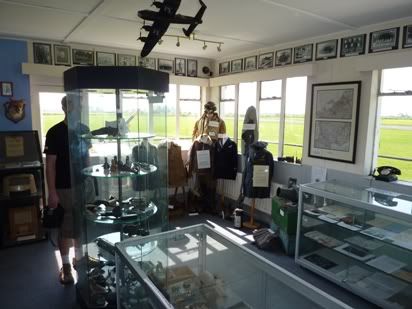
Flenburg to Stauning (about halfway up the Danish mainland on the west coast), stop for lunch and peruse the Danish Flight Museum at Stauning.

Stauning to Aalborg, the northern-most major city in Denmark, for an overnight stay and a poke around the city. We had deliberately decided to avoid Copenhagen as a destination as we had both been or were about to go there.

Monday 27th June 2011
One leg, this time from Aalborg in Denmark to Goteborg on the west coast of Sweden, crossing the Kattegat, the stretch of water that separates Denmark from Sweden, about a 35nm sea crossing.

Tuesday 28th June 2011
Non-flying day. Stay around Goteborg and have a look around the city. Hopefully meet uop with a Flyer Forum contact who is also a pilot and we may be able to get an evening sightseeing flight around the city.

Wednesday 29th June 2011
Flying along the western Swedish coast from Goteborg to Hoganas. Hoganas is opposite the narrowest bit of sea that separates Sweden from Denmark.

Thursday 30th June 2011
Hoganas in Sweden to the small island of Samso in Denmark for an overnight stay if we could find accommodation, or if not a second flight to the city of Odense in Denmark on the large island of Fyn.

Friday 1st July 2011
Our return home day with two legs if the weather was good or three if not.

Samso in Denmark to Texel in Holland.

Texel in Holland back to Gloucestershire in the UK.

The alternate was again to route instead from Texel to Calais, then from Calais home.

Saturday 2nd July 2011
Contingency day if required.

Sunday 3rd July 2011
Super contingency day (plane not actually booked and would cause problems with other bookings, but if worst came to worst….

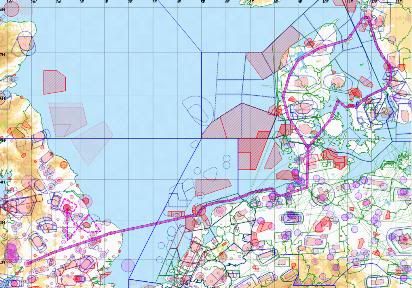
Planned Route
The planned route


Well that was the plan, but then the course of VFR touring in Europe, especially northern Europe rarely runs smoothly does it?

Monday, June 13, 2011

Throckmorton and 'Help for Heroes'

An ex-member of our aircraft group unexpectedly got in touch with me three months ago and asked if I would be interested in flying in to the disused Throckmorton airfield near Pershore for a Help for Heroes day. Well I wasn’t about to pass up the chance to go to an airfield that I hadn’t been to, especially one where you are not normally allowed to land, so of course I said yes. The day of the show arrived on Saturday and I invited Neil along as we need to get used to flying together for our coming big trip to Denmark and Sweden.

I checked the plane out nice and early at Gloucester. I find it relaxing to be able to do this in a leisurely fashion as you don’t miss anything and it helps to set the tone for the coming flight, especially if you do not feel rushed or pressured. The plane was in good shape and the paintwork felt good, it had obviously been properly polished (we pay for this to be done once a month or so). Neil helped as we wheeled the plane out of the hangar, then I booked out with Gloucester as usual.

A trip to the pumps was necessary, so I took advantage of this and made sure that we had the sort of overall load we will be using in our touring at the end of June, just to get used to the weight and handling of the plane at these weights. The weather was excellent, scattered cumulus with minimal wind, but the forecast was for the Cu to build and to have scattered showers from midday onwards, with the sort of gusts associated with showery Cu’s.

Suitably refuelled, we carried out power checks and called ready for departure. The circuit was quiet and we were cleared for a right turnout after noise abatement on 27, then en-route to the north north east to Throckmorton, a mere 20 miles of so distant – by the time I levelled out in the cruise, it would be time to start the descent! Lined up and power up and we trundle away. I get the tail up and ‘feel’ for the direction with the rudder bars. I hold her down as she starts hopping on the runway, then ease off and she pretty much flies herself off, no positive ‘rotate’ action as such really. I wait until the end of the runway, then put in the required ten degree noise abatement turn and start a moderate climbing turn onto track.

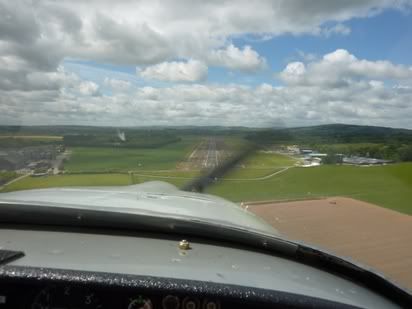
I get up to 2000’ and start to establish the plane in the cruise, remembering that we are still running it at a fairly high power of 65% as we are still running in one of the cylinders. By the time we finish changing frequencies and getting settled in the cruise, we can see past Bredon Hill and can definitely see Defford disused airfield. From that landmark, at about 2 o’clock we can make out what must be Pershore, then from there, we look again at 2 o’clock and see what I am pretty sure must be Throckmorton. I keep my eye on that as I change frequency and try the special frequency allocated for the day with the call-sign Pershore Radio (although why we think in the UK that we must have a frequency and speak to someone at an airfield eludes me, the US system of self-announcing on a UNICOMM of MULTICOMM, then each pilot sorting themselves out vis-à-vis each other just works and works really well, we would do well to emulate this!).

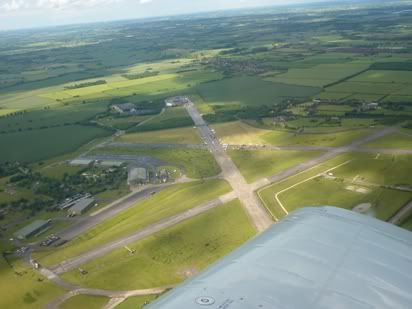
I get no response to my initial three calls, but they may be on a low powered Icom, so we continue. I hear another plane coming in from Wellesborne direction also calling Defford on the same frequency, but he seems to be speaking instead to another ground station who was clearly annoyed that someone was using ‘his’ frequency (I rest my case!). As we close in to the overhead, I hear no other traffic and the Wellesborne one is still several miles out. I can see the airfield clearly now, it is the classic three triangular runway wartime type configuration. Two of the runways are being used for the show and only a small part of runway 08 / 26 is being used (pretty much the bit between where the two other runways intersect) giving about 550m of runway, short by some standards, but plenty long enough for the RV, even if heavily laden.

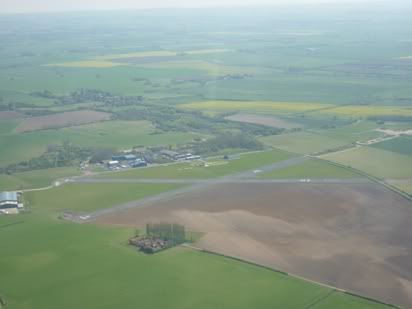
Throckmorton airfield
Throckmorton airfield, runway at the bottom between the intersection of the other two

I try the radio again and this time get a response. I am given the runway in use (26 as I expected) and the QFE. I decide to join high along the runway at 1500’, then descend onto left crosswind etc. This will allow me to see a bit of the runway, only part of which is in use. I fly along and note what Lyndon had said, that one of the biggest landfill sites in the area is located to the south, with an attendant massive bird strike hazard. As this is in the direction of the circuit, I make a point of flying quite a wide circuit so I can get well outside the dump. I give position calls on every leg and turn base. Power down a lot and bleed the speed off to the flap limiting speed. Click on two stages of flaps and stabilise the speed and descent.

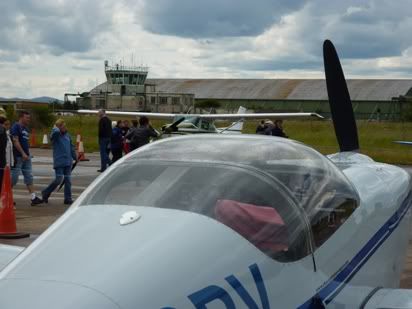
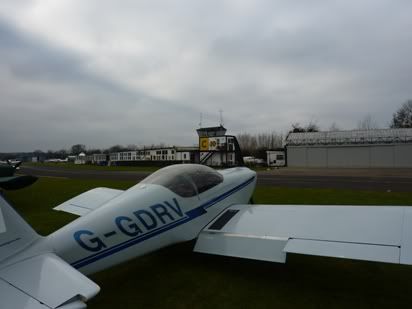
G-GDRV with the tower in the background
G-GDRV on the ground at Throckmorton

Turning final for 26 now and the picture is good. I note a few cones on the runway (it is technically a disused airfield after all, although local rumour has it that there are strange Hercules night flights there from time to time) which mark the rough ‘displaced threshold’ area. Do I am aiming for a small part of the runway a good one-third into the actual runway concrete. Speed good, picture good. Keep it coming down. OK, chop the power and round out. Hold her off, stall warner starting to pip. Hold her off more, settling a bit, off a bit more. Stall warner constant now. She touches, slightly tailwheel first. Mains down, feeling a little light, not a bounce, not even a hop really, just floating slightly, hold off more and we are definitely down for what in the RV must qualify as a smooth landing – I am tickled with that!

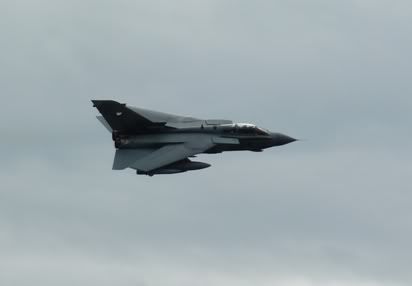
Tornado flyby
A Tornado flyby - noisy!

We are marshalled (as expected) very professionally to the static display line of aircraft. We are only the second to arrive. We trundle in and shutdown where indicated. A very short flight, but lots of fun as you are obviously kept very busy and there is the fun of a ‘new’ airfield, especially one with a limited runway length.

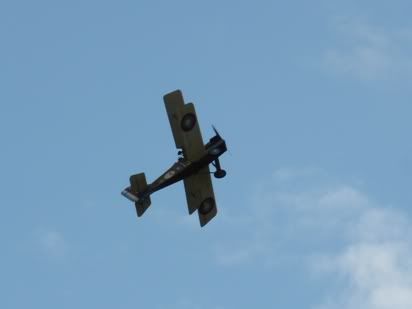
Replica SE5
SE5 replica

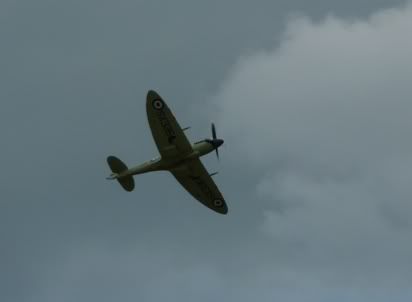
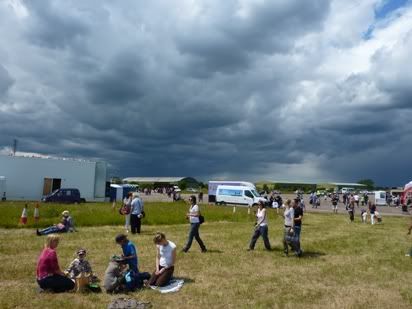
The show was very well attended with an eclectic mix of displays. Quite a few interesting visiting and displaying aircraft, including two scaled SE5 biplanes, a Stearman, an RAF ‘Huey’, two Belgian Air Force Augusta’s, a couple of Chippes, etc. There were also static displays from a Triumph TR car club, loads of gleaming HGV’s, Fire engines and police static displays (Throckmorton is some sort of police centre), vintage and current military vehicles and battle tanks etc. There was of course an air display, with the SE5’s, Brendan O’Brien and his crazy antics in the Cub, a Cap 10 doing aerobatics, a paid of Twisters doing synchronised aerobatics etc. We had a flyby by two Tornados, a Spitfire and a Seafire.

Seafire
Seafire flyby

All in all a really nice day, with a weird mix of things going on. We both contributed generously to Help for Heroes, I can at least spare the sort of landing fee I would otherwise pay! There were two convincing showers, and we chose to huddle in the RV with the canopy down.

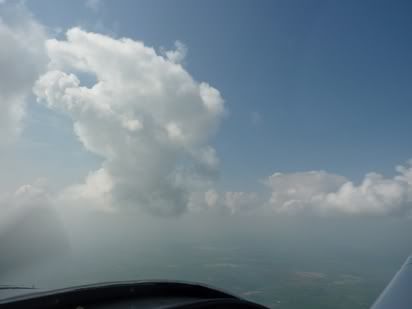
An impressive cloudscape
Armageddon is on it's way!

Neil flew back once we were cleared to leave after the final display at 16:30. All the departing planes sorted themselves out and we chose to leave pretty much last. As a backtrack was involved, we intelligently backtracked three aircraft at a time, then lined up as each departed in turn. It is amazing what pilots can do without being ‘told’ to by someone on the radio you know!

Sunday, May 15, 2011

Shobdon

I had tried twice since my last flight to go flying at the weekends, only to be frustrated by the weather. Both times it was cloudy and threatening rain with very high winds. I booked the Saturday as a joint flight with one of the other group members, hoping for good weather and maybe a longer run to say Plymouth, where he would fly pone leg and I would fly the other.

Well, the weather still didn’t want to play ball. We turned up and if was broken cumulus with maybe the odd small gap in the cloud, but quite windy. The forecast wasn’t great and the wind was from the west or slightly to the north west. That ruled out a few of the airfields we looked at as they were single runway and generally oriented to the south west. I didn’t fancy taking on 10-15 kt crosswinds if I could avoid it, se we decided to stay closer to home and go to good old Shobdon again.

Final at Shobdon
Final on 27 at Shobdon

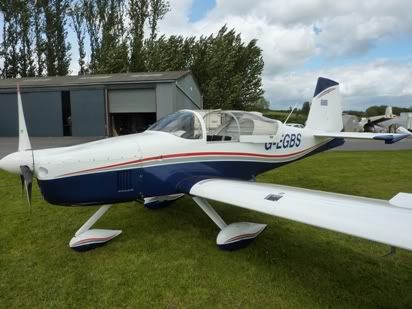
I checked the plane while Neil got the now essential PPR after Shobdon got a b*ll*cking from the CAA for being ‘overloaded’, especially with the helicopter training now taking place at the airfield. Neil flew the leg going out and I flew coming back. The wind at Gloucester on take off was being given as 310 / 10, but it seemed stronger than that. At Shobdon, we indulged in lunch and had a chat with a few of the members of the G-EGBS RV12 group, as they spotted us landing in our ‘world famous’ RV6 (nowt to do with me, all down to Manuel who flew around the world in it).

They have a very interesting aircraft in that it is equipped with a Wilksch 3 cylinder 2 stroke engine that runs on Jet A1. In truth it is underpowered for the RV and gives a mere 110 kts in the cruise. But it does run on far cheaper fuel and even then barely sips that. They do have problems with the pre-combustion chambers and have to replace these every 50 hours, although this problem has now been fixed in the latest version of the engine (which also delivers more horse power, now up to a really useful 140 hp!). They also showed us there rather nice home made control lock, something we could definitely use on the RV6 (such are the exciting topics of conversation once pilots really start letting their hair down – boy, we really know how to party!). I can’t help but think that AVTUR engines are the way forward as AVGAS get more expensive and harder to come by at any price, but that time is not yet here. We will know that AVTUR engines have arrived when the notoriously conservative (and probably rightly so) flying schools start to switch over. I would guess this will be in 5 years time or so.

AVTUR RV
The Wilksch powered RV, a face that only a mother could love!

We also went into one of the hangars to have a look at the restoration work taking place on the Swallow – a very old and early monoplane with huge wings, exposed cockpits and an exposed radial engine.

We clambered in for my flight back. The wind seemed fairly stiff now, but it was at least straight down runway 27. Power checks complete, we waited for the glider tug to tow a glider aloft and for another glider to land on the grass runway. I trundled across to the hard runway, lined up and we were away. Neil used to fly out of Shobdon, so was very familiar with the airfield and helped me on the local noise abatement and to avoid the noise sensitive areas.

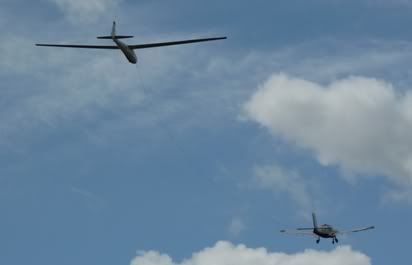
Glider towing at Shobdon
Busy with glider tow launches that day

I set course for Gloucester at around 2800’ as it wasn’t worth climbing to go ‘over’ the clouds for such a short hop. We are still running in the new cylinder, so we are flying the engine fairly hard, at least 65% power, but this is a bit more comfortable than the 75% power we were using for the first 25 hours at least! I diverted a little to the Malverns to have a quick play with them. I called up Gloucester, got the ATIS and was given the standard overhead for 27.

The plane was handling fine and I was feeling quite comfortable, despite not having flown for nearly a month. At three miles we were cleared to the downwind and warned of traffic also joining overhead. Neil and I both spotted the traffic and Neil kept an eye on it as I descended on the deadside (it is very easy to lose sight of the traffic as it appears below the horizon and is easily lost in the ‘ground’. We seemed to be spaced OK. I turned downwind as he was well downwind and tried to slow the RV up some more.

I turned base as he was on final and followed him around slightly further out than I would have flown myself. Power to nearly idle to bleed the airspeed off to the flap limiting speed. Flaps out and turn onto final and settle the airspeed down. The windsock seemed to show the wind only slightly off the centreline. Gloucester were giving 280 / 10, but I swear it seemed to be blowing more than that. I was settled on final as the traffic in front crossed the threshold so I called final. After a pause, I was cleared to ‘land-after’ as it was clear the traffic in front had missed the early turnoff and would roll to the end. I was quite happy to take a land-after as there is stacks of length on 27.

Over the displaced threshold, airspeed a bit above the normal 70kts IAS (the indicator over-reads slightly), so I knew I was in for a fair old hold off. Down and flare and hold off, and off and off. Stall warner starting, don’t let it land yet, make it holler (getting the usual conflicting visual clues from the strong wind where we seem to be crawling along the ground, but of course it is airspeed that matters!). Then we touch and stay touched – OK, pleased with that! I just miss the early turnoff as I don’t want to hammer the brakes and call for a short backtrack which is granted.

We trundle back to the ramp and park up, taking care on taxi doe to the winds. It ain’t over with a taildragger until it’s locked up in the hangar or chocked and tied down (preferably both!).

Nice flight, but a short one. Still it will do for now. Next definite booking is 11th June to Pershore.

Neil and I went into a huddle in Cotswold Aero club planning the route of our joint tour around Denmark and Sweden at the end of June. We got the legs finalised and agreed who would fly what leg and who would plan what leg. We bought all but one of the required Jeppesen charts and Neil will have first go with them and the planning. At home that evening, I finally purchased the full version of Sky Demon and effortlessly planned all of the legs just for fun – boy this program really makes it easy! Looking forward to it already – pray for the weather (as usual)!

Friday, May 06, 2011

Solway Aviation Museum at Carlisle Airport

I had a road trip planned to Edinburgh for a long weekend with the wife, as she has never been to that lovely city. On the way back, we decided to visit a section of Hadrian’s Wall near Carlisle. On the way to this, I saw signposts to Carlisle Airport. As we came to the turnoff, the car unaccountably turned off the main road and headed towards the airfield – I got a severe ‘rolling of the eyes’ together with a theatrical ‘looking at the watch’ from the war department for that!

Photobucket
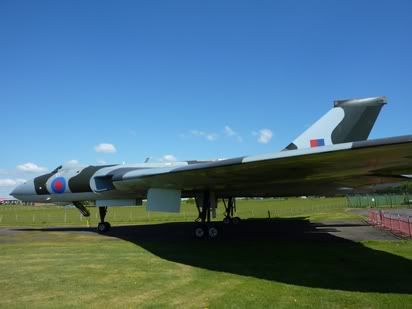
The mighty Avro Vulcan

It was a lovely sunny day, but very windy, not a great day for flying a taildragger with anything other than an into-wind runway, so in some ways, I was pleased that I hadn’t flown in as I would be worrying about the plane being tied down and any later take-off I would have to make (shades of the very sporting wind that I came across in Avignon – aaargh!).

Photobucket
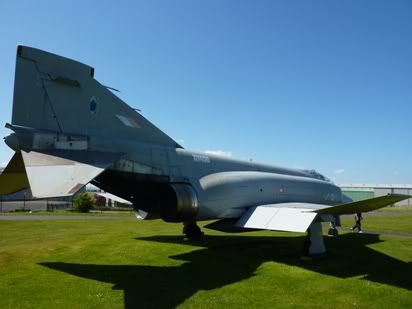
McDonnell Douglas Phantom

As we approached I saw the distinctive outline of an Avro Vulcan bomber and signs to the Solway Aviation Museum - this just gets better and better! I had a quick poke around the entrance to the airfield, then drove to the Vulcan bomber. It was open and encouraged you to climb up inside and sit in the cockpit, but only if you paid at the museum first. So we drove around the corner to the museum and paid a modest £4.50 per person for admission. Unfortunately, I didn’t have much time, so I had to dash around the static exhibition, which I am sure would have warranted at least an hour slowly reading my way around, but I just didn’t have the time. So out into the yard to have a look at the static aircraft on display.

Photobucket
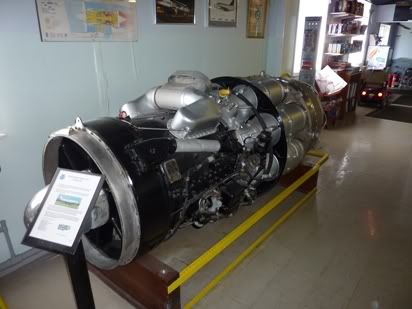
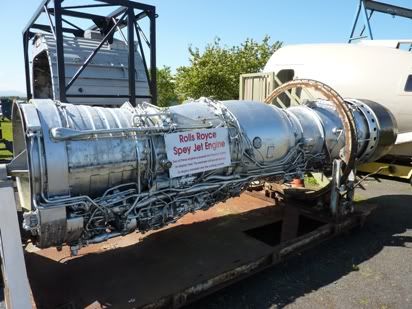
Jet engine

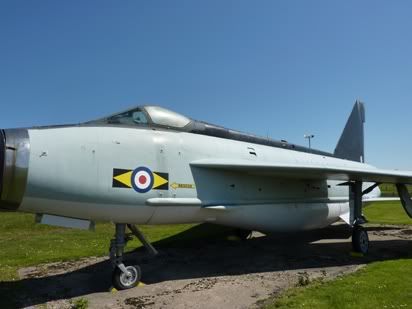
And quite a collection they have too. I had to climb into and sit in the cockpit of the Canberra bomber, the first time I have been so close to this classic jet bomber. The a quick walkaround and photos of the Hawker Hunter, the McDonnell Douglas Phantom (ex-British Navy carrier specimen as indicated by the arrestor hook), the English Electric Lightning, the Vampire, a rather modified and ugly Meteor and a few other bits besides.

Photobucket
Jet engine

Photobucket
English Electric Lightning

I really wasn’t aware that Carlisle airport had a museum and such a good one at that. I would say it was well worth a proper, leisurely visit sometime.

Hadrian’s Wall? Edinburgh? Yeah, they were OK I guess!

Tuesday, April 19, 2011

Swanwick UK ATC Centre

I had an email from the flying club a while ago, asking if anyone wanted to visit the UK air traffic control centre in Swanwick (near Southampton). I immediately replied yes and was allocated a space. Ten of us made that visit yesterday and very worthwhile it was too. I would recommend every pilot to make this trip. We were not allowed to take in or use cameras, so any photos here are ‘stock’ photos from the internet.

Swanwick general
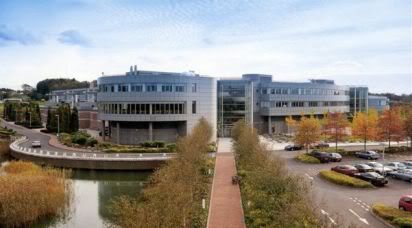
The centre itself is really tucked away near Hamble Point Marina. You think you must be lost as you are in a small, quiet village, then you turn down a lane and spot a sign. Then you come upon the security gate, with the main building hidden in a dip in the ground. They are very hot on security and must see government issued photo id and check your car before allowing you through. Once through the building itself is quite splendid. Very modern and feels like a ‘no expenses spared’ typical government project (although NATS are now a limited company, HMG still hold 48% of the shares, but apparently may be selling those soon).

The building feels deserted and walking through it we bumped into very few people walking the corridors. Many of the rooms were either empty or partially used. I believe that they are anticipating moving some more functions down from other parts of the country and of course ramping up for the Olympics, so that may account for some of the space. I know my company would not settle for such low occupancy.

Swanwick
The very swanky Swanwick building near Southampton

But a really nice building in extensive, landscaped surrounds, apparently built on the site of an on brickworks.

Flight plans
First we had a presentation from the chap that runs the team that passes flight plans to the appropriate units. It was useful understanding how it works. It is clearly a legacy of yesteryear where direct copper connections and telex protocols ruled the world. I guess that it could easily be replaced by TCP/IP and the current internet protocols and XML standards, but as that required world-wide agreement and re-equipping and changing airfields as remotes as secondary airfields in Africa, it will be some time before this happens.

He was keen to demonstrate AFPx, the internet flight plan submission and messaging program that NATS make available free of charge. There are 5500 UK accounts active (probably mainly private pilots). He explained the early problems with addressing flight plans for landing in France and that they used a non-ICAO approach to addressing, so NATS have ‘fixed’ the problem by creating a single ‘group email’ type address that automatically send the flight plan to pretty much every French region. Apart from that, the dreaded ‘addressing’ seemed to be automatic. It seems a good system and I would use it myself, except that I tried it once. I went through the trouble of registering for an account and getting my ‘one time only’ password, I tried to sort out my account. The problem I had is that their password standards are insanely tight, far tighter than even my on-line banking. They insist on all sorts of weird and random combinations of upper and lower case, numbers and special symbols. No problem, I can manage that – oh, and they have a huge database of ‘banned combinations’ so you can’t use any vaguely recognisable English word. I tried for ten minutes to find a password that it would accept and one that I had a chance or remembering and failed. I realised that the password was so secure that I would be forced to write it down, which kinda defeats the object – so I gave up in disgust.

Not a bad system at all guys and I would use it except for your crazy password requirements, fix that and I would use it. In the meantime, I use the far friendlier and easier Olivia for flight plans to and from France and either local facilities or Sky Demon for flight plans for all other European countries.

Sector Control
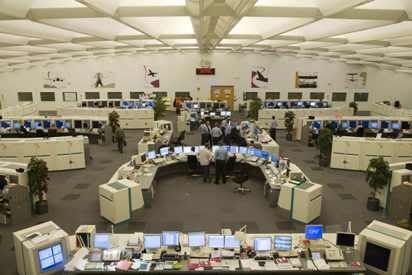
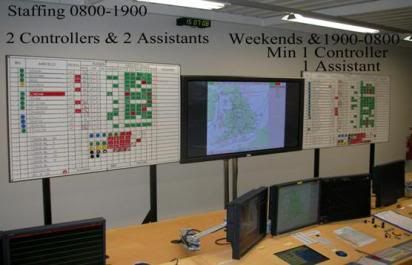
We then had a presentation of how the UK controlled airspace was divided up, what was controlled from Swanwick and what was controlled fro Prestwick. He explained how the desks were arranged and the staff structure for each sector. We were then shown from a sort of glazed viewing gallery, the floor where all the sector control takes place. It was a very large room with a high arched ceiling that looked a bit like the inside of a huge nissen hut. It is completely windowless and the lighting seems to be the same as in the main gaming floors of Las Vegas clubs – subdued. Of course they operate 24 hours a day, but the really busy times are early morning to 10:00 then mid-afternoon to early evening.

Swanwick sector control
The main room for sector control

It was a fair bit more ‘high-tech’ than I envisaged (but then we are used to those old films with their round, green radar display screens!). I noted that they still use paper flight strips. We were told that they will be doing away with those and going completely electronic sometime later this year.

London Information
After lunch, we were split into two groups. The group I was in was taken first to London Information. These are the guys that I have often spoken to where I cannot get a sensible service from a nearby airfield and when coasting out and back in from the continent. They are base in a corner of the main sector control hall. They have two frequencies to use, on for flights to the west and other for flights to the east. There really are only two people actually manning each frequency as I had pictured, so they can be easily overwhelmed by calls (which I have heard myself on busy weekends – standby you are number 6!). As the name suggests, they do have a lot of information easily available to them, like TAFs and METARs, regional QNH’s, airfield frequencies etc.

They do have a SSR radar display for the whole of the UK, but they are not allowed to use it as such and only really use it occasionally for situational awareness. It is on a single relatively small screen that shows the whole of the UK and is set off to one side of the operators, so if you think that just because you have been given a squawk, they are really seeing you on an SSR radar display and are giving you traffic services in all but name, you will be sadly disappointed! The only traffic picture that they have is the one they have built up in their heads – see it really is you job to ‘see and avoid’.

They were a good bunch of people and very friendly. I can no just picture them on a busy weekend – I certainly wouldn’t like to do that job!

Distress and Diversion
The UK is apparently virtually unique in the world in offering a dedicated D&D unit. Most other countries integrate this into their sector controls. The D&D unit are located in their own room. The facilities are paid for by NATS, but the unit is manned by the RAF and they provide D&D to both civilians on 121.5 and the military on a separate UHF frequency. When we visited they were manned by a Flight Lt (OIC), a Flight Sergeant and two Corporal controllers.

London D & D
A mixture of high and low tech at London D & D

The unit is a curious mixture of relatively low-tech (whiteboards and airfield manuals) and high-tech (awesome automatic triangulation kit). The impressive facility that they have is that on one screen they will get automatic triangulation lines appear everytime someone transmits on 121.5, and as long as they can the person isn’t flying too low (3000’ and above ideal), then they can get a pretty good immediately location fix. They can then zoom in on the location and return with increasing levels of detailed maps, including the OS maps. That is how they can be so helpful in telling a lost pilot what features to look for and ‘steering’ the pilots verbally. Believe me that if you are ‘uncertain of position’ and at a sensible height, they can help you and are very pleased to be able to do so. Do not hesitate to give them a call before the situation gets really serious.

They emphasised that they are very happy with training calls and practice pans. Just listen out first and if nothing is going on, either ask or just go into it. They said to ignore any caustic comments you may get from airliners (e.g. get off the guard frequency), unlike other countries, it is perfectly OK to use 121.5 for training calls to D&D as there is no separate training frequency.

The whiteboard displays the main RAF airfields and their current weather status expressed in the usual military colour-coded terms. They have a huge amount of information at their fingertips. They did say that probably 90% of their calls came from General Aviation pilots. It is good to know these guys are there if you need them. I now know that if I really did get into a Mayday situation and managed to get as far as a radio call (priorities being aviate, navigate, communicate), that I needn’t get too distracted with a detailed position report.

A really good day. Highly recommended.

Sunday, April 17, 2011

Wickenby

The weather forecast for the weekend was excellent and I was astonished to find that again the group booking system was completely clear all weekend. I wasn’t planning of flying, but with the wife away ‘do-gooding’ for her Charity on Sunday, it was a choice between helping her ‘do-good’, some industrial-duty gardening or flying somewhere – now lemme think….. that’s long enough, flying it is!

I called by daughters ex-boyfriend and he was at a loose end so we met up early on Sunday morning at the airfield. The weather was warm and sunny with no clouds, blue skies and virtually no wind. A non-pilot would think it was perfect flying weather, but looking at the lateral visibility showed haze and much reduced lateral visibility, certainly less than 10km. So my view was that it should be OK and I might be able to get on top of the inversion layer, but in any event, I was OK with it, even though it would give ‘goldfish bowl’ type visibility.

I did check the NOTAM’s courtesy of SykDemon Light and checked the TAF’s and METARs for airfields en-route. They seemed to be saying that it was CAVOK out east, so perhaps it was better on that side of the country. I quickly planned a route to Wickenby (North East of Lincoln in Lincolnshire, North of the Wash) for the simple fact that running the engine hard as I have to (still running the new cylinder in) and for ideally at least bone hour legs, meant I needed somewhere far enough away at the 160 – 170kts the plane was flying at 75% power, and Wickenby fitted the bill. I have also never been there and it has a couple of shorter runways (around 500m or tarmac), so a bit of added spice for interest.

We topped up with fuel and I made a point of putting the fuel caps on my seat so I wouldn’t forget to put them back on – worked a treat! I lined up on 27 and applied power and we were off. A clean take-off and hold her down to pick up speed, then cruise climb at 110 – 120kts for better cooling. Climbing to 5000’ showed me that the visibility was indeed not good at all. I was finding my heading drifting as I didn’t have a horizon at all and fell for some of the conflicting visual queues and put the plane in a slight bank. I rebuked myself as I should know better and instead started checking the Attitude Indicator and Direction Indicator carefully a lot more frequently, in effect, dusting down my lapsed IMC rating skills, but hey – fun for that!

I settled in at 5000’ and headed for DTY. My forward visibility was pretty horrible, I wasn’t at all sure that this ‘see and avoid’ thing was going to be of any real use to me, so I was relying on ‘big sky’ theory as much as anything! I contacted Coventry Approach who were as helpful and professional as ever. Approaching DTY they warned me about the 4500’ ceiling for controlled airspace. Damn, I did plan the route and looked carefully at the various bit of controlled airspace and for the life of me I spotted the 5500’ bit but not the 4500’ bit. Had it not been for me squawking Mode S (i.e. passing my altitude), and Coventry warning me, I would have busted the airspace – thank you Coventry. In the blink of an eye (but without negative G!), I descended to 4400’ and held it there until they confirmed I was clear, when I climbed again to 5000’.

I changed to Waddington LARS to help me over the mess of military airfields in the area (courtesy of WW2 when this part of the country was ‘bombing central’). I was way over their airspace anyway, but it’s good to talk. Near Waddington I advised them that I wanted a gradual cruise descent to 2000’ into Wickenby and they were fine with that. I tried Wickenby a couple of time for airfield information on the standby box, but got no reply. I know they are a ‘Radio’ and just assumed that they were either unmanned or more likely on a weak, handheld Icom, so I couldn’t hear them.

At ten mile to run, I switched from Waddington to Wickenby and got the airfield information. They were using runway 32, so I would be OK for a left base direct join. There was no one else on frequency, so I wasn’t worried about barging into a busy circuit. I announced my intentions, as I scanned hard for the airfield. For the life of me I couldn’t see it. I knew exactly where it should be and was looking there. Then it dawned on me that the disused WW2 triangular-type airfield that I was looking at WAS Wickenby, but that the two short ‘X’ configured runways were the small remnant of the much larger disused set of runways I was looking at – DOH! I realised I was too high to loose the height to get in direct so flew along the runway at 2000’ and joined the left hand circuit descending on the crosswind.

Wickenby EGNW
Wickenby EGNW

This was going well. I called final as I set up for what looked like a really short runway (well, compared with Gloucester’s 1000m runways, it was short, one gets spoiled at Gloucester). I got the speed nailed, but was a bit high. A little sideslip sorted that out. Ooops, a bit low now, add some power – better, back on, power down and hold that approach. Over the public road, good job there were no triple decker buses going past at the time. Drag her in over the displaced threshold and flare and hold off. Past the numbers and still holding off, stall warner squealing (good). WE touch softly (maybe slightly tailwheel first), I dip the wing a bit, but bring it back, we stay touched and I let her roll to a taxi speed about 70-100m past the intersection – so landed on a 500m hard runway with 250m to spare on my first try – happy with that! Backtrack and look for the exit near the intersection of the runways. I ask on the radio for help and just then spot the grass taxiway. We taxi in to the parking spot indicated and park up. I shut down and pop the canopy as quickly as I can as the heat really builds up fast in this bubble canopy.

Wickenby Tower
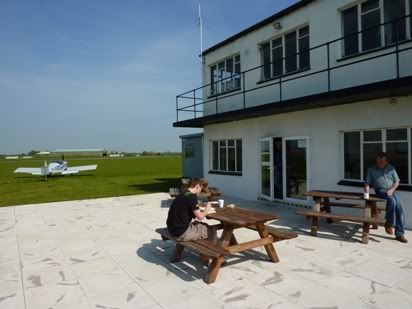
Wickenby tower and cafe

With the engine stopped and the canopy open we are greeted by – nothing at all – no sound, just sweet, warm air and gratifying silence! Wonderful!

We pop out and I pay the fee at the portacabin next to the tower. The guy on the radio if the only guy there that day so he is on the Icom and not on the more powerful radio in the tower as he is also doing the fuel and everything else. We pay the entirely reasonable £10 fee and head to the café on the ground floor of the old WW2 tower. The guys in the café are very friendly and welcoming and whistle up a bacon bap and tea in short order. I have a chat with the guy in the café and he tells me that there is an amazing Sbach extreme aerobatics plane around the corner, so we head off to have a look. A real beauty she was too!

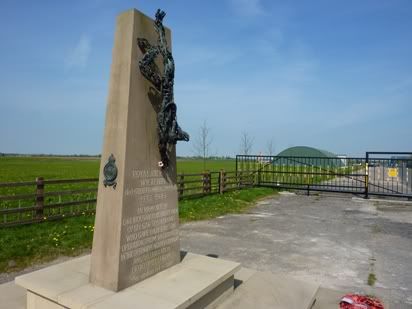
We wander to the main gate to see the WW2 memorial. On the way a couple of guys are pulling out some WW2 Austers in full military marking – lovely, I want one (actually I probably want a J3 Cub in USAAC markings, but maybe some day!)! Walking back to the tower, we see the Sbach take off and pull some low level aerobatics as it headed south, and why not?

Wickenby WW2 Memorial
Wickenby WW2 memorial

Back in the tower, we wander up to the first floor where there is a nice little WW2 museum with all sort of memorabilia.

Wickenby Museum
Wickenby museum

I check the map and looking carefully, I can now see the small 4500’ bit of airspace the guy in Coventry was referring to, damn that’s a tricky one to see! I don’t want to make a full day of this, so after just over one hour on the ground we mount up again and take off. I climb again to 5000’ but find that some very scattered cumulus has now developed, so after going through a few of these on instruments, I decide to drop to 4500’ which I will have to at Daventry anyway. The visibility hasn’t improved and I am partially on instruments due to the goldfish bowl visibility.

Cloudscape
Cloudscape at 4500'

Past DTY now and both Rob and I spot a black speck at the same altitude at my 1 o’clock. I quickly put the plane into a left turn in time to see a large black bird whizz past on our right, that wouldn’t have helped the canopy! We spot a glider below and I again alter course. I pick up Gloucester ATIS who are giving runway 09 in nil wind. I ask for an am given a direct downwind join. I come in behind another aircraft, but find I am gaining too quickly on it. I am about to ask for an orbit for spacing when Gloucester call up and ask if I need a orbit (well spotted guys). One orbit later I continue, but find that the aircraft in front went wide and is still on one mile final. I am forced out wider that I would normally to maintain spacing. I call final and get the expected ‘Continue approach’. He is down on the runway as I am approaching short final. I concentrate on my approach and resolve to land long as I need to get to the far end of the runway to turn off and I don’t want to force anyone behind me to go around while I trundle along the runway having landed near the numbers.

I get a ‘land-after’, then the guy on the runway asks for a backtrack – isn’t he listening to the RT? Doesn’t he have any situational awareness? The tower decline the request and point out that I am right on his tail. I land long as I wanted and make a decent landing. We trundle into parking as I do the post-landings off the runway and loosen the straps so I can see over the nose (I can do this if I crane my neck, so I don’t really need to weave). We park up and shut down. Rob knows the score and quickly gets the hangar doors open while I faff about. We push her back in and I do the post-flight paperwork.

A reasonable flight, but somewhat marred by the poor visibility. Wickenby is a really nice and friendly airfield and I was pleased to have gone there.

Sunday, April 10, 2011

Perranporth in CAVOK

I had planned on a quick local on Sunday, but the weather was so good, I extended my booking slot and decided on a more distant landaway to somewhere I had not been to yet. The plane is still in the running in period for the new cylinder, so we have to fly it at high power settings for ideally legs of an hour or more, this means burning a lot of fuel and flying at 160 – 170kts, so I needed to find somewhere about one hour away at those sort of speeds. I settled on Perranporth. A clifftop ex-WW2 airfield on the north coast of Cornwall.

I turned up at the airfield early at 09:00, as I wanted to be back by 13:00. So I carefully gave the plane a leisurely A-check. As I would be flying by myself, I decided to fly with nearly full tanks, so off to the pumps to add about 90 litres of fuel. I climbed back in the plane and started up when I glanced at the wings – aaarrgh! I had forgotten to put the fuel caps back on as I got distracted by manually rewinding the hose. I would not have taken off without the caps on as I have an item in the checklist for my power checks to visually check for the fuel caps, but nevertheless that was careless. I have now resolved to put the fuel caps on my seat while I next fuel the plane. That way, I will always notice when I sit back down!

Then I realised that I had taxied across and refuelled but I had not ‘booked-out’ with the tower. I called on the radio and asked if he wanted me to taxi to the stand to book out but fortunately he took my details on the radio. OK, that’s two mistakes so far, NO MORE! When I was learning and early post-PPL, when I made a silly mistake, I would dwell on it and get myself flustered, leading to more mistakes and creating a vicious circle, but in recent years, I have been able to break such circles and stop them developing, well that was going to happen here and now.

I carried out the power checks, making sure to keep the engine high power check as short as possible to ensure that the engine did not exceed the maximum 224 degrees set for the running in period – high power plus low (in this case no) airspeed equals high engine temperatures. Power checks were fine and as I taxi forward to the hold, the tower anticipates my next call and kindly offers me an immediate if I am ready. I accept and line up on 27 and apply full power. The plane leaps forward, tail up shortly and keep a very close eye on the distant centreline ready with the pedals to keep her straight. There is virtually no wind. She starts hopping and we are up. I hold the nose low for a very slow climb so that the airspeed builds to aid engine cooling. I continue the cruise climb, looking for 110 – 120kts. Ten degree right noise abatement turn at the end of the runway and I set track for a straight line between Gloucester and Perranporth. This will take me straight through Cardiff category D airspace, so I have to get clearance.

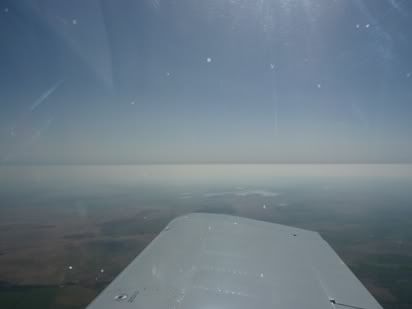
I climb to 5000’ where I am on top of the inversion layer. Although the sky is clear, it is a high pressure type day and so hazy below the inversion layer and not-great lateral visibility. I call Cardiff and they are OK with a zone transit at 5000’. They ask me to fly closer to the Welsh coast to avoid Bristol airspace (Cardiff and Bristol controlled airspace runs pretty much mid-Bristol channel). I am happy to do this as all I have is a lifejacket and at 5000’, if the engine failed it would be touch and go if I could glide to either shore from mid-channel. Cardiff call me and ask me where I intend to cross the English coast, I am confused for a few seconds thinking ‘but I am not flying in from France, what do they mean ‘English coast’ – then it dawns on me, this whole ‘Wales / England’ thing! I didn’t have anywhere picked out so I grab the map and see where the line crosses the coast. He repeats his request and without thinking I revert to military radio procedure and reply ‘Wait – Out’. He responds with a quizzical ‘Brighthouse???’. Then I recall the correct aviation phrase and say the magic word – ‘Standby’. OK, I will cross at Minehead. Shortly after Minehead on the Somerset coast, Cardiff dispense with me. Initially, I maintain a listening watch on London Information, but they are busy and constant chatter is distracting, so I switch to Newquay Approach who are much quieter. I enjoy the relative silence sitting up here at 5000’ above the inversion watching the changing landscape slip by below.

I monitor the engine readings carefully. The engine temperature is steady at between 191 – 194 degrees. RPM is 2520 and manifold pressure is 23.1. So I am at 75% power. Fuel consumption is (for me) an alarming, but expected 37 litres an hour and indicated airspeed is 165 – 170 kts.

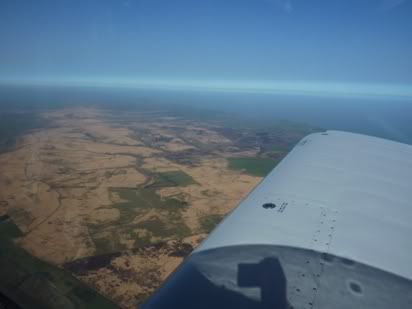
First the beige and brown uplands of Exmoor in Somerset, then the green fields of Devon, then the deserted ex-RAF airfield of Davidstow Moor.
Photobucket
North Devon coast from 5000'

I make contact with Newquay and tell them that I intend to route through their overhead at 3000’ en-route to Perranporth. As they only have a normal ATZ, which tops out at 2000’ AAL, it is of course nothing to do with them, but it is sensible to talk to an airfield if you intend to wander above their airspace. I started a slow cruise descent with a slight reduction in engine power, but still at 65 – 70%. The airspeed is still blazing away at 170 kts. I hurtle through the Newquay overhead and look carefully for Perranporth. Damned if I can see it yet. I switch to Perranporth Radio and gather that they are using runway 23 with right hand circuits, but no mention of the wind. Call them for a wind check, it is 260 at 06 kts – the expected effects of a sea breeze. I wonder why they are not using 27, but I am happy with 23 as it isn’t much of a crosswind.
Photobucket
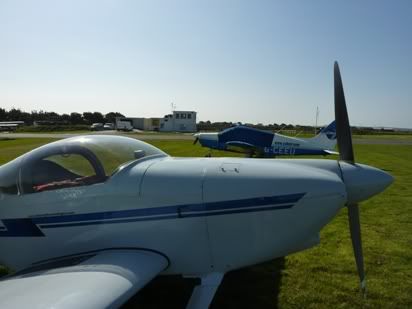
G-GDRV on the ground at Perranporth

I spot the airfield and listen for other traffic in the pattern. I figure that I am OK to join right base for 23 and advise him of my intentions. I now have to pull the power and work hard to get the aircraft to slow down. I do manage it, but predictably leave myself high on final, so I side-slip that off and unwind on short final with a good picture and a good airspeed. I come in to flare, I hear an aircraft behind me calling a go-around (I hope I didn’t cut him up, I thought he was quite a bit further behind me), I hold off, no stall warner yet (bad sign), so I hold off and off and off and it starts to ring (phew!). We touch and stay touched, oh, hey, not bad that one! I trundle to a taxi and have to taxi a fair way to the turnoff of the grass taxiway. The tower are happy for me to park anywhere, so I oblige, park up on the grass and shut down.

I pop the canopy and am greeted by…….silence. Slight onshore breeze and beautiful warm sunshine – wow, what a day! I make my way to the tower, they ask if I need fuel. Need? No probably not, but I could use the weight. They suggest I leave the landing fee until I have refuelled then pay one bill. I head down to the basic but entirely adequate café in the ground floor of the tower. Very friendly guys there and they promptly rustle up the mandatory cup of tea and bacon bap – and yes, they were nice baps!
Photobucket
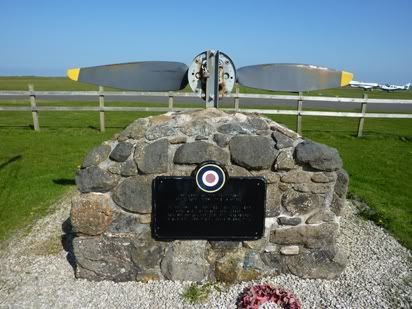
Simple but moving RAF memorial at Perranporth

I walk around outside and chat to go guy at one of the picnic tables. He lives locally and has just started his flying lessons (looks like a mid-life crisis decision like mine!). I spot a Cessna that has just landed, it must have landed long as I can see it still going a fair speed along the runway past the turnoff for parking. I note that his wings seem to be tilting from side to side and I thought it strange as the wind wasn’t that strong. I don’t think anymore of it and turn away. Then I hear the fire land rover starting up and heading out to the plane. It seems to have stopped near the end of the runway, but that’s it. I ask later in the tower and apparently he had made a hard (and fast) landing and seems to have pulled it off the runway to one side (I think it might have been a student).

There is a nice little RAF memorial by the tower to all of the various squadrons that flew from the airfield in WW2. It really is a lovely, basic but very friendly airfield. A bit flat and exposed here on top of the cliffs at 330’. I fill up on Avgas from the pumps. They are near the tower and in an ex-shipping contained located by some ex-WW2 blast bunkers.

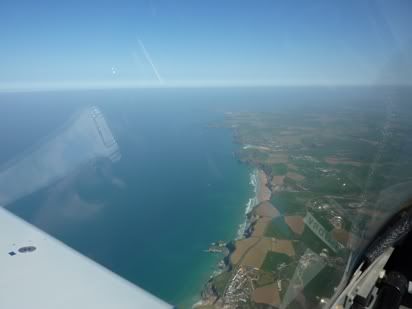
I pay up. The fuel is a pricey £1.94 a litre but the landing fee is something like £12 (I can’t remember other than thinking it was what I expected). I mount up and call for airfield information. The wind has freshened slightly to 270 / 10. As I mount up, I see G-BKCC land and park up, a fellow aircraft from Gloucester, but I don’t have time for a chat. I start up and I am about to say that I will take off from the shorter runway 27 (plenty of room at 750m) when they say they are switching to 27 anyway. On the taxi around, I taxi past what must be a locally based RV7 and get a comradely wave from the owner. Brief power checks complete, I line up and power down 27. We are up quite soon and I am rewarded by flying straight over the cliff (only about 200m past the end of 27) for the land to fall away to the beach below.
Photobucket
Cornish coast

I start a gentle right hand turn and climb and call Newquay. I am passing 4500’ by the time I get to the Newquay overhead and continue the climb back up to 5000’ for the return flight, following the same route as I did coming out. The plane settles down to the same numbers and I am sat again on top of the inversion layer. Minimal wind according to the groundspeed readout on the GPS.
Photobucket
Looking into the sun at the inversion layer

I get a transit of Cardiff after a couple of ‘standby’ – he was pretty busy. At the Severn River crossings Cardiff let me go and I pick up the ATIS for Gloucester and start a very gentle cruise descent. I ask for and am given a direct to final join for runway 04 – the wind is something like 010/02 – minimal. I call at five miles and am given number 2. I slow the plane up now and by the time I am on 2 mile final, I spot the aircraft that I am meant to be No 2 to at the same time as he sees me. He is a twin and must have been flying a wide circuit as it is a toss-up who would be best placed to go to final otherwise. I call for one orbit for spacing and the tower are happy. I start my approach at the end of the orbit. Altitude good, airspeed a bit high. Keep it going. Airspeed still a little high, but hey, I’ve got lot’s of runway to use before I turnoff so I may as well land long. I hold off and bleed the speed off in the flare. Good stall warner and we touch and stay touched. Hmmm… two decent landings in a row, but the I know better than to start getting blasé with the RV6, because it will bite you if you start to get sloppy.

I taxi back to the stand and the sun beats down and without airflow from the vents, we heat up quickly. I am relieved to pop the canopy. As I get ready to put the plane away, a guy pops out from Aeros and asks if this is the plane that went around the world (Manuel has left a large ‘Chasing the Morning Sun’ decal on the fin). I say that the plane has (been around the world) but I haven’t. I explain that Manuel started the group and is still in it. This guy is taking lessons at Aeros and plans to build an RV10. I show him around the plane and point out the ‘nothing special’ nature of the engine and avionics fit (other than of course all the extra tanks and HF radio that were required for the trip). We discuss the merits of the various canopy opening methods and I add my personal preference for a sliding canopy.

I put the plane away. It is 13:00 – Cornwall and back by 13:00 with a leisurely stay on the ground – not bad, but I still can’t wait to get this running-in stuff over with so I can get back to my preferred, leisurely ‘economy cruise’ of 125 – 130kts which sips fuel at 21 litres an hour.

Anyway, a really great and relaxing flight, you really can cover a lot of ground at 170kts!
Monday, March 21, 2011

Running in

We had a minor issue with cylinder #4 on our recent annual service. It turned out to be nothing more that carbon build up that prevented the valves working properly, but for our sins, we were given new piston rings etc. which basically means that we must ‘run the cylinder in’ pretty much as thought it was a new engine.

What this means is running the engine for the next 50 hours or so:

- At high power settings for longer periods (75% with a bit of 65%)
- Keeping the CHT’s reasonably cool, below 224 degrees
- With the mixture pretty much fully rich
- Below 5000’ (or we won’t develop the necessary 75% power)
- Using straight 80 oil
- Keeping a careful record of oil consumption
- Being very careful to avoid rapid cooling
- Using gradual power reductions
- Without varying the power hugely over short periods

What this really means is we will be belting along at 2400 rpm and 165 – 170 kts – into the yellow band of airspeed, so smooth air operation only. It also means a fuel consumption of 37 litres an hour as compared to our more normal average of 29 litres an hour. It also means certainly NO circuits as the constant cycle of full power to idle and back again repeatedly over a short period of time is most definitely NOT what the engine needs! It also means careful planning and cruise descents into airfield circuits, which at these sort of speeds and only using slight reductions in power for cruise descents, means starting the descent some 40 nautical miles out – now I know how an airline pilot feels!
As for slowing the plane up from 170kts to the flap limiting speed of some 100 kts while trying not to shock cool the engine – well, it is interesting to say the least. To try to play my part, I am also asking for direct joins where possible, to cut the amount of time I have the engine running close to idle. It can all be done of course, but it is a far cry from my preferred method of flying the RV, which is at ‘economy cruise’ of probably 50% power (2000 rpm and leaned back to 21 litres and hour fuel burn) which gives a stately, but still respectable 125 kts – fine for me and great for touring.

Oh well. I will be doing my part to get the plane past it’s 50 hours, and therefore into normal engine operation before my planned touring in Denmark and Sweden in late-June.

Monday, March 14, 2011

Haverfordwest for lunch

Finally, the plane is out on annual service. We had a bit of a scare as compressions on cylinder four were way down with valve problems, but on review, it turned out to be carbon build up on the valve seating. This was fixed, but the bad news was that we had all new cylinder rings, so we have to go through a ‘running in’ process of tearing around the sky at 75% power for the next fifty or so hours. That means a whopping fuel consumption of about 35 litres an hour and an airspeed into the amber range of 165 – 170 kts. It also means not allowing the CHT’s to go above 224 and not to shock cool, so cruise climbs and very gentle slowing down and descents that we pretty much have to plan from 30 – 40 miles out! A bit of a change from my personally preferred ‘economy cruise’ of around 50% power which gives a modest 125 – 130 kts, but a pleasing leaned-out 20-22 litres per hour fuel burn.

Me and another group member agreed to fly together as we plan to go touring in late June, so sensible if we get used to flying with each other first. The weather on Sunday started gloomy and it had rained the previous night, but by the time I got to the airfield, the promised good weather was arriving from the west and the cloud was already scattered and ‘fair weather cumulus’ that just begged to be flown ‘on top’. We carefully checked the plane out as this was it’s first flight after the test flights associated with the annual. I had vaguely planned to fly to Leicester, but as the best weather was coming in from the west, we hastily re-planned for a flight to Haverfordwest on the western tip of Wales. I was happy to fly the leg out and Neil would fly the leg back. We put some more fuel on board to take it up to MAUW (as we will have to get used to flying like that while touring) as I exchanged pleasantries with a pilot I recognised refuelling his PA46 mini-airliner at the pumps.

Carefully ran through the power checks as I haven’t flown for just over five weeks. There was a bit of congestion at the hold and I kept a very careful eye on the CHT’s which kept nicely below the magic 224 degrees. The log jam cleared quickly and I lined up on 27, the wind was a pleasing 300 / 03. I progressively applied full power and got the tail up. The RV was very quickly hopping along on the two main wheels in the usual distance and I eased her into the air. Keep her down a bit and let the speed build to aid cooling as I was going for a cruise climb. At the end of 27, put in the 10 degrees noise abatement turn and come onto track for the BCN VOR. I kept her climbing to FL50 and put her into level cruise at 75% power. Basically, that means leave it fully rich, pull the throttle only very slightly to about 2450 and check manifold pressure at about 23.5”. The airspeed was a frantic (well for me anyway) 170 kts, albeit with a modest 10-15 kt headwind, so reducing groundspeed a bit. I did notice a tendency to roll slightly to the right (which we were warned about by Manuel), so I compensated with some aileron trim, set considerably further to the left than normal for me (it is usually just off to the right).

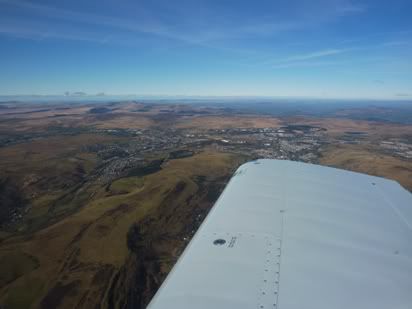
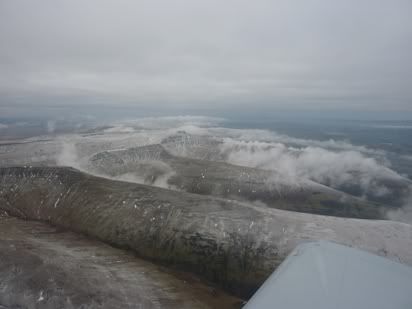
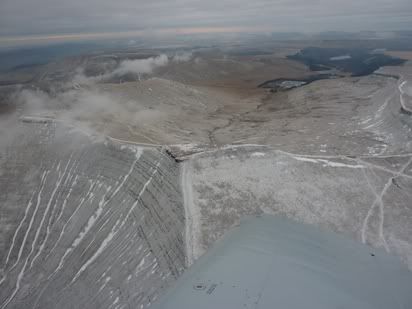
Welsh Hills
The Welsh Hills from FL50 near BCN VOR

I spoke to Cardiff Zone and got a squawk and a basic service and settled into the high-speed cruise above the Welsh Hills at FL50. The weather was glorious, only a slight wind, scattered fair weather cumulus and us barrelling along up to in glorious sunshine with gin-clear lateral visibility. Before I knew it, we were released by Cardiff and headed north of Swansea. I decided not to talk to Swansea and to tune unto Haverfordwest radio on listening watch. I heard some of their calls and they were giving runway 27 with minimal crosswinds. Before I knew it, I was having to think about a gentle cruise descent from 35 miles out! I pulled the power slightly so we were around 65% power and started losing about 2-300 fpm, but still with some blistering speed! To try to be kind to the engine, I was aiming at a direct join onto long final for 27. I called them up and they were happy with this and there didn’t appear to be too much traffic about.

Seven miles to run and airfield in sight. Altitude good, but way too fast. No choice but to pull the power to a much lower setting (but no idle) and bleed the speed off. Eventually, I managed to get it back into flap limiting range and dropped the flaps. By this time I was on one mile final and way too high. So I made the decision to side-slip the height off rather than fart around in the circuit playing around at low power settings. The sideslip worked nicely and I unwound on short final for 27. Still a bit fast, but into the flare and bleed it off in the hold-off. Little bit of and over-correction, but eased her down into the hold off again. Ease back a bit more, stall warner going now, ease back some more, a bit of sink, ease back more. We touch, only a small hop, hold off and touch again and stay touched as there is no more energy left in the wings. OK, not bad for my first after a near six week lay off, though I say it myself.

I taxi in, park up and shut down. We are glad to pop the hatch as it is starting to warm up under the sun. It took us about 45 minutes airtime heading into a modest headwind. What lovely weather, a really warm spring day! On the way to the reporting point, we bump into a gaggle of pilots who are all RV pilots. So we chew the fat for a while. One of the planes is a very nice looking nosewheel RV10 (my idea of an ideal tourer), I now kick myself for not asking to have a look.

Bulldog at Haverfordwest
A local TV report about a disabled guy having a flight in a Bulldog

We treat ourselves to some lunch and a sit out on the picnic tables watching the planes come and go. Neil plans a more circuitous return route as we would be back in no time at all at those speeds and with a slight tailwind. So we plan to route up to the Aberdovey estuary, then across the Welsh Hills pretty much along the A44 / A470 to Hay on Wye, then direct past Hereford into Gloucester. Neil was flying the return leg and it felt strange to be in the right hand seat.

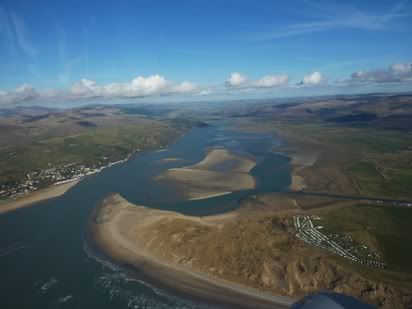
Aberdovey Estuary
Aberdovey Estuary

I did get some excellent photos of the Aberdovey estuary. Why can’t the weather be like this all the time? The flight went really well as we kept to power up and went tearing around the turbulence-free Welsh Hills. Just past Hereford, Neil starts the descent as we call up Gloucester. We are offered and accept with pleasure a direct downwind join for 27. Neil handles the power setting carefully and make a very nice landing on 27.

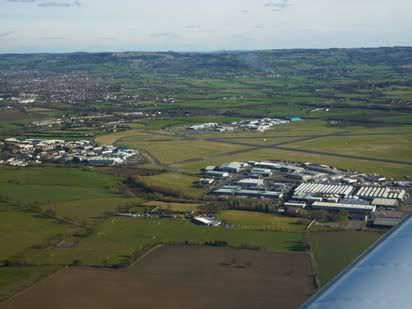
Gloster from downwind
Gloucester from right downwind for runway 27

We put the plane away carefully past the Cessna Citation parked right at the front of the hangar. This involves some careful handling (preferably two person) as the starboard wing of the RV must go underneath the port wing of the Citation, and there isn’t much clearance.

Neil and I wander into the clubhouse at Cotswold Aero Club and as agreed, spread maps out and start some vague planning for a one week trip at the end of June to Denmark and Sweden. We come up with some likely destinations (courtesy of some feedback from some pilot contacts I know over there) and a rough idea of direction. We will meet up a few more times to go flying like this and firm up the plans and hotels etc.

Well a nice flight to start the ‘2011 flying season’ and we have to make many more like it, tearing around at high speed. So we will probably take in some of the slightly more distant airfields I have not been to yet. It will be important to get past the 50 hours running in period before the touring trip I think.

Monday, February 21, 2011

Bristol ATC

My local flying club issued an email invitation on a first come first served basis for anyone wanting to visit the Air Traffic Control tower at Bristol Airport. As I have my personal email plumbed through to my BlackBerry, of course I got the email immediately and accepted at once.

The downside, was that it was 19:30 on a Friday at Bristol Airport, so I may have to fight my way through M4 Friday night rush hour traffic in Bristol. They wanted to keep the people attending to eight maximum and the number of cars going to two, as we would be parking in the NATS secure airside parking. Well, I offered my services as a cost-share taxi and quickly had two passengers that I would pick up from the aero club at Gloucester, then trek the 60-odd miles down the M5 to Bristol Airport, carefully sited the far side of Bristol well away from any main roads.

I picked up my guys at 17:15 as I wanted to allow plenty of time to get through the traffic. Well of course having made such generous contingency allowances, there was no traffic and we sailed through, so we stopped for a prolonged coffee break at some services before hitting the airport at around 19:10.

Lesson #1: If you allow contingency you won’t need it (but of course if you don’t allow contingency, there will be serious delays!)

I followed the map instructions and reported at a security barrier near the tower. I walked in and announced myself, who we were here to see and that I was 20 minutes early. The security staff were very uninterested and regarded me with some disdain. They made a cursory glance at two sheets of paper and announced: ‘Nope, you’re not on the list’ and seemed to want to go back to their sports pages of the newspaper. I produced a printout of the email with our contacts name and suggested they get in touch with him.

Lesson #2: No matter how well it has been organised, there will be problems

They asked me to call him instead. When I pointed out that the email did not include his number and perhaps they would know it, they simply said ‘He’s NATS’ as if that explained everything. Well I won’t drag it out, but you get the idea. I managed to get them to call this guy and we were asked to park temporarily outside the security gates until our contact came to the gate in 10 minutes or so.

Lesson #3: Keep your cool and remain polite but assertive (not at all easy for me as anyone that knows me can tell you!)

By this time, the second car had turned up and to save him going through the same rigmarole, I suggested he parked up near me and waited for our contact. Our contact arrived and he ushered the other car into the security barrier so the passengers could be checked for the required ID and the car checked. I waited for some time, then was asked to join them. The problem seemed to be that despite the email from Cotswolds clearly stating what ID was required (photo driving licence with counterpart or valid passport), only one of the three people in the other car had this, and only two in my car did! After some discussion, I agreed to give the only guy in the other car with valid ID a lift back to Bristol to let the two in the other car go home, while the passenger in my car without ID would have to make his way to the terminal and have coffee while three of us had the tour. Sorry, no photos as I didn’t think they would allow any, I will check next time as I have a visit to Swanwick arranged for May.

Lesson #4: RTFE – Read The Flippin Email!

We parked up and signed into the tower with our guide, who was the head of that particular ATC shift of NATS at Bristol Airport Tower. He was an excellent guide and apologised for not being able to allow our colleagues in. We had a very informative slide presentation where he talked us through various things ATC. I was particularly interested that Bristol had a Cat 3 ILS facility on one of the runways. This is the true ‘blind landing’ facility whereby IF both the pilots and the aircraft were also suitably equipped, they could make a fully automated approach and landing in zero cloudbase and zero visibility (i.e. fog). Many airports have Cat 2 capability, which needs something like (figures probably wrong, but illustrates the point) 150’ cloudbase and 400m forward visibility etc. He also explained how the airways system worked vis-à-vis Bristol and how and where their approach control took over from London Information in Swanwick. It was helpful when he explained how they catered for a slot in people like us, asking for VFR transits. He also answered a question I had which was why when flying in the USA, they were very happy for VFR traffic to transit through the overhead at right angles to the active runway at 1500’ when in the UK, we never seemed to do that? He said that wasn’t true and that they would quite happily allow such transits at Bristol at 2000’ if it made sense for the route we wanted. He also explained about aircraft slot times and said that it wasn’t just a slot to take off from the airport, but that they would plan ‘all the way back’ for the riute you needed to make sure that when you took off, that you could fit in with all sectors of your trip without hold (i.e. making sure all of the traffic lights for the route were ready to go to green as you got there), it was not necessarily about congestion at the airport.

After this, we had a trip to the tower itself. Well, they were not at all busy, but there were one or two flights so we could see what was going on. I was surprised to see that they still used paper flight strips that are printed when a plane is within 30 minutes of their airspace. These are placed into a plastic holder, the colour of which denotes whether it is an arrival, departure or in the circuit. They use a very clear screen which displays both primary and secondary radar displays. They can use filters on the primary radar to filter out clutter of radar returns from surrounding hills and radar returns from rain and weather fronts. The aircraft were very easy to see as they had their secondary radar data blocks clearly displayed, showing altitude (FL), Callsign and an indicator to show whether climbing or descending.

In the tower, the radar display was oriented ‘track up’ so that it matched what they saw out of the window (the tower is on the northside, looking south across the main East / West runway, so the display was pretty much ‘south up’ – which threw me for a while as I always use ‘north-up’). We could see the progress of an inbound flight as it came in left downwind for 09 and could make sense of the radio calls etc. Our guide explained how they always updated the master arrivals board and allocated stands etc. as this ‘drove’ pretty much everything at the airport, the arrivals boards, the baggage handlers knowing which flight was getting in next and where to be to unload it, the aircraft marshallers etc.

After the tower, we were taken down one floor to approach / departures. This was a windowless room (as they really didn’t need to look out to see anything as it would all be too far away). They had the same type of display as the tower, but set to a larger scale and oriented north up. There was only one guy in the room, but two stations. They weren’t busy. But our guide talked us through showing us the aircraft inbound from the east that he was talking to and another arriving from the north who would be transferred to Bristol shortly. Sure enough, the strip started to print for the northerly arrival and this was taken, mounted and put in the arrivals rack. They still note everything they say to the arcraft on the flight strip by hand, in case anyone has to take over, there is a complete record of comms with the aircraft (well, that and the recordings that is!).

He explained that aircraft do not ‘have’ to make instrument approaches, they can call visual with the airfield and if traffic allows, make a normal visual approach. Our guide recounted an incident a couple of years ago then a KLM arrival from the east called ‘visual’ and said he could clearly see the airfield off to his right. ATC challenged as said ‘surely you mean to your left’, no he was adamant that he really meant to the right. It dawned on them that despite the pilot’s own map, GPS, radio beacons and a plethora of other navaids, that he had mistaken Bristol Filton to the north for Bristol Lulsgate to the south! I have done something similar where I was convinced that I was lined up for 09 and became so convinced that I disregarded everything that told me otherwise, until ATC calmly suggested that I extended my ‘ahem’ base leg to line up for final on 09 as I was on 04 at the moment! There have been many incidents of commercial jets landing at the wrong airport (Northholt mistaken for Heathrow was a good one, but my personal favourite was a B52 doing a low level beat-up of Blackbushe airfield, skittling planes out of the circuit having mistaken it for Farnborough Air Show) – human factors eh? Gotta love em!

Well it was an excellent trip and we very much enjoyed it. I picked up our non-ID carrying passenger and drove back through the rain via Bristol back to Cheltenham, getting home at 23:10, tired, but well worth it. Next trip is to the UK ATC centre at Swanwick, near Southampton.

Saturday, January 29, 2011

Wellesborne Mountford

After two weather cancellations, I finally got to fly today. The weather was not perfect, but do-able. It was one of those murky, high-pressure, very cold, little wind type deals we see in the UK. I planned to fly Rob to Wellesborne Mountford, a very short flight from Gloucestershire, to see the ‘fast-taxi capable’ Vulcan bomber based there.

I checked the weather there on their excellent website as they only have one runway in use at weekends, and I wanted to know what crosswind I would be facing, if any. Turned out to be 030/07, so it would be 36 with a slight crosswind component from the right. I called them for PPR as per the plates, but they seemed to just want my details in advance.

I bumped into a few fellow Flyer Forumites in Cotswold Aero Club, Hogster, Johnm and Timmy P. It is one of those surreal moment when you meet people you have been ‘talking to’ via a bulletin board only – ‘Hello, I am Karg the destroyer of worlds, you must be Mekon emperor of the seventh quadrant!’ – well not quite, at least we have semi-sensible forum names – I am Steve H – original huh? Anyway, I was put to shame as one was going to Calais and the other two were going to Gamston. Here’s me only scuttling along 20 minutes to Wellesborne, oh well, plan the flight and fly the plan!

I checked the plane out and Rob helped me pull it out of the hangar past the Citation jets. I tried the normal startup routine, and again and again and again. It was very cold and had been for the previous few days and no one had flown her for a week, so she was very cold and ratty! I primed and tried again, a splutter then dead. I carefully primed some more. By now I was worried in case I had flooded the engine, but no smell of fuel, so more priming. Eventually she caught and the battery seemed none the worse for the experience. Taxi to the pumps to put some fuel in, called for clearance and we had the ‘long march of death’ around to C1 for 09 – oh well, I needed a little while to get the oil up to temperature anyway!

After power checks I was cleared for take off for the short flight to Wellesborne. I climbed to 2100’ and it started to get very murky, at 2200’ I was almost in poorly defined murky clouds, so I dropped to 2000’ and dinked left to swing north around the Cotswold ridge rather than head straight over it. Yes, it was murky up there, although lateral visibility was OK, they were saying 10km or more on the ATIS, but I can only assume they had not been flying as it seemed a little less than that. In no time at all, I was switching from Gloster to Wellesborne and calling for airfield information (it is only a 20 minute run). As expected, they were giving 36 with left had circuits and the wind was as expected.

I carried out a standard overhead join, slotted into the traffic already in the circuit and swung her onto final. As usual, I left myself a bit high, a bit of sideslip took care of that. A bit fast, but then I do want to land a bit long, so I’ll bleed that off with a longer flare. Over the numbers and rounding out, hold off and off and off and off. We are heavy, but this is taking a while. Little bit of crosswind, dab of rudder to straighten and we touch – and stay touched. A little into wind aileron, dance on the peddles until she is down to taxi speed, yes, there we go. Well false modesty aside, that was about as good a landing as you can do in the RV – very smooth (I was of course to pay for this hubris later!).

G-GDRV parked up at Wellesborne

We parked up and dutifully trotted into the tower to pay. £15 landing fee and a friendly welcome. I asked about getting to the intact Vulcan bomber on the north west perimeter. They said if I had a hi-vis vest, we could walk along the taxiway. It was a good half mile and the wind (such as it was) made the sub-zero temperature feel a lot worse.

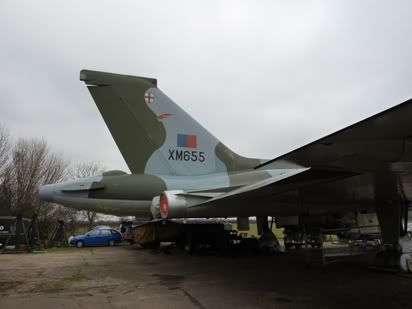
The mighty Avro Vulcan

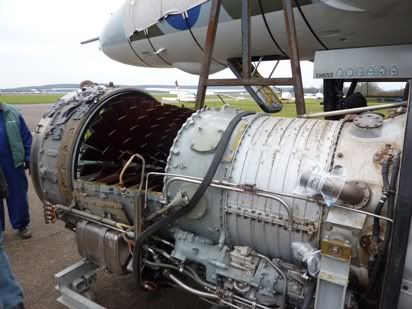
We were happy to be in the lee of the mighty Vulcan. Sure enough, there were many volunteers at the Vulcan. They had one of the engine out for overhaul. They were very friendly and welcomed us in and chatted about the plane. I knew something about Vulcans, but of course not as much as them. I was surprised to learn that the engine did not have after-burners and that this was the later and more powerful Olympus 301 engined version.

Olympus 301 engine
One of the working Olympus 301 engines being serviced

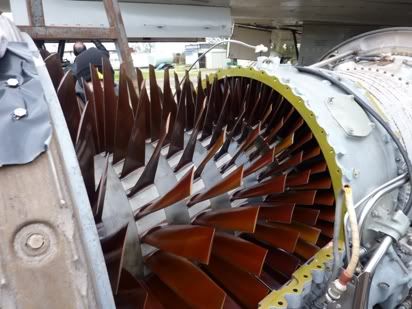
We had a wander around and had a close up of one of the partially stripped engines. It is a real treat to see a real, running engine being overhauled, not some dead, lifeless hulk that has been dissected in a museum somewhere. I was surprised at how small it seemed.

Lovely clean turbine blades

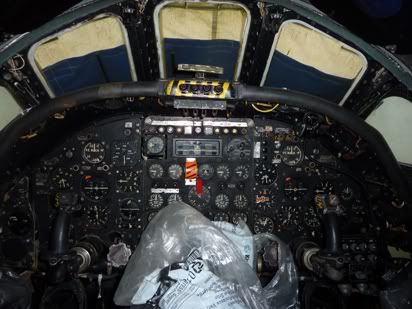
I was grateful for the tour and offered a donation to a lady in one of the portakabins. She immediately offered us a trip into the crew compartment. That too was a treat. I was amazed at how cramped it was and what a truly lousy view the pilots had. It was the usual chaos of black panels and switches and dials scattered around seemingly at random – no digital stuff here, oh no! I thought the two London Underground tube train flexible hanging handles in the ceiling of the crew compartment said it all – period British pragmatism, hey if they work, stick them in there!

Vulcan pilots panel
Possibly the most cluttered and worst designed panel ever

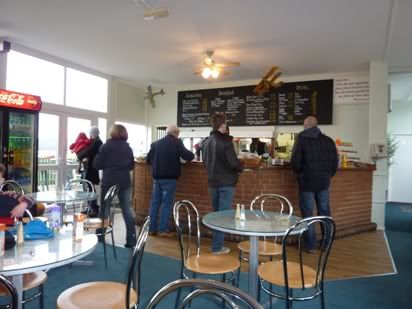
We made our way back, now quite cold, to the ‘new’ café. Well, it looks very much like to old café to me! Having said that, it is perfectly fine. There are normally a lot of locals that turn up with families for a fried breakfast and to watch the planes, which I think is an excellent thing. There is a great deck looking onto the airfield with tables etc., but no takers on a cold day like this. It would be a nice spot in the summer though.

The 'new' cafe
The 'new' cafe - different from the 'old' cafe....err....how?

We didn’t hang around and soon mounted up for the return trip. The plane started first time as we taxied for the hold for 36. The tower again confirmed the noise abatement procedures as I lined up, applied power and started hopping eagerly along 36 (the plane was moving down the runway too!). Up we went and I turned onto 030 and glimpsed the green roofed building we were aiming for. Nicely on track. At 1200’ I turned left onto direct track back to Gloucester. I could still only manage 2100’, but that was fine.

Picked up the ATIS and called for rejoin. Got the expected standard overhead for 09 although the wind was a mild 030/05. I wasn’t sure why they hadn’t switched to runway 04, but I was OK with that wind. The circuit was quiet with only one other in as I called final. OK, a bit high and a bit fast. Slipped some of it off, but still a bit fast. Over the threshold aiming to land long, flared, a bit high though, felt her down, no real stall warner, we touched and I guess I knew what was going to happen. Now after my last landing which was really good, you would have thought the plane would say ‘Y’know Steve, that last one you did was really good, so I’ll let you off this one’ – but no. The RV has no such memory. I was punished with a bounce. As we were heading back up it is amazing how quickly you think. By the time we got to the top of the bounce and were about to come down a second time, I weighed up the pro’s and cons and thought that yes, I could control this mext one and land, but it would be messy and anyway, what is the hurry, so I pushed in the power and the engine and aircraft responded beautifully into a go around, as if to say to me ‘good decision, coz I was going to kick your ass if you tried anything else!’.

This was the first go around I have done for a few years, so probably long overdue anyway. I explained to Rob who was (or at least seemed to be) unconcerned. The second approach was better and my second landing was almost as good as the one at Wellesborne, certainly the plane seemed happy with it. What was it my PPL instructor used to say? ‘A good landing comes from a good approach’ – how true.

Taxied in and shut down. Rob help me put the plane away and we got it precisely into it’s tight slot first time with very few instructions.

Well all in all, poor weather but a really nice flight. It would be nice if the heater could be a little more efficient though. Loved seeing the Vulcan, well worth it for that alone.

Wednesday, January 26, 2011

Goddam weather!

For the second time in as many weeks, I tried for even a measly local or even circuits, but no dice!

The first Saturday, I called off a local due to high and gusty winds. Just not worth chancing it in a taildragger.

Last weekend was cold and certainly a very ‘high pressure murk’, but I figured I could at least managed some circuits. I got to the airfield and the weather was considerably worse than where I live, with an indeterminate cloud base (it was that murky), probably 3k visibility and light drizzle / rain. That and the temperature on the ground was only just above freezing, even 2000’ altitude (if you could get it without going IMC which was doubtful) the temperature would be sub-zero, add to that visible moisture and you have all the recipe for airframe icing. So I alreadt made the call to myself that I was not flying, even

I decided to at least call into the local flying club to console myself with a coffee before heading back home. As if to confirm my appraisal, I heard the CFI come into the next room after having been out with a student. He was talking to someone in the next room and said ‘take a look at the icing on the plane (he just flew in on)’.

No contest, I am out of here, even for circuits. On my way out, I passed another pilot cheerfully coming in with full kit. I asked in jest if he was flying anywhere. He looked surprised and said ‘Yes, why not?’. I just replied ‘I hope you like icing’ and walked on. I know different people have different attitudes to risk, but icing? That is one thing I would NOT mess with! While I know he has a lightweight instrument rating, I also know his aircraft does not have any de-icing equipment. I am sure he came to the right decision.

So I shall be trying for a third time for quick flight next weekend. Such are the joys of flying in the UK in the winter!

Friday, January 14, 2011

AVGAS and Lyconosaurus

I’m not a whiner, BUT!

In the UK, the price of normal petrol / gasoline has risen swiftly and inexorably like a flood tide from an eye-watering £0.85 pence a litre (yes, litre not gallon!) as recently as January 2009 to an unbelievable £1.30 now (January 2011) and a predicted £1.50 a litre by this summer. All of this is incredibly bad news for anyone that drives a car or rides a motorbike, but these prices seem like a bargain when comparing them to AVGAS fuel prices for light aircraft.

UK Gasoline Prices
UK Gasoline Prices - per litre

Light aircraft can use a variety of different fuels, depending on the engine(s) being used.

AVGAS

The vast majority of light aircraft are still powered by legacy air-cooled petrol engine made mainly by either Lycoming or Continental (there are a few smaller suppliers). These are amazing beasts in this day and age and the technology used amazes non-aviation aware people, especially those who know a bit about cars. They are literally built using 1930’s technology that has remained completely unchanged to the present day. The engine in my own aircraft is typical. It is a Lycoming 0-320 that delivers a peak of 160 horse power.

The ‘320’ signifies the ‘swept volume’ of the four gigantic cylinders as expressed in cubic inches. Yes, you got that right, four cylinders and a swept volume of 320 cubic inches. For those more familiar with engine capacity expressed in litres, that’s 5.2 litres. Yes, a four cylinder 5.2 LITRE engine that delivers a whopping 160 horse power (not!)! Each cylinder normally has a mere two spark plugs per cylinder with the spark being created by two sets of magnetos – yes, magnetos! One set of mags drive one of the plugs in each cylinder and the second drives the second etc. Actually not such a silly arrangement as it means that if the battery dies, the engine doesn’t care and carries on as happy as Larry. If one set of mags fails, there is a second which continues to run the engine, albeit usually at a slightly lower power level.

What these engine deliver is a very slow revving engine that directly drives the propeller rpm (let’s ignore VP props for now), normally in the cruise of between 2000 – 2400 rpm with a maximum of 2600 rpm. If it turned a normal prop any faster, the tips of the propeller would break the sound barrier and make an incredible noise but more importantly create a lot of supersonic and transonic turbulence which would seriously impact the lift or ‘bite’ of the propeller and therefore it’s ability to pull / push the plane along. An engine revving at these speeds means that you don’t need the added mechanical complexity (the more stuff you have the more points of failure there are) and as important the added weight of an rpm reduction gearbox.

As it is old (for that, read ‘ancient’) technology, these engines must use a high octane leaded gasoline, also called AVGAS. This is 100 octane (also referred to as 100LL for ‘low lead’ to keep the green campaigners happy). This is the sort of fuel that we used to see at the pumps for cars before unleaded fuel became all the rage, albeit for a much higher octane. Now the problem with this is that apart from the miniscule demands of the classic and vintage car market, there is no other commercial demand for high octane leaded fuel than to fuel these antique engines used mainly by private flyers for light aircraft (OK, and of course heavy WW2 warbirds that are still flying). So the market for AVGAS is tiny and producing it is an irritation for oil companies, so by the law of supply and demand, availability of AVGAS in Europe is not good (many French GA airfields run out every summer) and it is very expensive. We have just been hit with a huge hike and pump prices at my airfield are now £1.74 a litre. Given that we get through 25 – 30 litres an hour flying that hurts a lot! The smart money is on AVGAS in the UK being more than £2.00 a litre by the summer.

UK AVGAS Prices
UK AVGAS Prices - PER LITRE!

By way of comparison with the vibrant US General Aviation industry, they too will tell you that they are staggering around under the burden of an AVGAS price of an eye-watering $5.00 a US Gallon. Now in case you aren’t good at doing conversions that is an exorbitant £0.83 a litre – wait a minute….. £0.83 pence a litre, ARE YOU KIDDING! That’s under half the UK price!!!! Small wonder there is little appetite in the US engine running on MOGAS or AVTUR!

MOGAS

This is just a clever-dicky name for the petrol / gasoline you put into your car. Now I know that it is really hard for a motorist to think that £1.30 for a litre of 95 octane unleaded is a bargain, but imagine if you had a car-type engine in your light aircraft. The fuel burn would be considerably less for about the same horse power (usually 15-20 litres an hour vs 25-30 litres an hour using AVGAS engines) and of course the price per litre would be one-third cheaper litre for litre and a whopping half to two-third cheaper when you also take into account the lower fuel burn for the same power!

The downside? Well, you basically have a modern car engine revving at 4500 rpm for peak efficiency, so you need a reduction gearbox and of course car engines don’t use magnetos, so you are tied to a battery, the battery dies, your engine stops – not nice if you are in the air at the time. Having said that, the engine itself is much smaller and lighter, reduction gearboxes are very reliable as are modern batteries, and you can carry two anyway. The other advantage is that they are water-cooled. So while that adds further addition weight, it means that you really don’t have to worry about engine over-heating at high power setting and low airspeeds (in the climb after take-off) or possible shock-cooling associated with low power settings and normal or high airspeeds (in the descent).

The good news is that there are such engines available in the GA world, they are called ‘Rotax’ engines. The downside is that they are relatively small engines aiming at the very light aircraft end of the market. The largets such engine is the Rotax 914 which can only pump out 115 horse power – so no good for our RV6 which really does need 160 horses. But then they are a measly 1.2 litre engine. Why or why can’t Rotax develop a similar 1.6 or even 2.0 litre engine, God knows there are plenty driving cars around!

Many people (including me) are looking at MOGAS Rotax type engine and the new VLA or ‘Light Sport’ type aircraft now emerging as a longer term and economically viable alternative to AVGAS Lyconosuarus engines.

AVTUR

This is the fuel used worldwide to power the jet and turbine engines you find in commercial aircraft all the way from a modest King Air to the awesome Airbus A380. It is basically a ‘diesel’ type fuel, also very similar / identical to kerosene / paraffin etc. The majority of military jet aircraft also use a kerosene type fuel, either JP5 or JP8. The major difference is that the military fuel types are more fire resistant that regular AVTUR (and unlike what you see in the movies, AVTUR is much less flammable than AVGAS or MOGAS).

GA AVTUR engines are basically nowhere in the USA, and after all, it is the USA who are still the main driver for the General Aviation industry. However, there are a few AVTUR engines around, makers like Thielert, Wilksch etc. Unfortunately, Thielert started with a converted 1.8 litre Mercedes diesel engine which only managed a measly 120hp. They were not a very well managed company and went into administration (from which they are now emerging). But quite a few people were ‘bitten’ by paying for expensive conversions to existing aircraft or buying expensive new Austrian Diamond aircraft (who had a ties up with Thielert) only to find parts impossible and warranties no-existant. But one bad experience should not surely sink what must be the true way forward for light piston engines? Any commercial airfield will have AVTUR and by worldwide convention, AVTUR is sold around the world tax and duty free and runs out at around £0.60 per litre.

Having said that, the UK have cottoned onto that and now have a tax on AVTUR if you use it for non-commercial flying. A tax of £0.54 a litre is mentioned, taking the price up to, but still short of MOGAS prices.

However, the fuel burn is very modest (about the same as a Rotax) and the fuel itself is less flammable. It is very widely available at virtually every airport. This has to be the future, certainly in Europe and it probably won’t be long before the US wake up and have to see that too, how much longer will oil companies continue to produce this hobby fuel of AVGAS?

So bottom line? I can’t wait to see the back of AVGAS and will be looking to switch ideally to an AVTUR single engine piston – now all I need is an established, reliable and proven AVTUR piston engine manufacturer!

Sunday, January 02, 2011

Welsh Hills

First flight of the new year was early for me, on Sunday the 2nd. The weather was OK, overcast, but thin and high enough, probably 5000’nil wind and cold, probably around freezing.

I checked the plane out and pulled it carefully out of the hangar past the Citation jet, which was far enough back that I didn’t have to try to get under part of it’s wing. I decided to put a squirt of fuel in to be kind to the next person to fly as I was solo and so pretty light. At the pumps I bumped into another Flyer Forum member who I had ‘spoken’ to on the forum but not yet met – good to see you Hogster!

G-GDRV on the ground at Gloucester

Power checks complete, I let the engine drone on to get the oil temperature up to the magic 40 degrees before I called ready for departure. It has been about 35 days since I last flew and I went through the motions and readouts I expected for both take-off and landing in my head, then I lined up. Power smoothly on and hold it straight down the runway. Tail up as the speed builds and hold her down as she hops about impatient for her natural element. I let her climb away after a gratifyingly short ground run. At the end of the runway, I put in the 10 degree right noise abatement turn and climb straight ahead as I plan to check out the Welsh Hill and Pen-y-Fan in the distance to the west.

I climb to 4500’ and level out. Top of climb checks and lean the engine to my preferred ‘economy cruise’ of around 2050 rpm and 20 litres an hour which gives 120 – 125kts. I navigate carefully between the two prohibited zones at Credenhill and Madley, near Hereford (both of which are SAS training areas that they are understandably protective of) using both GPS and the prominent ground feature of the disused airfield at Madley.

Welsh Hills

The Welsh Hills are still somewhat snow-covered, unlike the rest of the countryside where it melted a few days ago. It looks like the snow (or deep frost) is carefully following the 1500’ contour line. I close in on Hay on Wye and head towards the peak of Pen-y-Fan (much beloved of Paratroopers and SAS wannabes). It looks beautiful in the heavy frosting and I am amazed at the number of hikers up on the hills today. I have a quick look for G-TOMS, a PA38 that made a forced landing near Pen-y-Fan a couple of weeks ago, but cannot spot it, although I am sure it is still there (and is I understand, a real ‘attraction’ for hill walkers and mountain-bikers). I play around the outside of the peak in this nil wind condition, confident that I won’t pick up any nasty gusts. For the hell of it, I throw in a few steep turns then waggle my wings at the hikers and head back towards Gloucester. While I was over Pen-y-Fan, I had switched onto 121.5 just in case. I heard London Centre calling for a plane that was squawking 7700 near Winchester. He clearly wasn’t on frequency despite a few calls by London Centre. I wonder what happened there?

Pen-y-Fan busy with hikers

I call Gloster Approach with 20 miles to run for a direct join and they give me direct to 09, which I am pretty much in a straight line final for anyway. I hear another forumite on frequency as he flies from Shoreham to Shobdon. I call again as requested at 5 miles and I am given clear to land. I do my pre-landing checks and get the airspeed under control by pulling the throttle to idle and holding altitude for what seems like ages as the plane slowly loses speed to allow me to pull on some flaps. Some power back in as I get the speed back to 80 kts. At 1 mile final, I bleed it back to 70 kts and hold it there. Good approach, good airspeed. I go through the landing in my head and try to land long so as not to tie the runway up while I trundle to the end. Over the hedge and get ready…. flare…..NOW. I hold off remembering that I am light so it will take a while for the stall warner to blare. I touch very lightly before I want to and hop slightly (not a bounce, just a gentle hop), I curse a bit then as she settles again, I make a determined effort to hold off and make the stall warner holler. I succeed and when we touch again, there is no more flying left in the wing and she settles nicely. Despite all of this, I still have a fair way to taxi to A2.

Back to the hangar and I put the plane away just in time to see a note on the hangar from another group member saying that he is in the clubhouse and I can leave the plane out – DOH! Too late! Never mind, good practice. I complete the paperwork and update the other group member on the plane (not much to say). I sort out the end of month / start of month paperwork as I need to sort out the December accounts (I run the books and billings for the group).

A lovely flight to start 2011 – thoroughly enjoyed that! For 2011 I am vaguely planning on a tour of Denmark and Sweden in the summer – fingers crossed!